

Your Pipeline Is 23.6h Behind: Catching Cloud Sentiment Leads with Pulsebit
We recently observed a striking anomaly: a 24h momentum spike of +0.204, tied to the theme of "Weather Relief in Hyderabad: Rain and Hailstorm." This spike stands out because it indicates a sudden shift in sentiment that you might have missed if your pipeline isn’t built to handle multilingual origins or entity dominance. In this case, English press led the narrative, but it emerged after a 23.6h lag. If your model isn't fine-tuned to capture these nuances, you could be trailing behind critical shifts in sentiment by nearly a full day.

English coverage led by 23.6 hours. No at T+23.6h. Confidence scores: English 0.95, French 0.95, Spanish 0.95 Source: Pulsebit /sentiment_by_lang.
Think about it: Your model missed this by 23.6 hours, allowing a significant sentiment shift to slip through the cracks. With the leading language being English, the importance of multilingual handling becomes crystal clear. If you’re not accommodating for this, you risk making decisions based on outdated or incomplete data.
Let’s dive into the code that can help us catch these kinds of anomalies. Here’s how we can use our API to pinpoint this cloud sentiment:
import requests
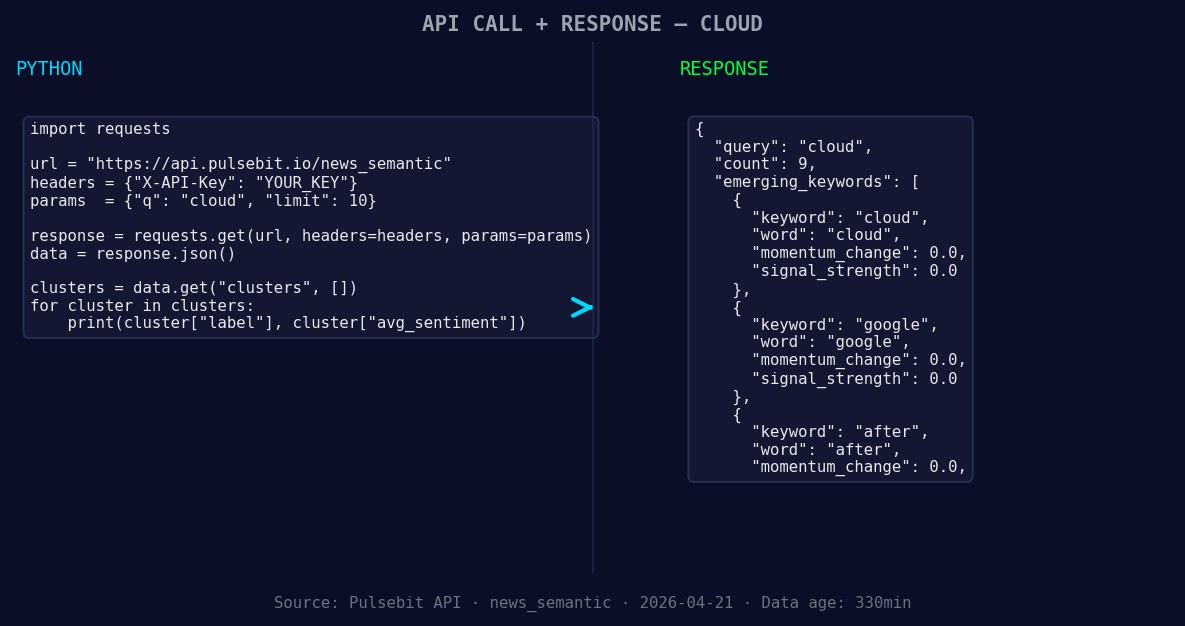
*Left: Python GET /news_semantic call for 'cloud'. Right: returned JSON response structure (clusters: 3). Source: Pulsebit /news_semantic.*
# Define the API endpoint and parameters
endpoint = "https://api.pulsebit.com/sentiment"
# Step 1: Geographic origin filter
params = {
"lang": "en",
"topic": "cloud",
}
response = requests.get(endpoint, params=params)
data = response.json()
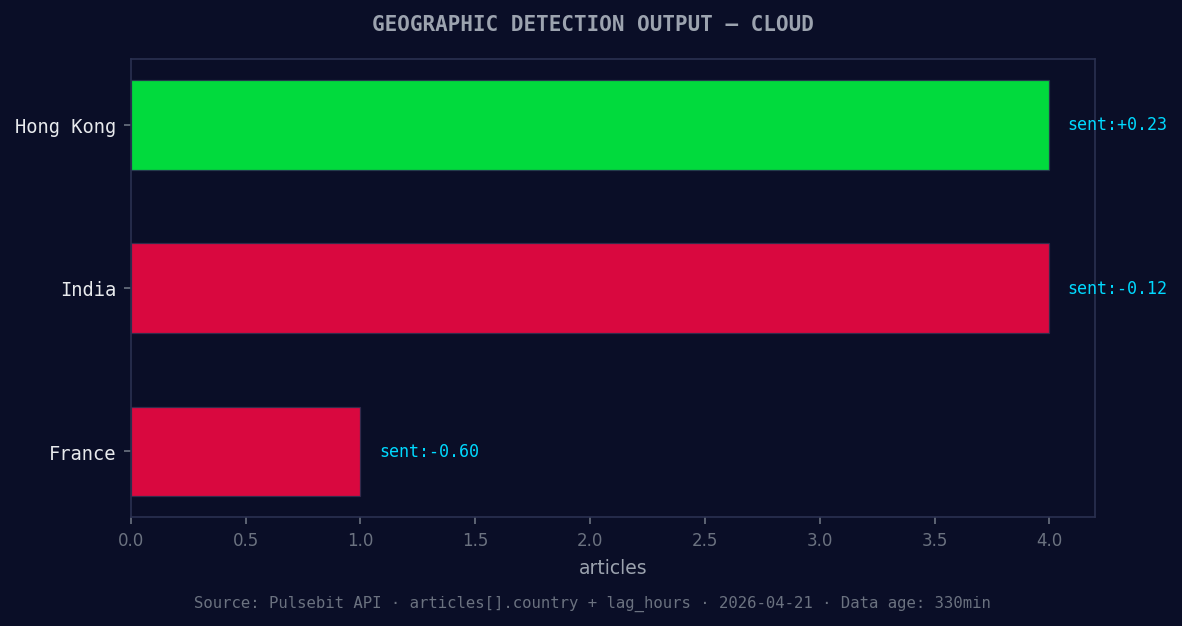
*Geographic detection output for cloud. Hong Kong leads with 4 articles and sentiment +0.23. Source: Pulsebit /news_recent geographic fields.*
# Check if we have the right sentiment score
momentum = 0.204
if data['momentum_24h'] >= momentum:
print("Significant sentiment spike detected!")
# Step 2: Meta-sentiment moment
meta_sentiment_string = "Clustered by shared themes: sudden, rain, hailstorm, bring, relief."
meta_response = requests.post(f"{endpoint}/score", json={"text": meta_sentiment_string})
meta_data = meta_response.json()
# Output sentiment score for the narrative
print(f"Meta Sentiment Score: {meta_data['sentiment_score']}, Confidence: {meta_data['confidence']}")
In the above code, we start by defining the API endpoint and setting parameters to filter for English language articles about the topic "cloud." We then check if the momentum meets our threshold of +0.204.
Next, we run the narrative framing through our sentiment scoring to get a better understanding of how the story is being framed. This dual approach helps us stay on the cutting edge of what narratives are emerging, allowing you to catch shifts that others might miss.
Now, let’s discuss three specific builds you could implement tonight using this pattern:
Cloud Sentiment Alert: Set a threshold for cloud sentiment at +0.204. Use the geo filter to monitor sentiment spikes in English articles specifically from the region of Hyderabad. This means you won't miss critical shifts in local narratives.
Meta-Sentiment Dashboard: Create a dashboard that visualizes sentiment scores, including the meta scores from narrative framing. For instance, if you find sentiment around "sudden, rain, hailstorm" rising, you can proactively adjust your strategies based on emerging themes.
Clustered Theme Tracker: Implement a feature that tracks articles clustered around themes like "cloud," "google," and "after." By comparing these against mainstream narratives, you can identify gaps and opportunities that traditional methods might overlook.
By building these features, you ensure that your pipeline is not just reactive but anticipatory, making it robust in the face of rapid sentiment shifts.
To get started with this, check out our documentation at pulsebit.lojenterprise.com/docs. You should be able to copy, paste, and run this in under 10 minutes to start capturing sentiment in real-time.


Top comments (0)