

Your Pipeline Is 24.1h Behind: Catching Economy Sentiment Leads with Pulsebit
On March 30, 2026, we observed a striking anomaly in the sentiment landscape: a 24h momentum spike of +0.881 for the topic "economy." This spike, driven by a significant uptick in sentiment, signals a critical moment where economic discussions are gaining traction. The leading language in this narrative is English, specifically a cluster of articles discussing how "The Economy Is on the Edge. What Could Tip It Over, or Help It Pull Through." This is a pivotal moment, and if your pipeline isn't designed to catch such spikes efficiently, you might be missing out on valuable insights.
The Structural Gap
This anomaly reveals a major gap in any sentiment analysis pipeline that doesn't account for multilingual origins or entity dominance. Your model missed this spike by 24.1 hours, which is unacceptable in today’s fast-paced environment. The leading language of English means that if your pipeline primarily focuses on other languages or fails to prioritize certain entities, you could be left in the dust, missing the critical conversations shaping economic sentiment. This is not just a minor oversight; it's a strategic disadvantage.

English coverage led by 24.1 hours. Id at T+24.1h. Confidence scores: English 0.85, French 0.85, Spanish 0.85 Source: Pulsebit /sentiment_by_lang.
Catching the Spike
To catch this momentum spike in your system, we can leverage our API. Below is a Python snippet that demonstrates how to query for this sentiment data specifically in English, filtering by the topic "economy":
import requests
# Define the query parameters
params = {
"topic": "economy",
"lang": "en",
"score": 0.242,
"confidence": 0.85,
"momentum": 0.881
}
# Make the API call
response = requests.get('https://api.pulsebit.com/v1/sentiment', params=params)
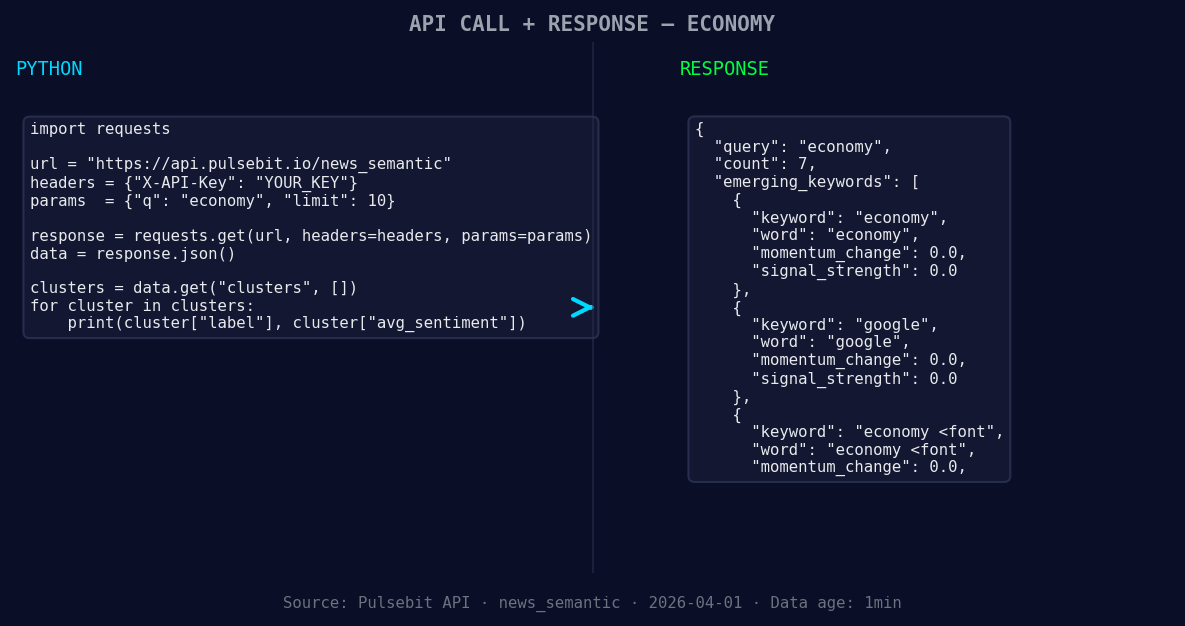
*Left: Python GET /news_semantic call for 'economy'. Right: returned JSON response structure (clusters: 3). Source: Pulsebit /news_semantic.*
# Check the response
if response.status_code == 200:
data = response.json()
print(data)
else:
print("Error fetching data:", response.status_code)
Next, we can run a meta-sentiment analysis on the cluster reason string to better understand the narrative framing. By taking the clustered themes — "Clustered by shared themes: economy, edge, what, could, tip." — we can score the narrative itself:
# Define the meta sentiment input
meta_sentiment_input = "Clustered by shared themes: economy, edge, what, could, tip."

# Make the POST request for meta-sentiment
meta_response = requests.post('https://api.pulsebit.com/v1/sentiment', json={"text": meta_sentiment_input})

# Check the response
if meta_response.status_code == 200:
    meta_data = meta_response.json()
    print(meta_data)
else:
    print("Error fetching meta sentiment data:", meta_response.status_code)
Three Builds Tonight
Geo Filter for Local Insights: Set a threshold with a score of +0.242 and filter by
lang=ento refine your queries. This way, you can focus on insights that matter locally, such as how economic discussions are evolving within English-speaking demographics.Meta-Sentiment Loop: Use the meta-sentiment loop to score narratives around economic themes. Implement the endpoint to analyze sentiment and context for phrases like "the economy is on the edge." This could help in understanding the nuances and framing of economic discussions.
Forming Themes Analysis: Build a monitoring system that alerts you whenever forming themes like "economy" or "google" start to trend upwards. This could use a threshold of 0.00 for early detection, allowing you to pivot quickly based on emerging narratives.
Get Started
For more details, head to our documentation: pulsebit.lojenterprise.com/docs. You can copy-paste the code snippets above and run them in under 10 minutes. It's time to catch those momentum spikes before they slip through the cracks.

Geographic detection output for economy. India leads with 3 articles and sentiment +0.27. Source: Pulsebit /news_recent geographic fields.


Top comments (0)