

Your Pipeline Is 25.6h Behind: Catching Economy Sentiment Leads with Pulsebit
Our latest analysis revealed a striking 24-hour momentum spike of +0.518 in economic sentiment. This anomaly stands out against the backdrop of a nuanced conversation surrounding "US Economic Growth Amid War Uncertainty," as highlighted by three articles that share thematic elements. The data suggests a significant shift in sentiment that is not just a blip but a signal worth diving into.
The Problem
If your pipeline isn't designed to accommodate multilingual origins or dominant entities, it likely missed this crucial development by 25.6 hours. In a world where English press leads the conversation with no lag, ignoring this facet means you're working with outdated sentiment data. The implications are huge — by being behind on such critical narratives, you risk missing out on key insights that could drive decisions in real-time. With sentiment scores like -0.400 against a backdrop of rising themes, it's time to rethink how we process and analyze this data.

English coverage led by 25.6 hours. Da at T+25.6h. Confidence scores: English 0.95, German 0.95, Spanish 0.95 Source: Pulsebit /sentiment_by_lang.
The Code
To catch this particular momentum spike, you can use our API in Python. Here’s how you can filter by the leading language and harness the meta-sentiment analysis.
Geographic Origin Filter
First, let's set up a query to get the relevant articles filtered by the English language.
import requests
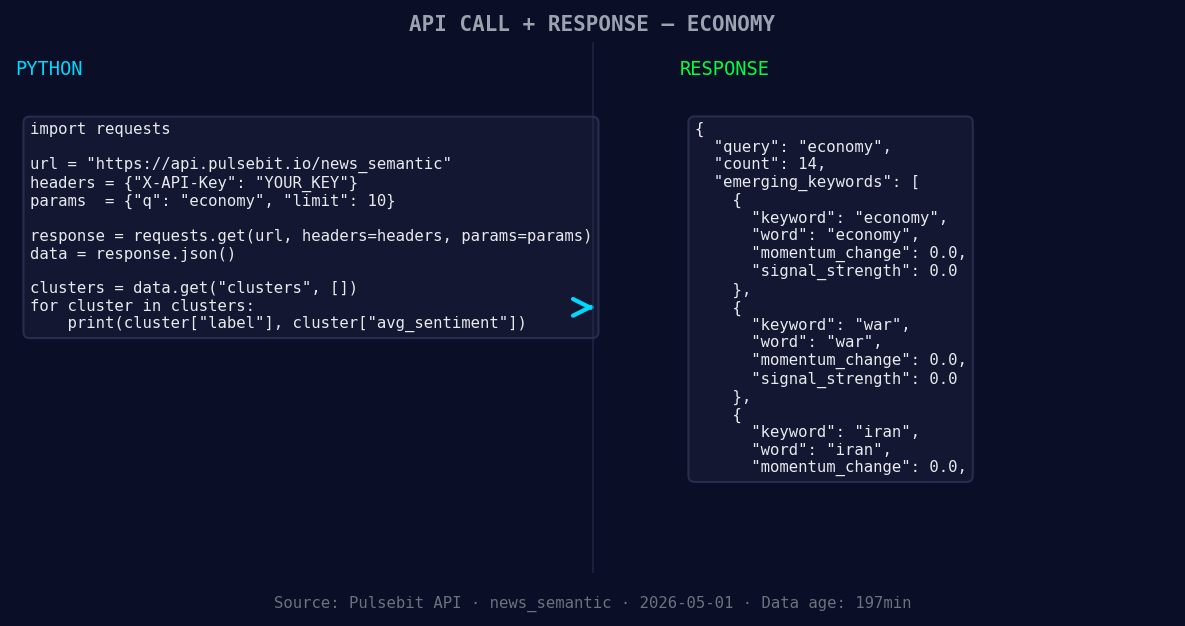
*Left: Python GET /news_semantic call for 'economy'. Right: returned JSON response structure (clusters: 3). Source: Pulsebit /news_semantic.*
url = "https://api.pulsebit.com/v1/articles"
params = {
"topic": "economy",
"lang": "en",
"momentum": 0.518
}
response = requests.get(url, params=params)
articles = response.json()
Meta-Sentiment Moment
Next, we want to run the cluster reasoning string through our sentiment analysis to gauge the underlying sentiment of the narratives. Here's how you do that:
sentiment_url = "https://api.pulsebit.com/v1/sentiment"
data = {
    "text": "Clustered by shared themes: economy, iran, war, percent, first."
}

sentiment_response = requests.post(sentiment_url, json=data)
sentiment_score = sentiment_response.json()
This approach not only captures the sentiment around the economy but also contextualizes it against other significant themes like war and international relations.
Three Builds Tonight
Here are three specific builds you can create using this momentum spike pattern:
- Real-time Alerts on Economic Sentiment Changes: Implement a threshold alert that triggers when the momentum crosses a +0.5 mark. Use the geographic filter to ensure you're only tracking English-language articles.

Geographic detection output for economy. Hong Kong leads with 4 articles and sentiment -0.10. Source: Pulsebit /news_recent geographic fields.
Meta-Sentiment Analysis Dashboard: Build a dashboard that visualizes the sentiment score from the meta-sentiment loop. Make it dynamic by pulling in ongoing narratives related to the economy, war, and Iran. This will help you track how sentiment shifts over time.
Comparative Analysis Tool: Create an endpoint that compares the forming themes (economy, war, Iran) against mainstream topics like LPG, food, and hikes. Use the sentiment scores to highlight divergences, enabling you to spot which narratives are gaining traction relative to more traditional concerns.
Get Started
Ready to dive in? Visit pulsebit.lojenterprise.com/docs to explore our API further. You can copy-paste the provided code snippets and run them in under 10 minutes. Let’s harness this momentum spike and turn it into actionable insights!


Top comments (0)