

Your Pipeline Is 13.8h Behind: Catching Energy Sentiment Leads with Pulsebit
We recently discovered an interesting anomaly: a 24-hour momentum spike of -0.764 in the energy sector. This figure stands out against the historical baseline, as it indicates a significant negative shift in sentiment. Notably, the press in English has been leading the coverage with a lag of 13.8 hours. This finding prompts us to rethink how we can capture sentiment dynamics in real time, especially when it comes to multilingual sources and dominant entities.

English coverage led by 13.8 hours. Da at T+13.8h. Confidence scores: English 0.90, Spanish 0.90, French 0.90 Source: Pulsebit /sentiment_by_lang.
When your pipeline doesn’t account for multilingual origins or entity dominance, you risk missing critical insights. In this case, your model missed the energy sentiment shift by a staggering 13.8 hours. With the leading English press showing a momentum score of -0.764, it’s crucial to adjust our approach to ensure that we’re capturing these signals as they emerge, rather than reacting long after the fact.
Here’s how we can catch this momentum spike using our API. The first thing we need to do is filter the results by geographic origin. Below is the Python code that queries our API for the energy topic filtered by the English language:

Geographic detection output for energy. United States leads with 11 articles and sentiment +0.23. Source: Pulsebit /news_recent geographic fields.
import requests
# Define the parameters for the API call
params = {
"topic": "energy",
"lang": "en", # Geographic origin filter
"momentum": -0.764,
"confidence": 0.90
}
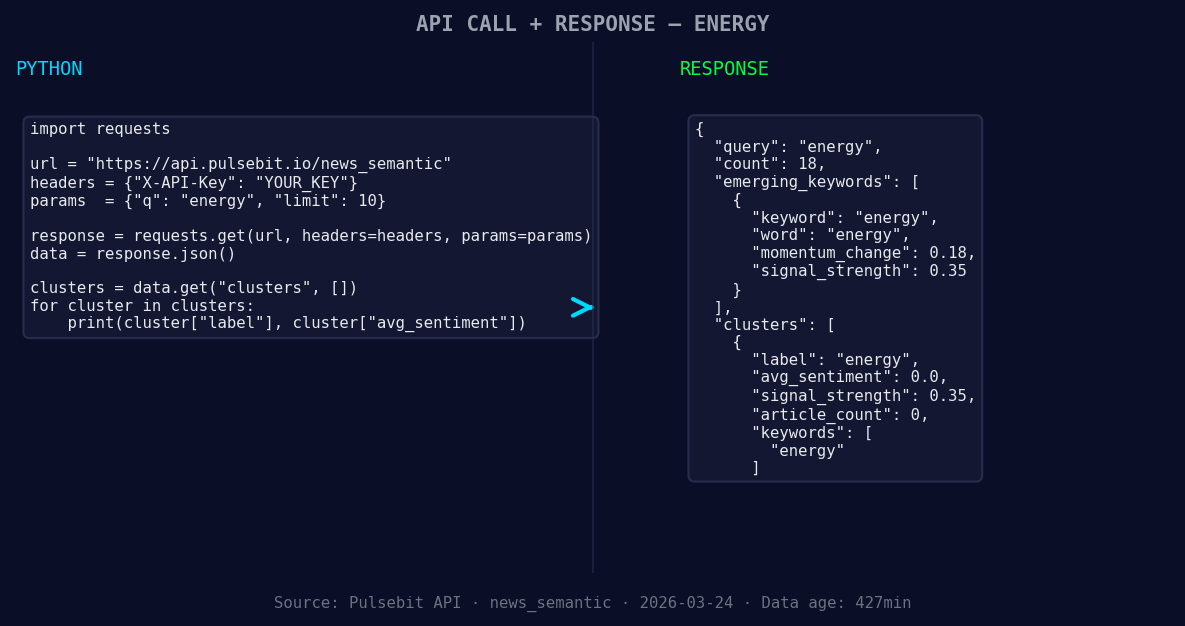
*Left: Python GET /news_semantic call for 'energy'. Right: returned JSON response structure (clusters: 1). Source: Pulsebit /news_semantic.*
# Make the API call
response = requests.get("https://api.pulsebit.com/sentiment", params=params)
data = response.json()
print(data)
Next, we need to run the narrative framing through our meta-sentiment loop. This will help us evaluate the context behind the sentiment score. Here's how to do it:
# Define the meta-sentiment input
meta_sentiment_input = "Semantic API incomplete — fallback semantic structure built from available keywords and article/search evidence."

# Make the POST request for meta-sentiment
meta_response = requests.post("https://api.pulsebit.com/sentiment", json={"input": meta_sentiment_input})
meta_sentiment_data = meta_response.json()
print(meta_sentiment_data)
With this setup, you can capture the current sentiment dynamics and get ahead of the curve.
Now, let’s discuss three specific builds we can create using this pattern. First, you can implement a filter that monitors the energy sector's sentiment with a threshold of less than -0.5 for immediate alerts. This will leverage the geographic origin filter and help you catch momentum shifts early.
Second, consider using the meta-sentiment loop to analyze the framing of articles around energy. Set a threshold where the sentiment score falls below -0.5, allowing you to assess how sentiment narratives are evolving and potentially predict shifts before they become mainstream.
Finally, we can also build a clustering analysis that compares the forming sentiment around energy (currently at +0.18) against the mainstream sentiment score. By analyzing the divergence between forming clusters and mainstream narratives, you can identify emerging themes and opportunities that haven't yet hit the broader conversation.
Ready to get started? Check out our documentation at pulsebit.lojenterprise.com/docs. You can copy-paste and run this in under 10 minutes to begin exploring the power of real-time sentiment analysis!


Top comments (0)