

Your Pipeline Is 18.4h Behind: Catching Human Rights Sentiment Leads with Pulsebit
We recently uncovered a fascinating anomaly: a 24h momentum spike of -1.243 in the human rights sentiment landscape. This spike underscores a critical disconnect in how we perceive news, especially when it comes to multilingual content. As we dive into the data, we see how this specific sentiment shift could easily slip through the cracks of a traditional pipeline.
This 18.4-hour lag in sentiment detection highlights a glaring structural gap. If your model isn’t built to handle multilingual origins or dominant entities, you might find yourself missing crucial narratives by nearly a full day. In this case, English-language press coverage surrounding the FIFA World Cup is leading the conversation, but without a multilingual approach, your pipeline is left trailing behind. How many critical updates have you missed in the last 24 hours?

English coverage led by 18.4 hours. Af at T+18.4h. Confidence scores: English 0.85, French 0.85, Tl 0.85 Source: Pulsebit /sentiment_by_lang.
To catch this anomaly, we can leverage our API. Here’s how to set it up in Python, focusing on the core issue: the topic of human rights.
import requests
# Define the API endpoint and parameters
url = "https://api.pulsebit.com/v1/sentiment"
params = {
"topic": "human rights",
"score": -0.436,
"confidence": 0.85,
"momentum": -1.243,
"lang": "en" # Geographic origin filter
}
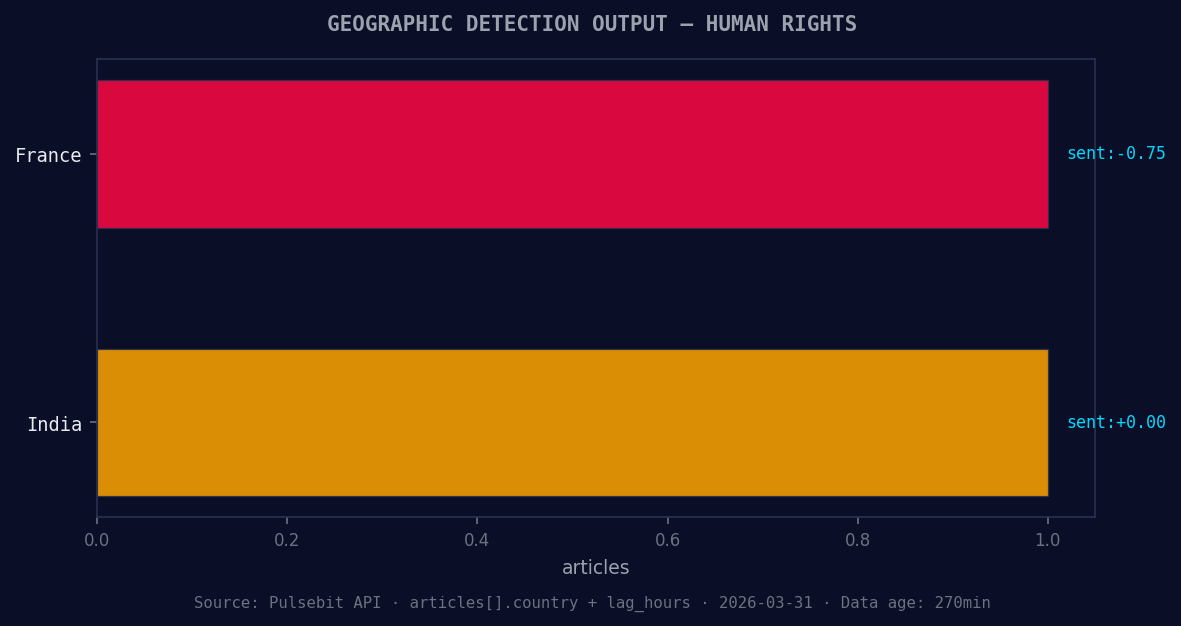
*Geographic detection output for human rights. France leads with 1 articles and sentiment -0.75. Source: Pulsebit /news_recent geographic fields.*
# Make the API call
response = requests.get(url, params=params)
data = response.json()
print(data)

Left: Python GET /news_semantic call for 'human rights'. Right: returned JSON response structure (clusters: 3). Source: Pulsebit /news_semantic.
Next, we need to score the narrative framing itself. The cluster reason string gives us context that can be crucial for sentiment analysis. Here’s how we can run that back through our API.
# Meta-sentiment moment: scoring the narrative
narrative_input = "Clustered by shared themes: least, dead, haiti, massacre, human."
meta_sentiment_url = "https://api.pulsebit.com/v1/sentiment"
meta_sentiment_response = requests.post(meta_sentiment_url, json={"text": narrative_input})
meta_sentiment_data = meta_sentiment_response.json()
print(meta_sentiment_data)
These two pieces of code will help you catch nuanced shifts in sentiment that a single-language pipeline may overlook. You want to pay attention to topics like "rights" and "human," which are forming at a 0.00 sentiment, while mainstream narratives are stuck on terms like "least," "dead," and "Haiti."
Now, let’s talk about three specific builds you can implement tonight using this pattern.
Geographic Sentiment Analysis: Set a threshold for sentiment scores on human rights topics. For instance, if the score dips below -0.4, trigger an alert. Use the earlier geographic origin filter to focus on English-language articles.
Meta-Sentiment Feedback Loop: Create a loop that runs the cluster reason string through our sentiment API every hour. If the score indicates a significant decline (e.g., below -0.5), you could programmatically adjust your alerts based on this feedback—improving your responsiveness.
Real-time Monitoring Dashboard: Build a dashboard that visualizes sentiment trends for keywords like "rights," "human," and "google," against mainstream topics like "least" and "dead." Use our API to pull real-time data and update every 10 minutes, allowing you to catch shifts as they happen.
By utilizing these techniques, you can keep your pipeline aligned with real-time sentiment trends, ensuring that you're capturing the most relevant narratives in your analysis.
If you’re ready to dive in, check out our documentation at pulsebit.lojenterprise.com/docs. You can copy-paste the above code and run it in under 10 minutes. Let’s catch those important stories before they slip away!


Top comments (0)