

Your Pipeline Is 26.4h Behind: Catching Finance Sentiment Leads with Pulsebit
We recently discovered a notable anomaly: a 24h momentum spike of -1.450 in the finance sector. This spike is reflective of a significant shift in sentiment, particularly around a clustered story titled "Talent Search in Japanese Finance Sector." What makes this even more intriguing is the leading language, which is English, arriving 26.4 hours ahead of the rest of the narratives. This discrepancy highlights a critical lag that many sentiment analysis pipelines might face, especially when they don't account for multilingual origins and entity dominance.

English coverage led by 26.4 hours. Af at T+26.4h. Confidence scores: English 0.85, Spanish 0.85, Ro 0.85 Source: Pulsebit /sentiment_by_lang.
The Problem
Your model missed this by 26.4 hours. By failing to incorporate multilingual considerations, you risk being blindsided by emerging trends that originate in non-English contexts. The leading entity in this case is the English press, while the actual discussions are rooted in Japanese finance. Without the ability to track and interpret these nuances across languages, your sentiment analysis could lead you to outdated conclusions, making your insights less actionable and timely.
The Code
To address this issue, we can leverage our API to catch these anomalies effectively. Below is the Python code that helps us filter and analyze the sentiment around finance:
import requests
# Step 1: Geographic origin filter
url = "https://api.pulsebit.com/v1/topics"
params = {
"topic": "finance",
"lang": "en"
}
response = requests.get(url, params=params)
data = response.json()
print(data)
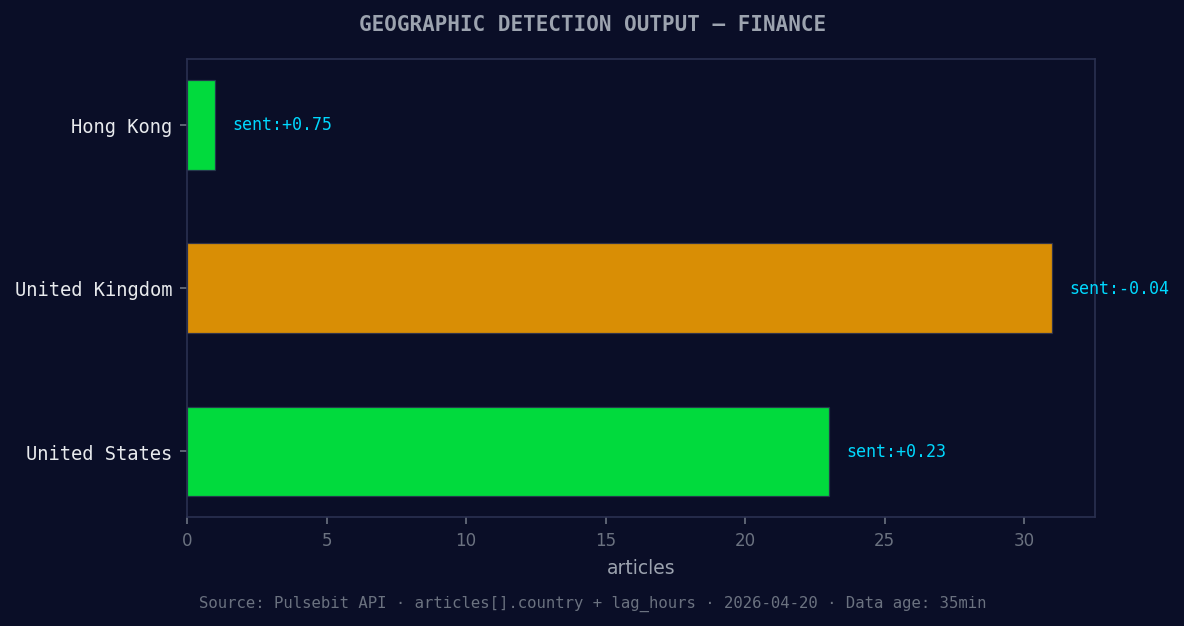
*Geographic detection output for finance. Hong Kong leads with 1 articles and sentiment +0.75. Source: Pulsebit /news_recent geographic fields.*
# Step 2: Meta-sentiment moment
meta_sentiment_input = "Clustered by shared themes: students, 'huge, relief', given, loans."
sentiment_url = "https://api.pulsebit.com/v1/sentiment"
sentiment_response = requests.post(sentiment_url, json={"text": meta_sentiment_input})
sentiment_data = sentiment_response.json()
print(sentiment_data)
In this code snippet, we first filter for articles on finance written in English. This allows us to capture a more relevant subset of data. Next, we run a second API call to analyze the sentiments surrounding the clustering themes. This approach provides us with a deeper understanding of narrative framing and sentiment shifts, which are crucial for timely decision-making.

Left: Python GET /news_semantic call for 'finance'. Right: returned JSON response structure (clusters: 3). Source: Pulsebit /news_semantic.
Three Builds Tonight
Geo-Filtered Signal: Create an alert for any significant momentum spikes in finance articles originating from English sources. Set a threshold of momentum less than -1.0. This way, you can react quickly to emerging trends that may lead to actionable insights.
Meta-Sentiment Loop: Develop a routine that feeds clustered themes back into the sentiment analysis pipeline. For instance, use the themes "students" and "huge, relief" to assess how they frame the conversation around financial loans. This will help you understand the public sentiment surrounding financial products and services.
Thematic Monitoring: Set up a monitoring system that tracks the sentiment around specific keywords like "finance" and "Google," both of which currently show no significant momentum. This can help you catch when mainstream narratives start to shift, allowing you to stay ahead of the curve.
Get Started
Dive into our documentation at pulsebit.lojenterprise.com/docs. You can copy-paste the provided code and run it in under 10 minutes to start capturing these critical insights for yourself. Don't let your pipeline lag behind!


Top comments (0)