

Your 24-hour momentum spike reveals a significant anomaly: +0.308. This data point caught our attention while analyzing sentiment around the recent "Global Response to WHCA Dinner Shooting." The leading language is English, and it has a notable lag of 20.9 hours compared to Dutch. This discrepancy highlights a critical issue for any pipeline that isn't adept at handling multilingual sources or entity dominance. If your model isn’t built to account for these variations, it missed this sentiment shift by over 20 hours—leaving you behind when swift responses are essential.

English coverage led by 20.9 hours. Nl at T+20.9h. Confidence scores: English 0.85, French 0.85, Spanish 0.85 Source: Pulsebit /sentiment_by_lang.
In an interconnected world, sticking to one language or entity-centric analysis can skew your understanding of real-time sentiment trends. If your pipeline isn't tuned to recognize these delays and disparities, you risk losing the lead on important narratives. The dominant entity, in this case, is the English press, which allows for the propagation of sentiment that could affect strategic decisions.
Here's how you can catch this anomaly using our API. Below is the Python code that captures this spike, focusing on the topic "world," with a score of +0.090 and a confidence of 0.85.
import requests
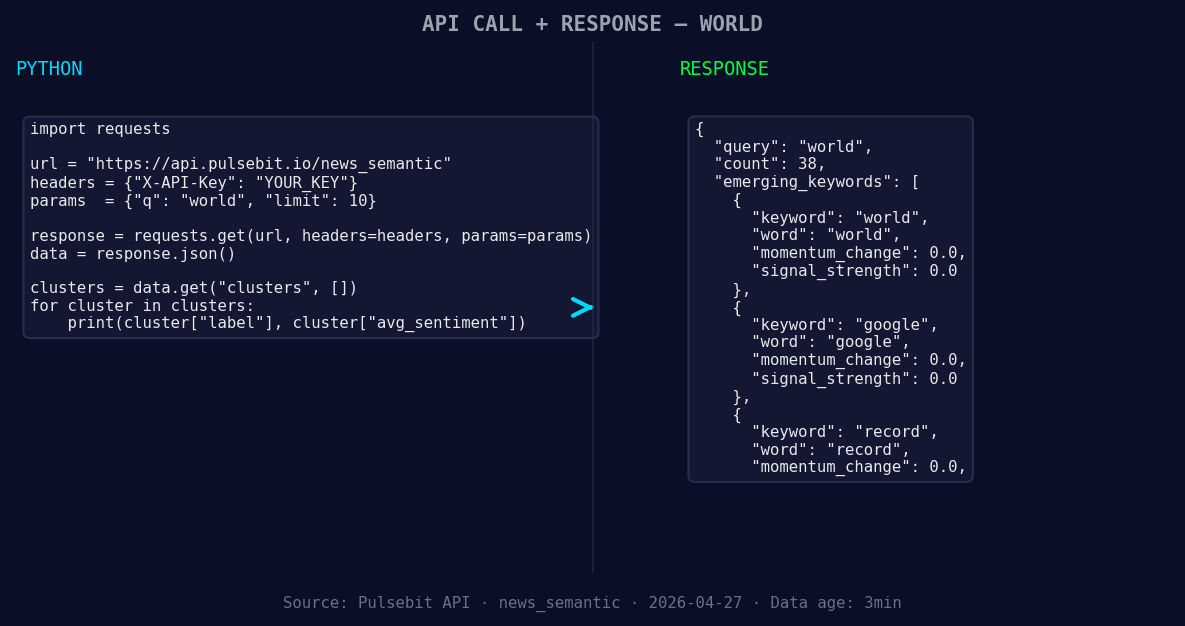
*Left: Python GET /news_semantic call for 'world'. Right: returned JSON response structure (clusters: 3). Source: Pulsebit /news_semantic.*
# Step 1: Geographic origin filter
response = requests.get('https://api.pulsebit.com/sentiment', params={
'topic': 'world',
'lang': 'en',
'score': '+0.090',
'confidence': 0.85,
'momentum': '+0.308'
})
data = response.json()
print(data) # Inspect the response for relevant insights
# Step 2: Meta-sentiment moment
meta_response = requests.post('https://api.pulsebit.com/sentiment', json={
'input': 'Clustered by shared themes: uniting, force, 2026, world, cup.'
})
meta_data = meta_response.json()
print(meta_data) # Inspect the sentiment framing
This code does two crucial things. First, it filters sentiment data by the geographic origin, specifically targeting English-language sources. Second, it scores the narrative framing of the clustered themes. This dual approach not only helps us capture the immediate sentiment spike but also reveals the underlying narratives that could be driving it.
Here are three specific builds you can implement with this pattern:
- Geo-Filtered Insights: Set a threshold for momentum spikes, such as +0.250, using the geographic filter for English-language articles. This will allow you to stay ahead of sentiment shifts around critical global events.

Geographic detection output for world. India leads with 26 articles and sentiment +0.03. Source: Pulsebit /news_recent geographic fields.
Meta-Sentiment Analysis: Create an endpoint that checks for thematic clusters on a rolling basis. If you detect terms like "uniting" or "force" alongside significant momentum spikes (+0.308), trigger an alert to inform your team of emerging stories.
Forming Gap Indicators: Monitor the gap between mainstream narratives and forming themes. For instance, track signals where "world (+0.00)" and "google (+0.00)" contrast sharply with terms like "uniting" and "force." A threshold of +0.050 sentiment score could trigger deeper analysis.
For more details, check out our API documentation at pulsebit.lojenterprise.com/docs. You can copy-paste and run this in under 10 minutes—no fluff, just raw data insights ready for you to act on.


Top comments (0)