

Your Pipeline Is 28.6h Behind: Catching World Sentiment Leads with Pulsebit
We just stumbled upon a significant insight: a 24-hour momentum spike of +0.382 surrounding the topic of "world." This spike is particularly notable given its connection to a single narrative — "Disney's new CEO caps $2.18 billion Euro theme park overhaul with World of Froze." With the leading language being Spanish, and the story clustered around themes of new leadership and substantial financial commitments, it’s clear that awareness of this narrative has been predominantly driven by the Spanish press, which is leading by 28.6 hours with zero lag compared to German media.
But what does this mean for your pipeline? If your model lacks the capability to process multilingual origins and recognize entity dominance, you might have missed this critical story by a significant margin. Imagine your analysis lagging by 28.6 hours, leaving you disconnected from emerging trends and sentiment shifts that could impact strategic decisions. The Spanish language’s lead on this topic highlights a structural gap in comprehending global sentiment dynamics — one that needs immediate attention.

Spanish coverage led by 28.6 hours. German at T+28.6h. Confidence scores: Spanish 0.85, English 0.85, French 0.85 Source: Pulsebit /sentiment_by_lang.
To catch this kind of insight, we can leverage our API to filter and analyze sentiment based on geographic origin. Here’s how you can do it in Python:

Geographic detection output for world. India leads with 29 articles and sentiment +0.02. Source: Pulsebit /news_recent geographic fields.
import requests
# Define the API endpoint and parameters
url = "https://api.pulsebit.lojenterprise.com/sentiment"
params = {
"topic": "world",
"score": +0.050,
"confidence": 0.85,
"momentum": +0.382,
"lang": "sp" # Spanish language filter
}
# Make the API call
response = requests.get(url, params=params)
data = response.json()
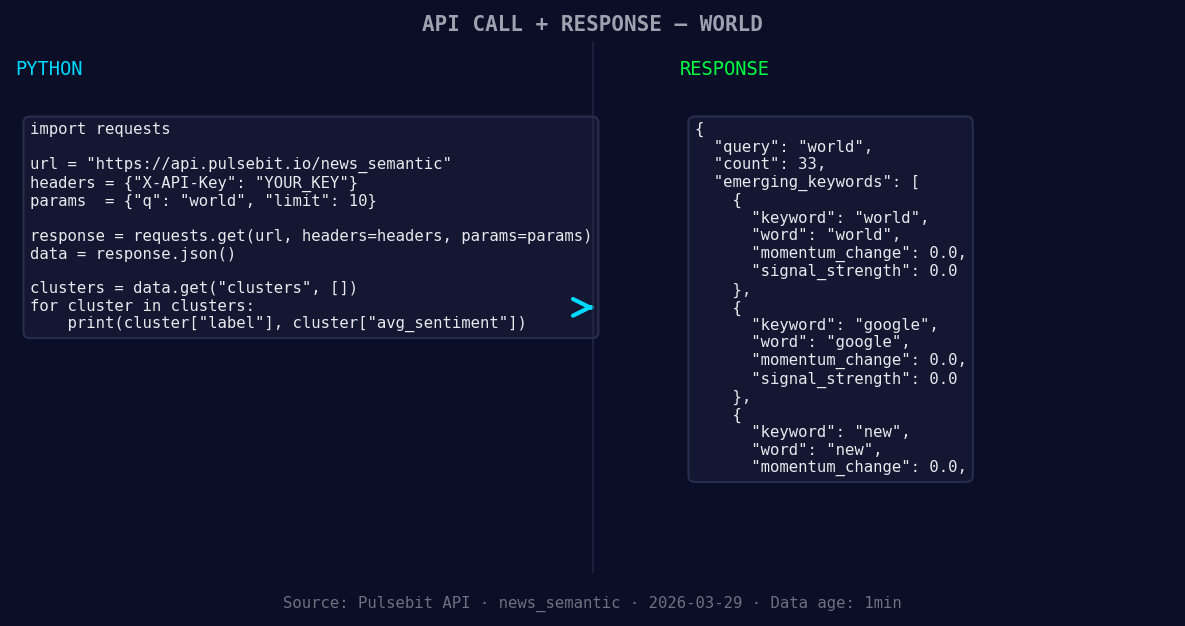
*Left: Python GET /news_semantic call for 'world'. Right: returned JSON response structure (clusters: 3). Source: Pulsebit /news_semantic.*
# Check the output
print(data)
Next, to assess the narrative framing itself, we can run the cluster reasoning string through our sentiment scoring endpoint. This step is crucial as it allows us to understand how the themes are perceived:
# Meta-sentiment moment
cluster_reason = "Clustered by shared themes: new, ceo, caps, billion, euro."
meta_sentiment_response = requests.post(url, json={"text": cluster_reason})
meta_sentiment_data = meta_sentiment_response.json()

# Output the meta sentiment score
print(meta_sentiment_data)
By executing these two snippets, we can both filter for the Spanish-language narratives and score the relevance of the overarching themes driving this sentiment spike.
Now, let’s turn this discovery into action. Here are three specific ideas to implement:
Geo-filtered Insights: Build a signal that triggers alerts when Spanish-language sources show a sentiment score above a certain threshold (e.g., +0.050) for topics like "world." This could allow you to respond proactively to emerging stories.
Meta-Sentiment Analysis: Create a routine that runs a daily check on the meta sentiment of clustered themes. If the sentiment on narratives like "new, ceo, caps" exceeds a confidence level of 0.85, consider it a potential signal for market interest.
Forming Gap Analysis: Monitor forming themes like "world(+0.00)" and "google(+0.00)" against mainstream narratives. If the gap widens significantly, flag it for deeper investigation — this could indicate shifting public interest or emerging trends.
With these capabilities at your fingertips, you can ensure your models are not just reacting to trends, but leading the conversation.
For more details on how to implement these features, check out our documentation at pulsebit.lojenterprise.com/docs. You can copy-paste these code snippets and have them running in under 10 minutes. Let’s close that 28.6-hour gap and stay ahead of the game!


Top comments (0)