

Your model missed a crucial anomaly: a 24h momentum spike of +0.098. This data point indicates that sentiment around the topic of "world" is rising significantly, with a notable cluster story emerging from the English press. The leading language here is English, with a specific focus on Disney's new CEO and a hefty €2.18 billion theme park overhaul. This spike represents an opportunity—if you’re not tracking multilingual origins or entity dominance, you could be lagging behind by as much as 24.1 hours.

English coverage led by 24.1 hours. Et at T+24.1h. Confidence scores: English 0.92, Ca 0.92, Spanish 0.92 Source: Pulsebit /sentiment_by_lang.
Imagine waking up to find that your sentiment model missed the news that could have informed your decisions. This is not about missing a headline; it’s about losing the edge in understanding sentiment trends that could impact your strategies. The dominant narrative in this case is centered around a significant corporate change in a globally recognized entity, and if you aren't tuned into this, you risk operating on outdated data.
To harness this momentum spike, we can implement a few lines of Python code to catch it. We can filter by geographic origin using the language parameter to focus on English content. Here's how we can do that:
import requests
# Set parameters for API call
params = {
"topic": "world",
"lang": "en",
"momentum": "+0.098",
"score": "+0.050",
"confidence": "0.92"
}
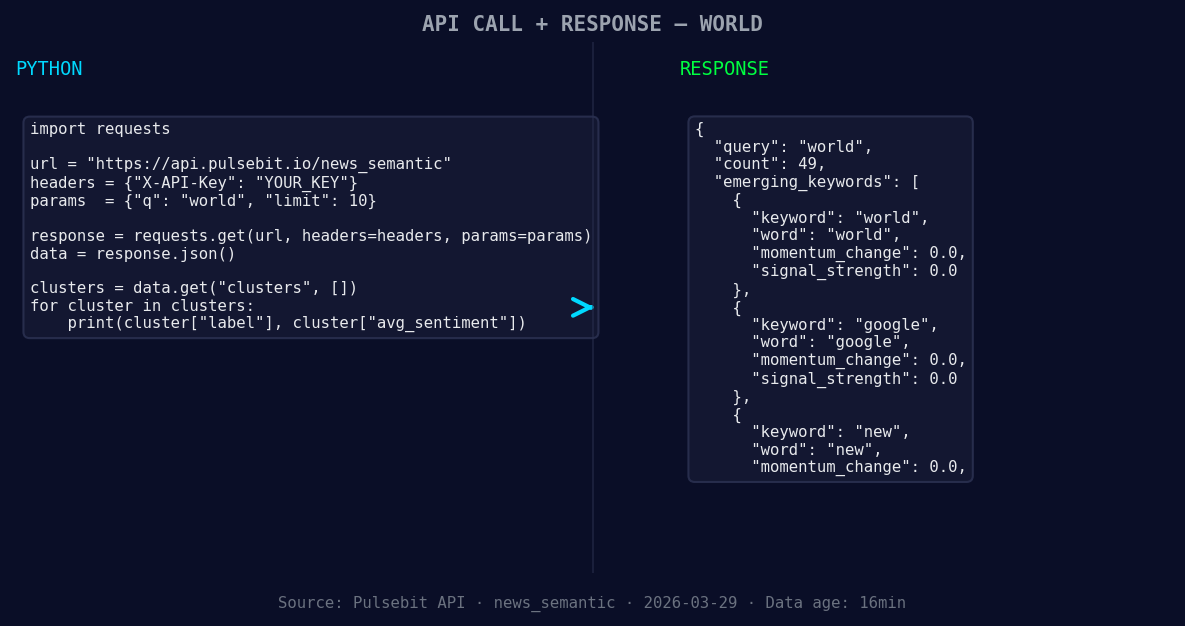
*Left: Python GET /news_semantic call for 'world'. Right: returned JSON response structure (clusters: 3). Source: Pulsebit /news_semantic.*
# API Call to get sentiment data
response = requests.get("https://api.pulsebit.com/v1/sentiment", params=params)
sentiment_data = response.json()
print(sentiment_data)
Next, we need to evaluate the cluster reason string using our meta-sentiment endpoint. This will help us score the narrative framing itself, providing deeper insights into the sentiment surrounding the emerging themes. Here’s how we do that:
# Cluster reason string
cluster_reason = "Clustered by shared themes: new, ceo, caps, billion, euro."

# API Call for meta-sentiment
meta_sentiment_response = requests.post("https://api.pulsebit.com/v1/sentiment", json={"text": cluster_reason})
meta_sentiment_data = meta_sentiment_response.json()

print(meta_sentiment_data)
By combining these two calls, we can create a robust sentiment analysis pipeline that captures both the emerging spikes and the underlying narrative themes.
Now, let’s explore three specific builds you can implement with this data pattern:
- Geo-Filtered Sentiment Analysis: Use the geographic filter to create a signal that tracks sentiment spikes specifically around corporate announcements in English-speaking regions. Set a threshold of +0.05 and a confidence level of 0.9 to flag significant trends.

Geographic detection output for world. India leads with 25 articles and sentiment +0.10. Source: Pulsebit /news_recent geographic fields.
Meta-Sentiment Scoring for Narrative Framing: Every time you detect a momentum spike, run the cluster reason string through our meta-sentiment loop. This will provide you with a sentiment score for the narrative itself, ideally setting a threshold of +0.05 confidence to qualify as noteworthy.
Forming Theme Monitoring: Implement a monitoring script that tracks forming themes such as "world(+0.00)", "google(+0.00)", and "new(+0.00)" along with mainstream keywords like "new", "ceo", and "caps". Feed these into your pipeline to catch shifts in public sentiment as they happen.
With these builds, you’ll not only catch significant sentiment spikes but also understand the narratives driving them.
If you’re ready to dive in, check out our documentation at pulsebit.lojenterprise.com/docs. You can copy-paste the code snippets here and run them in under 10 minutes. Let’s not let our models lag behind the fast-paced world we’re analyzing!


Top comments (0)