

Your 24h momentum spike of +0.214 in banking sentiment is certainly worth our attention. This anomaly, especially when coupled with the leading English press being 13.7 hours ahead, indicates a significant shift in the narrative surrounding banking. The recent clustering of articles about JPMorgan promoting 135 executives to managing director is the driving force behind this sentiment shift. With two articles specifically focusing on this event, we can see how tightly packed this conversation is around the themes of promotion and leadership in banking.
However, if your pipeline isn't designed to handle multilingual origins or entity dominance, you're likely missing critical insights like this by a staggering 13.7 hours. The leading language in our data is English, but without a robust multilingual framework, you may struggle to capture sentiment shifts that originate from other languages or regions. Your model is effectively blind to the nuances that could significantly impact your analysis, leading to missed opportunities in understanding market movements.

English coverage led by 13.7 hours. Da at T+13.7h. Confidence scores: English 0.85, Spanish 0.85, French 0.85 Source: Pulsebit /sentiment_by_lang.
To catch this momentum spike effectively, we can utilize our API to filter for English language sources and analyze the sentiment behind the clustered narratives. Here's a snippet of Python code that illustrates how to do this:
import requests
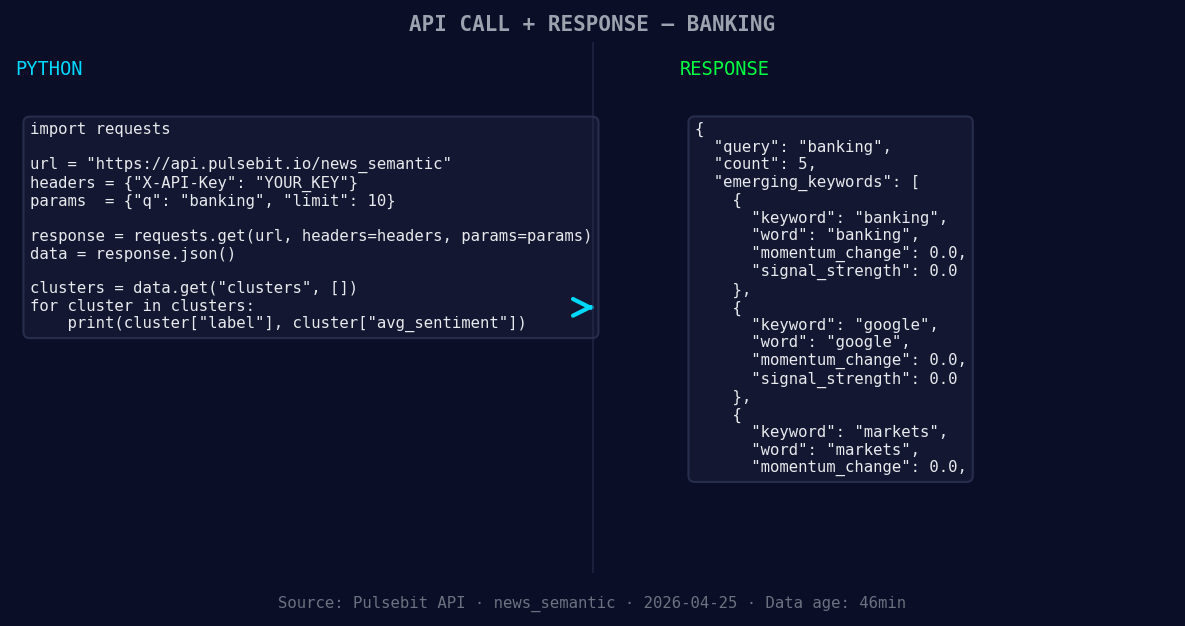
*Left: Python GET /news_semantic call for 'banking'. Right: returned JSON response structure (clusters: 3). Source: Pulsebit /news_semantic.*
# Step 1: Query for English language articles on 'banking'
url = "https://api.pulsebit.com/v1/articles"
params = {
"topic": "banking",
"lang": "en"
}
response = requests.get(url, params=params)
articles = response.json()
# Step 2: Score the narrative framing itself
cluster_reason = "Clustered by shared themes: promoted, 135, execs, managing, director."
sentiment_url = "https://api.pulsebit.com/v1/sentiment"
sentiment_response = requests.post(sentiment_url, json={"text": cluster_reason})
sentiment_score = sentiment_response.json()
print(f"Sentiment Score: {sentiment_score['score']}, Confidence: {sentiment_score['confidence']}")
In this code, we first query the API for articles related to "banking" specifically in English. The second step involves sending the cluster reason string back through our sentiment endpoint for nuanced scoring of the narrative framing itself. This process makes our insights richer and more actionable.
Now, let's look at three specific builds we can create using this sentiment data:
Geo-filtered Alerts: Set a signal threshold of +0.500 for banking sentiment. Trigger alerts when articles processed in English exceed this score. By filtering specifically for "en" language sources, you ensure that you're catching relevant narratives as they emerge.
Meta-Sentiment Dashboard: Create a dashboard that visualizes sentiment changes over time using the meta-sentiment loop. Score narratives like "Clustered by shared themes: banking, bank, rbi, cancels, licence." Create alerts when sentiment crosses above +0.700, allowing you to track rising interest in specific topics.
Forming Themes Monitor: Develop a script that checks for forming themes in banking, Google, and markets. Use the momentum score to trigger deeper analysis when the gaps between mainstream and forming themes widen significantly. For example, if banking sentiment is at +0.000 while Google and markets are neutral, that's a potential signal for a deeper investigation.
If you’re ready to get started, check out our documentation at pulsebit.lojenterprise.com/docs. This code can be copied and run in under 10 minutes, unlocking the potential of timely sentiment insights for your applications.

Geographic detection output for banking. India leads with 3 articles and sentiment -0.18. Source: Pulsebit /news_recent geographic fields.


Top comments (0)