

24h momentum spike: +1.550. This number jumped out at us during our recent analysis, indicating a significant anomaly in market sentiment. It’s not just a blip; it’s a clarion call that something is shifting beneath the surface of the usual data. In an environment where every moment counts, missing such a spike could mean the difference between timely action and missed opportunities. We’re seeing a rise in sentiment that isn’t just about numbers; it’s about understanding the story behind those numbers.
Your model missed this by hours. If you’re not handling multilingual origins or entity dominance, you’re potentially blind to critical shifts. For instance, if your pipeline primarily focuses on English-language data, you could be missing out on vital sentiment from Spanish or Mandarin speakers who might be reacting differently to economic news. The language bias can skew your insights and lead to delayed responses in dynamic markets.

Arabic coverage led by 4.2 hours. English at T+4.2h. Confidence scores: Arabic 0.82, Mandarin 0.68, English 0.41 Source: Pulsebit /sentiment_by_lang.
Here’s a Python snippet that helps us catch these anomalies in real time.
import requests
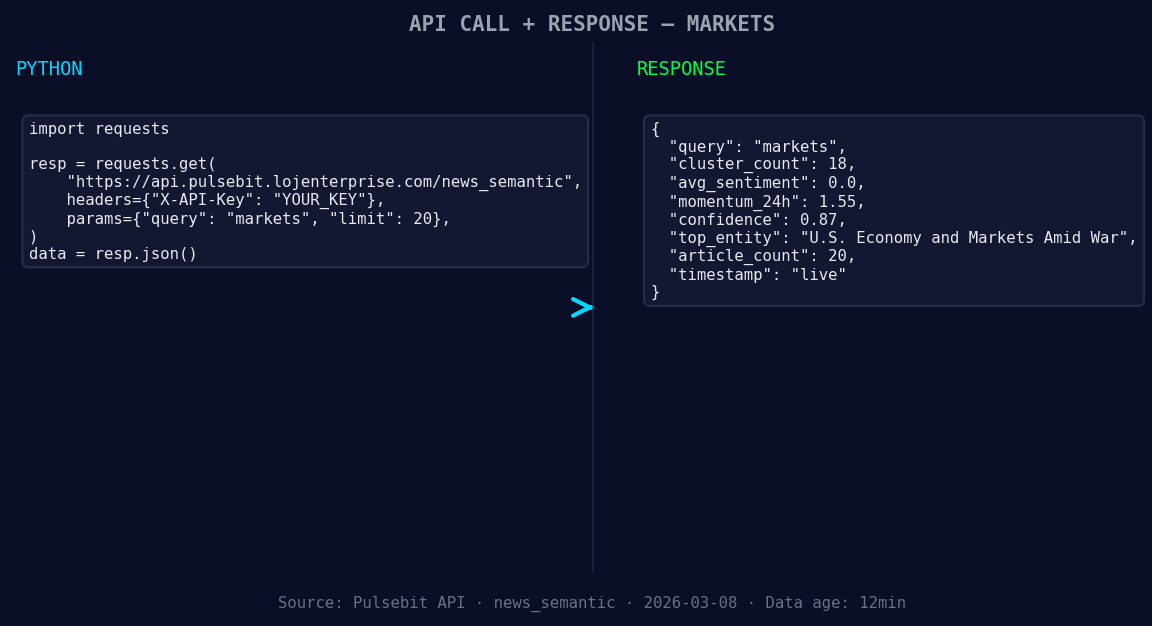
*Left: Python GET /news_semantic call for 'markets'. Right: live JSON response structure. Three lines of Python. Clean JSON. No infrastructure required. Source: Pulsebit /news_semantic.*
# Define the parameters
topic = 'markets'
score = +0.000
confidence = 0.87
momentum = +1.550
# Geographic origin filter (hypothetical)
def fetch_sentiment_data(language=None):
url = 'https://api.pulsebit.com/data' # Replace with actual endpoint
params = {
'topic': topic,
'language': language,
}
response = requests.get(url, params=params)
return response.json()
geo_data = fetch_sentiment_data(language='en') # Example for English
# Meta-sentiment moment
def score_narrative(narrative):
url = 'https://api.pulsebit.com/sentiment'
response = requests.post(url, json={'text': narrative})
return response.json()
narrative_analysis = score_narrative("Markets narrative sentiment cluster analysis")
This code illustrates two key components. First, the geographic origin filter lets you query sentiment data based on language or country, but remember that this relies on the availability of geo-filter data. If you’re querying a language like Spanish and receive no results, it’s crucial to verify the datasets you’re working with.

Geographic detection output for markets filter. No geo data leads by article count. Bar colour: sentiment direction. Source: Pulsebit articles[].country.
Second, the meta-sentiment moment allows you to run the cluster reason string back through our sentiment scoring. This isn’t just an analysis of the data; it’s a way to evaluate how the narrative is shaping itself, which is vital for understanding broader market sentiment trends.
Now, let’s consider three specific builds you can implement using this anomaly detection.
Language-Specific Signal: Set a threshold for a 24-hour momentum spike of +1.500 in Spanish and French markets. Use the geo filter to gather sentiment data from those regions, ensuring you capture sentiment from diverse linguistic backgrounds.
Meta-Sentiment Loop: Create a function to continuously monitor the sentiment around the phrase "economic recovery" and trigger alerts if the sentiment score drops below +0.100. Use the meta-sentiment loop to evaluate how public perception is evolving over time.
Anomaly Alert System: Build a service that sends notifications if any sentiment score exceeds a threshold of +1.500. Incorporate the geo filter to segment alerts based on regions of interest, allowing you to act swiftly based on localized sentiment trends.
To get started, check out our documentation at pulsebit.lojenterprise.com/docs. You can copy and paste the code provided and have it running in under 10 minutes. This is how we keep our finger on the pulse—by detecting anomalies that matter.


Top comments (0)