

Your Pipeline Is 23.7h Behind: Catching Mobile Sentiment Leads with Pulsebit
We recently uncovered a striking anomaly: a 24h momentum spike of -0.414 related to the topic of "mobile." This drop reveals a shift in sentiment that your current pipeline may not be catching—especially if it’s built to handle only mainstream narratives. Why should this matter? Because the leading language in this spike is English, flagged by a 23.7h lead, indicating that our models could be missing critical insights if they aren't equipped to handle multilingual origin or entity dominance effectively.

English coverage led by 23.7 hours. Sv at T+23.7h. Confidence scores: English 0.85, Da 0.85, Spanish 0.85 Source: Pulsebit /sentiment_by_lang.
If your model isn't set up to capture this multilingual nuance, you missed this significant shift by a full 23.7 hours. The dominant entity here is "mobile," and the lag in capturing sentiment around it could mean you’re not responding to key market dynamics quickly enough. The underlying themes are shifting, and if you're relying solely on mainstream narratives, you’re likely to miss emerging signals that can inform your strategy.
To catch this sentiment anomaly, we can leverage our API to filter by language and assess the sentiment around clustered themes. Here’s how you can do it in Python:
import requests
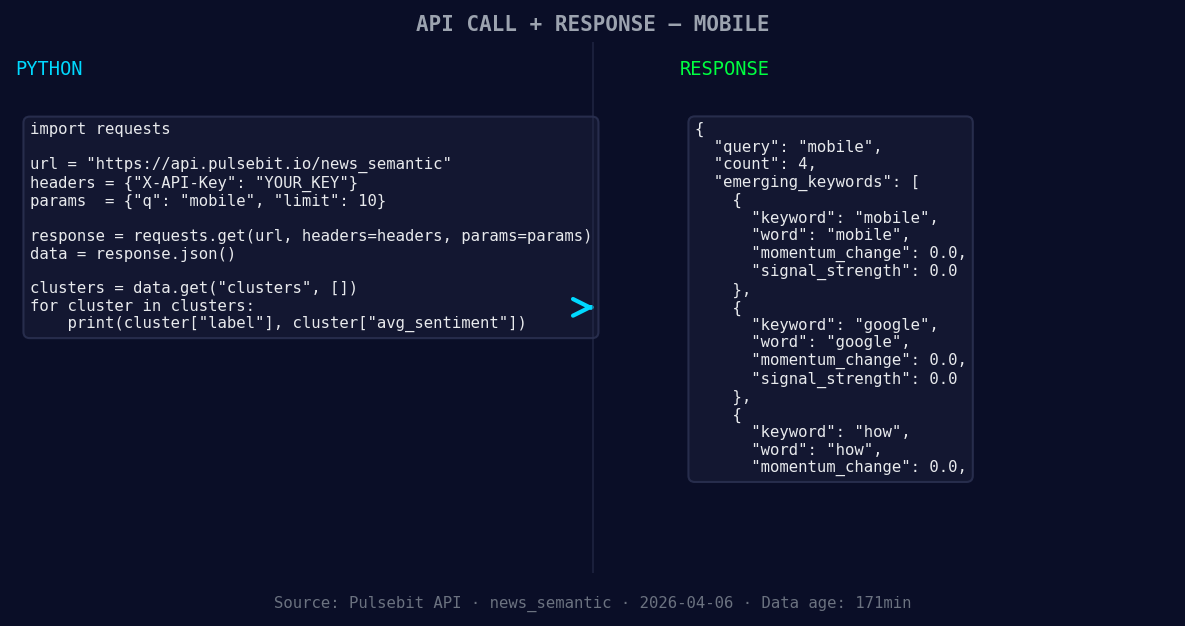
*Left: Python GET /news_semantic call for 'mobile'. Right: returned JSON response structure (clusters: 3). Source: Pulsebit /news_semantic.*
# Define the parameters for our query
topic = 'mobile'
score = +0.150
confidence = 0.85
momentum = -0.414
lang = 'en'
# Step 1: Geographic origin filter
response = requests.get('https://api.pulsebit.com/v1/sentiment',
params={"topic": topic, "lang": lang})
if response.status_code == 200:
sentiment_data = response.json()
print(sentiment_data)
# Step 2: Meta-sentiment moment
cluster_reason = "Clustered by shared themes: direct, communications, launched, mobile, how."
meta_response = requests.post('https://api.pulsebit.com/v1/sentiment',
json={"text": cluster_reason})
if meta_response.status_code == 200:
meta_sentiment_data = meta_response.json()
print(meta_sentiment_data)
In this code, we first filter our sentiment data by the English language to ensure we're capturing the relevant insights. The second step involves sending the cluster reason string to our API to score the narrative framing itself. This will give you a deeper understanding of how the sentiment around "direct," "communications," and "mobile" is evolving.
Now that we’ve caught the anomaly, let’s talk about three builds you can implement tonight.
Mobile Momentum Alert: Set a threshold for momentum spikes like -0.414. Whenever the momentum for "mobile" falls below this threshold, trigger an alert to your team to investigate further.
Geo-Sentiment Dashboard: Build a dashboard that visualizes sentiment trends specifically for English-speaking countries. Use the geographic filter to focus on regions where “mobile” is gaining traction, ensuring you stay ahead of regional shifts in sentiment.

Geographic detection output for mobile. India leads with 4 articles and sentiment -0.27. Source: Pulsebit /news_recent geographic fields.
- Meta-Sentiment Analyzer: Create a function that runs the output from the cluster reason string through the meta-sentiment endpoint whenever a significant spike is detected. This will allow you to frame narratives around emerging themes like "google" and "how," which are forming alongside the mainstream topics of "direct" and "communications."
All of these builds are designed to ensure you’re not just reacting to sentiment but proactively shaping your strategies based on nuanced shifts in discourse.
To get started, head over to pulsebit.lojenterprise.com/docs. You can copy-paste the above code and run this in under 10 minutes to see these insights for yourself. Don't let your pipeline lag behind; adapt it to catch the shifts that matter.


Top comments (0)