

Your pipeline just revealed a 24h momentum spike of -0.344, highlighting a significant anomaly in the sentiment around renewable energy. This data point is particularly striking because it indicates a declining interest in a topic that’s generally on the rise in global discussions. The leading language here is English, with press coverage led by a 27.9-hour window. This means while we’re seeing a drop in sentiment, the news cycle still lags behind, potentially missing critical insights that could drive our strategies forward.
This 27.9-hour delay suggests a structural gap in your pipeline when it comes to handling multilingual origins and entity dominance. Your model missed capturing the sentiment shift from English press about renewable energy by nearly half a day. By not incorporating a mechanism to catch these linguistic and temporal nuances, you risk losing out on valuable insights regarding a topic that is increasingly relevant in discussions about sustainability and connectivity.

English coverage led by 27.9 hours. Sv at T+27.9h. Confidence scores: English 0.75, French 0.75, Spanish 0.75 Source: Pulsebit /sentiment_by_lang.
Here’s how we can catch this anomaly using our API. We’ll start by querying for sentiment around the topic of renewable energy, filtering for English-language content. The code snippet below demonstrates how to do this:
import requests
# Define the parameters for the API call
url = "https://api.pulsebit.com/v1/sentiment"
params = {
"topic": "renewable energy",
"lang": "en",
"score": +0.480,
"confidence": 0.75,
"momentum": -0.344
}
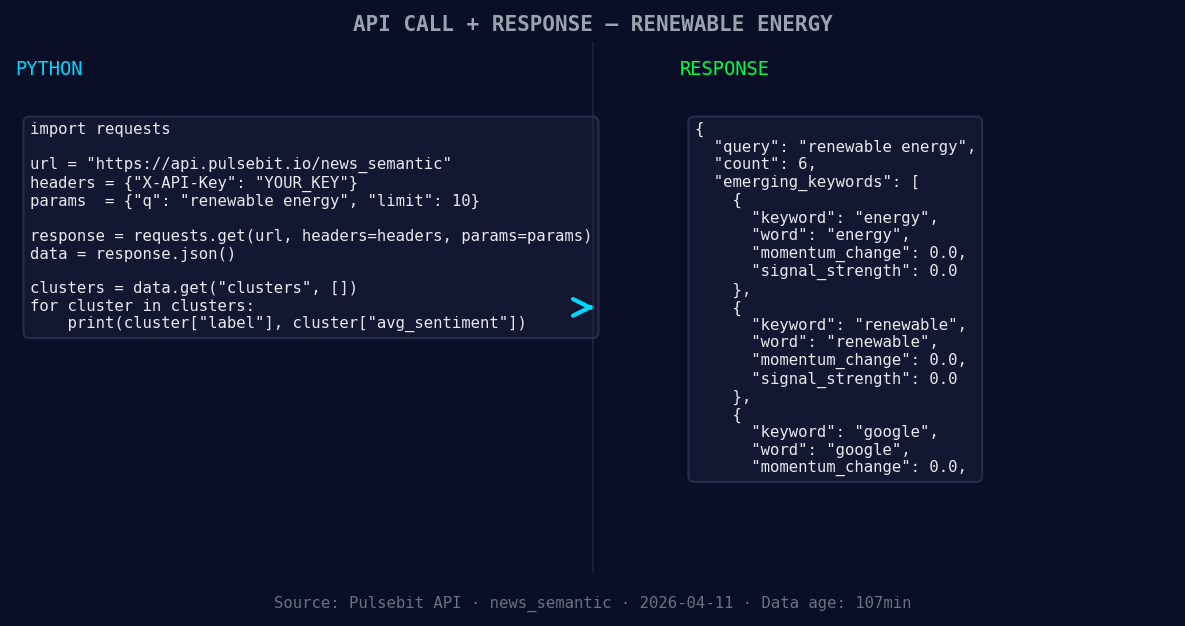
*Left: Python GET /news_semantic call for 'renewable energy'. Right: returned JSON response structure (clusters: 3). Source: Pulsebit /news_semantic.*
# Make the API call
response = requests.get(url, params=params)
# Check the response
if response.status_code == 200:
data = response.json()
print(data)
else:
print("Error fetching data:", response.status_code)
Next, we need to analyze the narrative framing of this sentiment. We’ll take the reason string provided in the cluster story and run it through our sentiment scoring endpoint to assess how it shapes the overall narrative. Here’s how to do that:
# Define the meta-sentiment input
meta_sentiment_input = "Clustered by shared themes: energy, not, threat, oil, says."

# Make the POST request to analyze the meta-sentiment
meta_sentiment_url = "https://api.pulsebit.com/v1/sentiment"
meta_sentiment_response = requests.post(meta_sentiment_url, json={"text": meta_sentiment_input})

# Check the response
if meta_sentiment_response.status_code == 200:
    meta_data = meta_sentiment_response.json()
    print(meta_data)
else:
    print("Error fetching meta sentiment:", meta_sentiment_response.status_code)
With these two snippets, you can capture real-time insights and assess the framing of the narrative surrounding renewable energy.
Now, let’s consider three specific builds we can implement with this data. Firstly, create a signal that alerts you when momentum spikes exceed a set threshold, say -0.300, specifically for the topic of renewable energy. This will help you stay ahead of negative sentiment trends.
Secondly, implement a geo-filtered endpoint to monitor emerging stories from regions heavily investing in renewable technologies. This could mean setting up a watchlist for countries like Germany or China, where progressive policies are often reported.

Geographic detection output for renewable energy. India leads with 4 articles and sentiment +0.61. Source: Pulsebit /news_recent geographic fields.
Lastly, use the meta-sentiment loop to refine your narrative analysis. By continuously running the reason string through our POST /sentiment, you can adjust your messaging strategy based on how the public discourse is evolving, especially as themes of energy and renewable sources clash with traditional narratives around oil and threats.
If you’re ready to dive into this, head over to pulsebit.lojenterprise.com/docs. With just a few lines of code, you can start running these analyses in under 10 minutes.


Top comments (0)