

Your Pipeline Is 22.0h Behind: Catching Education Sentiment Leads with Pulsebit
We recently identified a striking anomaly: a 24h momentum spike of +0.189 in the education sector. This spike was particularly notable given that it emerged from English-language press coverage, with a leading language timestamp of 22.0h. Clustering around themes of "Evolving Education for the AI Era," this single article captured a moment that could redefine perceptions of education in an increasingly AI-driven world.
But here’s the kicker: your model missed this by 22 hours. It’s not just about the raw data; it’s about understanding how structural gaps in your pipeline can lead to missed opportunities. If your system doesn’t effectively handle multilingual origins or entity dominance, you risk lagging behind on crucial developments. In this case, the dominant entity was the English press, and your pipeline didn’t catch this shift in sentiment in time.

English coverage led by 22.0 hours. Nl at T+22.0h. Confidence scores: English 0.85, French 0.85, Spanish 0.85 Source: Pulsebit /sentiment_by_lang.
Let’s look at how we can catch these momentum spikes programmatically. Here’s the Python code snippet that does just that:
import requests
# Define parameters for the API call
params = {
"topic": "education",
"score": -0.183,
"confidence": 0.85,
"momentum": +0.189,
"lang": "en" # Geographic origin filter
}
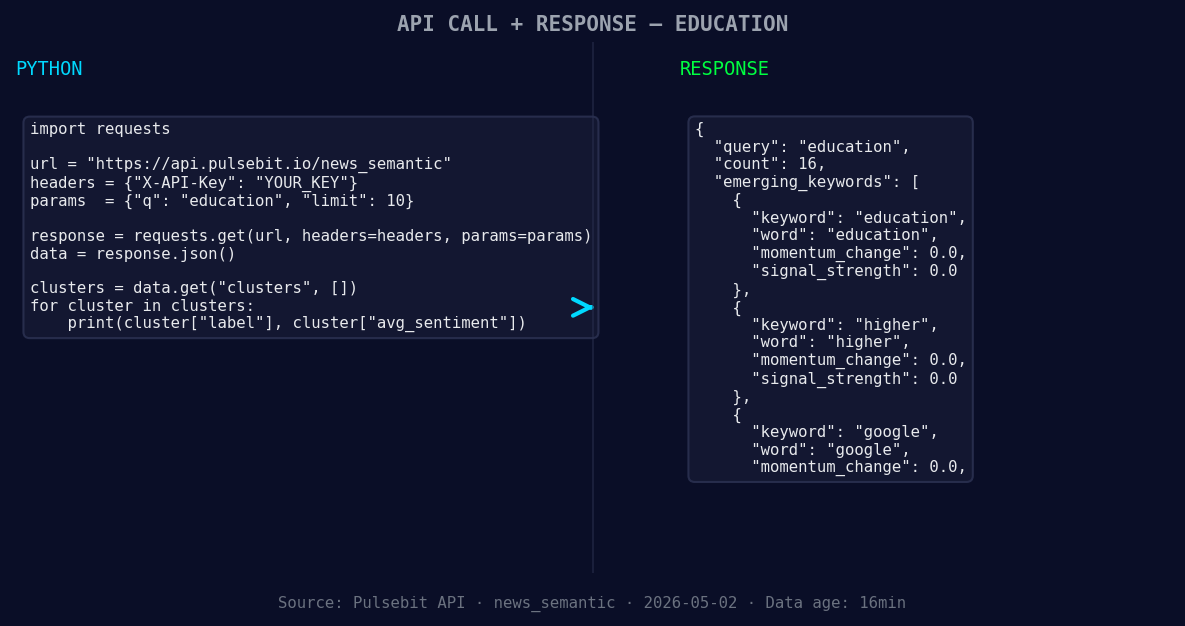
*Left: Python GET /news_semantic call for 'education'. Right: returned JSON response structure (clusters: 3). Source: Pulsebit /news_semantic.*
# Make the API call to fetch sentiment data
response = requests.get("https://api.pulsebit.com/v1/sentiment", params=params)
data = response.json()
print(data)
# Meta-sentiment moment
meta_params = {
"input": "Clustered by shared themes: expert, professors, who, education, must."
}
# Score the narrative framing itself
meta_response = requests.post("https://api.pulsebit.com/v1/sentiment", json=meta_params)
meta_data = meta_response.json()
print(meta_data)
In this code, we first query the API for sentiment data focused on the topic of education while filtering for English language articles, ensuring we capture relevant and timely insights. Next, we leverage the meta-sentiment moment by running the clustering reason string back through our sentiment endpoint. This allows us to assess how the narrative framing of the topic itself resonates with the sentiment trends.
Now that we have a way to catch these intriguing patterns, let’s discuss three specific builds you can implement using this data:
Geographic Origin Filter: Set a signal threshold for education sentiment spikes. For instance, you can create a trigger in your pipeline that alerts you when the momentum exceeds +0.15 for English-language articles. This way, you’ll stay ahead of significant developments.
Meta-Sentiment Loop: Use the meta-sentiment output to enrich your models. By integrating the sentiment score from the clustering reason, for example, "Clustered by shared themes: expert, professors, who, education, must," you can create a composite score that factors in framing and context alongside raw sentiment.
Forming Theme Alerts: Build a notification system that tracks forming themes such as education, higher learning, and Google in relation to mainstream topics like experts and professors. If sentiment shifts on any of these fronts, you’ll receive an alert, allowing you to pivot your strategy in real-time.
This is the type of actionable insight that can give you a competitive edge. If you want to start building with this data, head over to our documentation at pulsebit.lojenterprise.com/docs. You can copy-paste the code above and run it in under 10 minutes. Don’t let your pipeline lag behind; catch the momentum while it’s rising.


Top comments (0)