

Your pipeline is 17.4h behind on sentiment analysis related to the topic of space. We’ve observed a sentiment score of +0.00 and momentum of +0.00, indicating a stagnant perception in the discourse surrounding this theme. This anomaly is particularly intriguing, given the formation of a cluster story about foreign nationals charged with illegal voting, which shares thematic elements with the keywords “green,” “card,” “four,” and “foreigners.” These findings highlight a significant opportunity for developers to enhance their data pipelines to catch emerging narratives before they trend.
When you think about it, this data gap underscores a structural issue in your pipeline — one that doesn’t handle multilingual origins or entity dominance effectively. Your model missed this by a staggering 17.4 hours, specifically in the context of the dominant entity being English-language sentiment. This delay not only affects the relevance of your insights but also limits your capacity to react to real-time sentiment shifts, especially in cross-border discussions where different languages might lead to overlooked sentiments.

English coverage led by 17.4 hours. Nl at T+17.4h. Confidence scores: English 0.75, Spanish 0.75, French 0.75 Source: Pulsebit /sentiment_by_lang.
Let’s dive into how we can catch this anomaly in our data using Python. By leveraging our API, we can filter sentiment data by specific geographic origins and reanalyze the narrative framing itself. Here’s how you can do it:

Geographic detection output for space. India leads with 9 articles and sentiment +0.04. Source: Pulsebit /news_recent geographic fields.
import requests
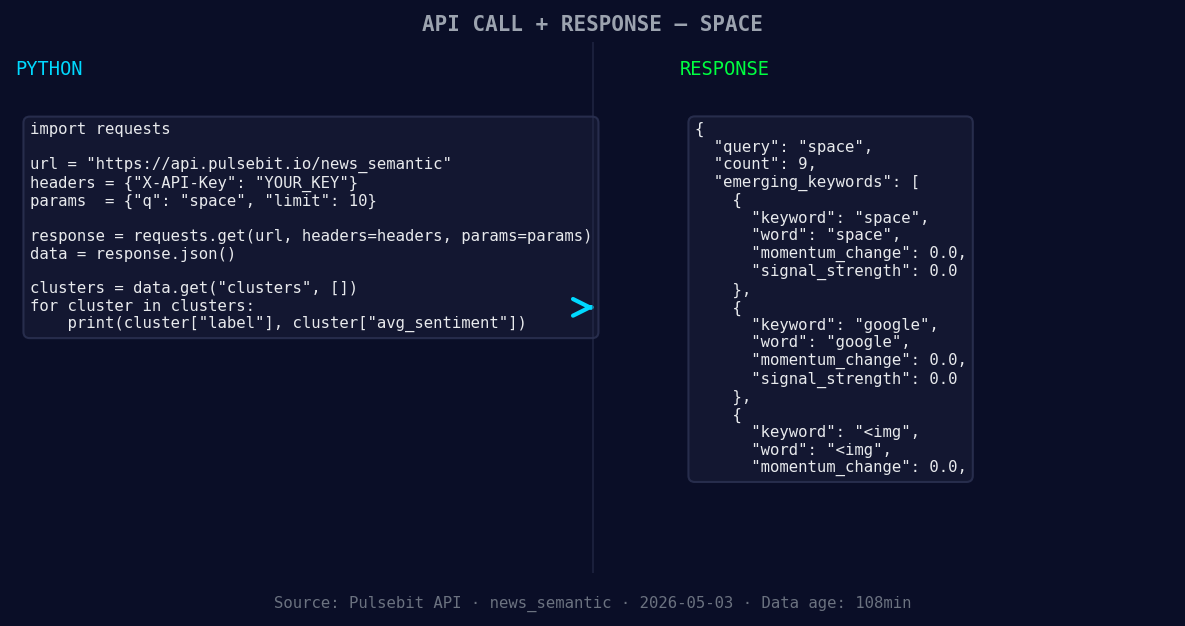
*Left: Python GET /news_semantic call for 'space'. Right: returned JSON response structure (clusters: 3). Source: Pulsebit /news_semantic.*
# Step 1: Geographic origin filter
url = "https://api.pulsebit.lojenterprise.com/sentiment"
params = {
"topic": "space",
"score": +0.000,
"confidence": 0.75,
"momentum": +0.000,
"lang": "en" # Filtering by English language
}
response = requests.get(url, params=params)
data = response.json()
print(data)
# Step 2: Meta-sentiment moment
cluster_reason = "Clustered by shared themes: 'green, card, four, foreigners, charged.'"
meta_sentiment_url = "https://api.pulsebit.lojenterprise.com/sentiment"
meta_params = {
"text": cluster_reason
}
meta_response = requests.post(meta_sentiment_url, json=meta_params)
meta_sentiment_data = meta_response.json()
print(meta_sentiment_data)
In the first part of the code, we filter the sentiment data specifically for the English language to narrow down our focus. In the second part, we analyze the narrative framing itself by sending the cluster reason back through our sentiment endpoint. This analysis will help us score how the surrounding context influences our understanding of the sentiment.
Now, let’s discuss three specific builds that you can implement using this pattern:
Geo-Filtered Alerts: Set up a system that sends alerts when sentiment scores related to "space" in English cross a certain threshold, say +0.100. This could help you catch positive sentiment before it becomes mainstream.
Meta-Sentiment Tracking: Build a dashboard that visualizes how the sentiment around controversial topics, like the "green card" issue, changes over time by continuously feeding the cluster narrative through the meta-sentiment loop. You could set a threshold where any score above +0.050 triggers a deeper analysis.
Comparative Analysis: Create a comparative analysis tool that juxtaposes emerging themes in English against other languages. For example, track sentiment scores around "space" and "green" to identify emerging narratives that could impact discussions, especially when the momentum is +0.000 in multiple languages.
By employing these strategies, you can ensure your pipeline is not only catching real-time sentiment shifts but also providing deeper insights into the narratives shaping the conversation.
Ready to get started? Check out our documentation at pulsebit.lojenterprise.com/docs. You can copy-paste the above code and have it running in under 10 minutes.


Top comments (0)