

Your Pipeline Is 17.9h Behind: Catching Travel Sentiment Leads with Pulsebit
We recently observed an intriguing anomaly in our data: a 24-hour momentum spike of +0.682 related to travel sentiment. This spike is driven by a powerful narrative connecting Egypt with Morocco, Kenya, Tanzania, and South Africa. As developers, we need to recognize the implications of such data shifts. Understanding and acting on these developments is crucial for maintaining an edge in our projects.
The Problem
Your model missed this by 17.9 hours. This structural gap becomes particularly evident when we consider that the leading language for this sentiment surge is English, yet the dominant entities in the narrative are African countries. If your pipeline isn't equipped to handle multilingual origins or the dominance of specific entities, you're missing out on critical insights and real-time sentiment shifts. This delay can lead to missed opportunities in decision-making or strategy formulation.

English coverage led by 17.9 hours. No at T+17.9h. Confidence scores: English 0.90, French 0.90, Spanish 0.90 Source: Pulsebit /sentiment_by_lang.
The Code
To catch this momentum spike effectively, we can use our API to filter and score the relevant data. Here's a simple Python script that demonstrates how to do this.
import requests
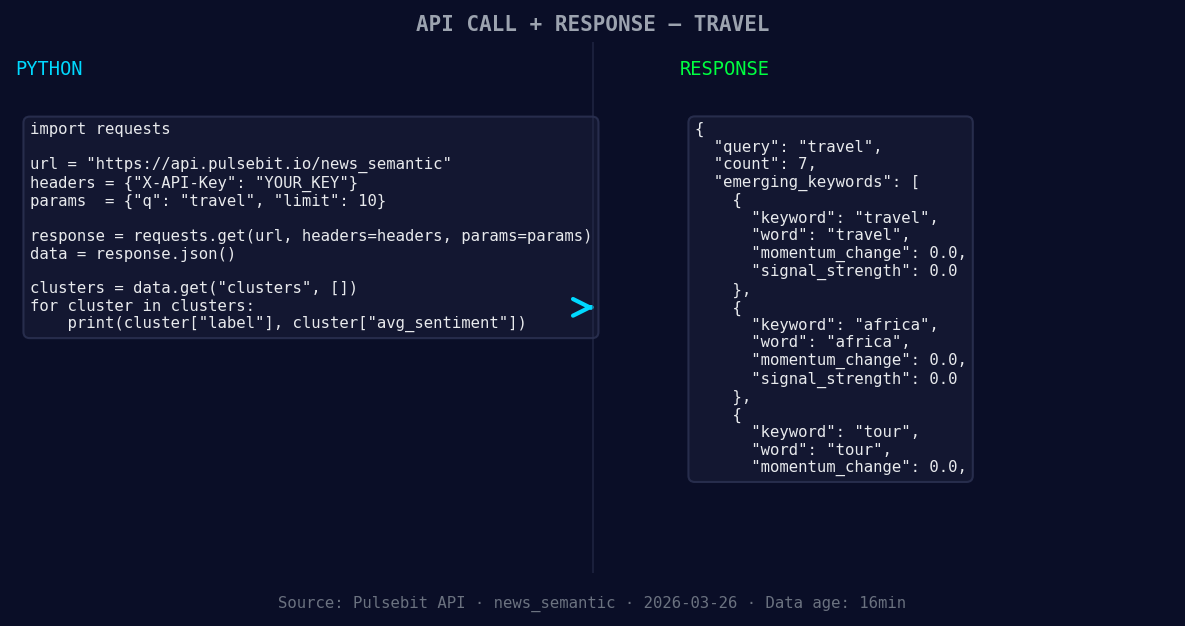
*Left: Python GET /news_semantic call for 'travel'. Right: returned JSON response structure (clusters: 3). Source: Pulsebit /news_semantic.*
# Step 1: Geographic origin filter
response = requests.get(
"https://api.pulsebit.io/v1/sentiment",
params={
"topic": "travel",
"lang": "en",
"score": -0.650,
"confidence": 0.90,
"momentum": +0.682
}
)
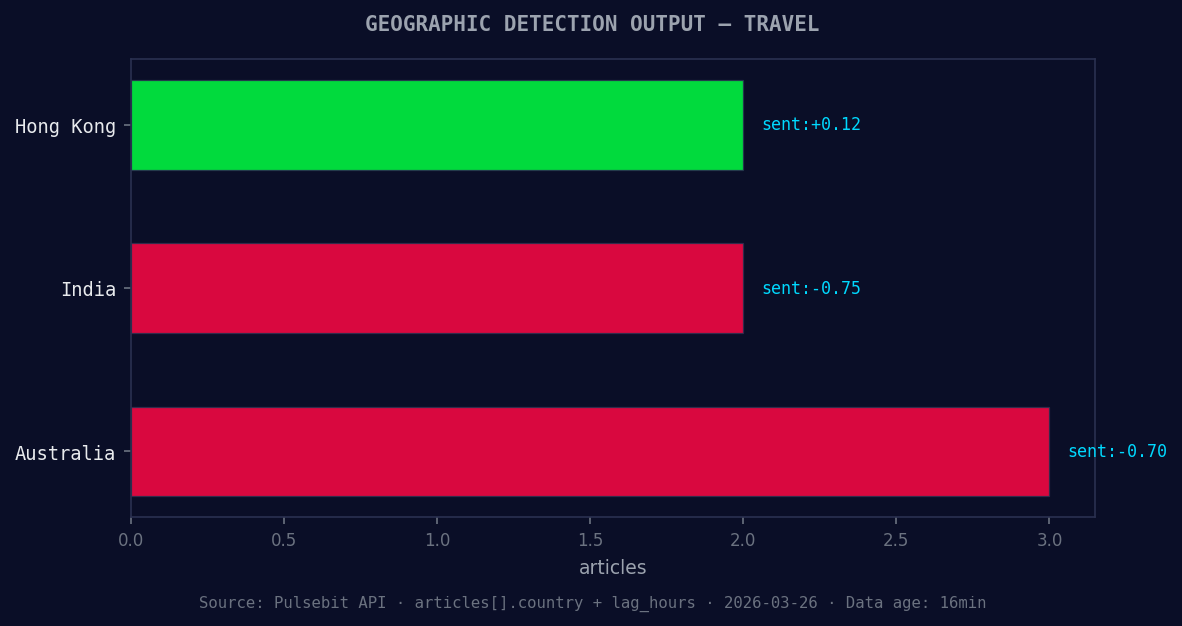
*Geographic detection output for travel. Hong Kong leads with 2 articles and sentiment +0.12. Source: Pulsebit /news_recent geographic fields.*
# Check the response
if response.status_code == 200:
print("Filtered sentiment data:", response.json())
else:
print("Error fetching data:", response.status_code, response.text)
# Step 2: Meta-sentiment moment
cluster_reason = "Clustered by shared themes: iranian, ban, 'sweeping, unchecked, powers'."
meta_response = requests.post(
"https://api.pulsebit.io/v1/sentiment",
json={"text": cluster_reason}
)
# Check the response
if meta_response.status_code == 200:
print("Meta sentiment score:", meta_response.json())
else:
print("Error fetching meta sentiment:", meta_response.status_code, meta_response.text)
In this code, we first filter our sentiment data to focus on the topic of travel in English. Following that, we run the cluster reason string back through the sentiment endpoint to analyze the narrative framing itself. This step is crucial because it helps us understand how external narratives can influence sentiment and thus inform our strategies.
Three Builds Tonight
With the insights gained from this analysis, here are three specific builds we can implement:
Real-time Monitoring for Travel Sentiment: Create a pipeline that continuously checks for sentiment spikes in the travel sector using the geo filter. Set a threshold for momentum spikes greater than +0.5 to alert you when significant shifts occur.
Narrative Analysis Dashboard: Develop a dashboard that visualizes the sentiment scores of clustered narratives. Use the meta-sentiment loop to score narratives that include themes like "travel" and "Africa," and establish thresholds for when to trigger alerts based on sentiment scores below -0.5.
Dynamic Content Strategies: Implement a content strategy that adapts based on sentiment changes. For example, when sentiment around travel in Africa starts to rise significantly, create proactive content that engages with that audience, targeting themes like "tour" and "travel" while monitoring for mainstream narratives that could influence public perception.
Get Started
For more details on how to implement these strategies, check out our documentation at pulsebit.lojenterprise.com/docs. With the right setup, you can copy, paste, and run this in under 10 minutes to start catching these valuable insights in real time.


Top comments (0)