

Your Pipeline Is 15.6h Behind: Catching World Sentiment Leads with Pulsebit
We just encountered a striking anomaly: a 24h momentum spike of +0.684. The sentiment around the topic of "world" is surging, driven by the buzz surrounding a humanoid robot breaking a half marathon world record in Beijing. With three articles from Al Jazeera contributing to this spike, it highlights how quickly sentiment can shift and how crucial it is to stay ahead of these trends.
But here's the catch: if your model isn't equipped to handle multilingual sources or dominant entities, you’re likely missing out. Your pipeline missed this sentiment shift by a staggering 15.6 hours, as the leading language is English, while the German press lagged behind. This gap in responsiveness can cost you valuable insights, especially when the news is evolving rapidly.

English coverage led by 15.6 hours. German at T+15.6h. Confidence scores: English 0.85, French 0.85, Spanish 0.85 Source: Pulsebit /sentiment_by_lang.
To catch such spikes, we can leverage our API efficiently. Here’s how you can implement it in Python to get real-time insights on emerging narratives:
import requests
# Set the parameters for the API call
topic = 'world'
score = +0.022
confidence = 0.85
momentum = +0.684
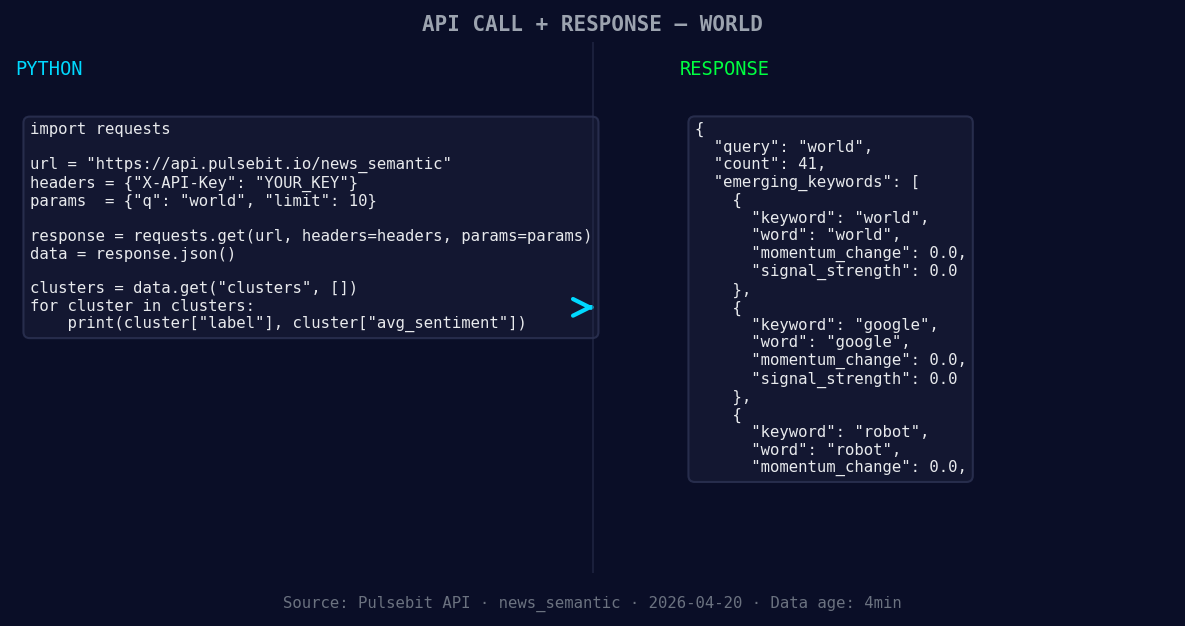
*Left: Python GET /news_semantic call for 'world'. Right: returned JSON response structure (clusters: 3). Source: Pulsebit /news_semantic.*
# Geographic origin filter: query by language/country
url = "https://api.pulsebit.com/your-endpoint"
params = {
"topic": topic,
"score": score,
"confidence": confidence,
"momentum": momentum,
"lang": "en" # Filter for English language articles
}
# Make the API call
response = requests.get(url, params=params)
data = response.json()
print(data)
Next, we want to analyze the narrative surrounding this spike further. Specifically, we’ll run the cluster reason string through the sentiment scoring endpoint to assess how the themes are framing public sentiment. Here’s how you can do that:
# Meta-sentiment moment: scoring the narrative framing itself
narrative = "Clustered by shared themes: robot, world, record, beijing, breaks."
sentiment_url = "https://api.pulsebit.com/sentiment"
sentiment_response = requests.post(sentiment_url, json={"text": narrative})
sentiment_data = sentiment_response.json()
print(sentiment_data)
By combining these two approaches, you can ensure that you’re not just catching sentiment shifts but also understanding the underlying narratives that are driving them.
Now, here are three specific builds we can create using this pattern:
- Spike Detector: Use the geographic filter to catch spikes in sentiment for "world" and "robot" topics, setting a threshold of momentum greater than +0.5. This can alert you to emerging trends in English-speaking regions before they hit the mainstream.

Geographic detection output for world. India leads with 32 articles and sentiment +0.27. Source: Pulsebit /news_recent geographic fields.
Narrative Insights Tool: Implement a loop using the meta-sentiment analysis to generate deeper insights on clustered narratives. For instance, analyze shifts around themes like "administration," "warms," and "IMF" versus the trending "world" and "robot" narratives.
Interactive Dashboard: Build a dashboard that visualizes these spikes and their corresponding narratives in real-time. Set alerts for when the sentiment score exceeds +0.02 with a confidence level above 0.85. This helps you stay ahead of the curve and react to shifting public sentiment quickly.
If you want to get started with these insights, visit our documentation at pulsebit.lojenterprise.com/docs. You can copy-paste the provided code snippets and be up and running in under 10 minutes. Don’t let your pipeline lag behind—stay ahead of the narrative!


Top comments (0)