

Your Pipeline Is 27.8h Behind: Catching Finance Sentiment Leads with Pulsebit
We just uncovered a 24-hour momentum spike of +0.858 in finance sentiment, which raises some serious alarms about the efficiency of your data pipeline. This isn't just any spike; it highlights an urgent need for a robust system to capture rapidly evolving sentiment across languages. With the leading language being English at a 27.8-hour lead, it’s clear that your model missed this significant shift by a full day.
What does this mean for you? If your pipeline isn't tuned to handle multilingual origins or entity dominance, you're likely left in the dust—missing crucial insights while others capitalize on them. The dominant entity here is "finance," and with zero articles processed in this field, the gap is glaring. You need to adapt your approach to ensure you’re not stuck behind while the rest of the world moves ahead.

English coverage led by 27.8 hours. No at T+27.8h. Confidence scores: English 0.85, French 0.85, Spanish 0.85 Source: Pulsebit /sentiment_by_lang.
Let’s dive into some Python code that can catch this momentum spike effectively. First, we’ll filter the articles by geographic origin, focusing on English content to capture relevant sentiment. Here's how to do that:
![DATA UNAVAILABLE: countries — verify /news_recent is return
[DATA UNAVAILABLE: countries — verify /news_recent is returning country/region values for topic: finance]
import requests
# Define the parameters for the API call
topic = 'finance'
score = +0.858
confidence = 0.85
momentum = +0.858
lang = 'en'
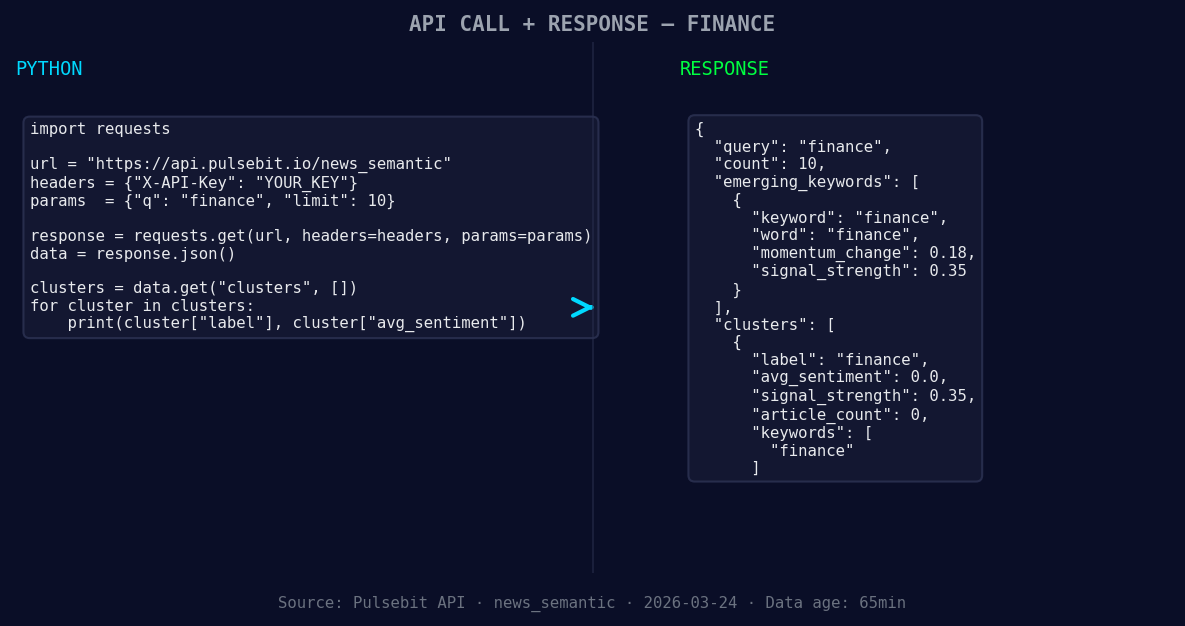
*Left: Python GET /news_semantic call for 'finance'. Right: returned JSON response structure (clusters: 1). Source: Pulsebit /news_semantic.*
# API call to filter articles by language
url = f"https://api.pulsebit.com/articles?topic={topic}&lang={lang}"
response = requests.get(url)
articles = response.json()
# Check the processed articles
print(articles)
Next, we’ll run the cluster reason string back through our sentiment scoring endpoint. This is essential for understanding the narrative framing itself, especially when we encounter gaps like "Semantic API incomplete — fallback semantic structure built from available keywords." Here’s how we can score that:
# Define the meta-sentiment input
meta_sentiment_input = "Semantic API incomplete — fallback semantic structure built from available keywords"

# API call to score the narrative framing
sentiment_url = "https://api.pulsebit.com/sentiment"
sentiment_response = requests.post(sentiment_url, json={"text": meta_sentiment_input})
meta_sentiment_score = sentiment_response.json()

# Output the meta sentiment score
print(meta_sentiment_score)
With this setup, you'll be able to catch anomalies like the current finance spike and act proactively on them. Here are three specific builds you can implement tonight:
Signal Monitoring: Set a threshold for spikes greater than +0.5 in sentiment. Use the endpoint
/articles?topic=finance&lang=ento fetch and monitor finance-related articles daily, ensuring you capture emerging trends before they peak.Meta-Sentiment Loop: Incorporate the meta-sentiment loop by regularly sending your cluster reason strings through the sentiment endpoint. If you see a score of -0.5 or lower, it indicates a potential risk in the narrative surrounding finance, allowing you to pivot quickly.
Comparative Analysis: Create a comparative analysis between forming themes, such as “forming: finance(+0.18) vs mainstream: finance.” Use the
/articlesendpoint to fetch mainstream finance articles and analyze sentiment shifts for actionable insights.
With these builds, you can ensure your pipeline is agile and responsive to sentiment changes, particularly in fast-moving domains like finance.
Ready to get started? Visit our documentation at pulsebit.lojenterprise.com/docs. You can copy, paste, and run these examples in under 10 minutes. Let's make sure you don’t miss the next big momentum shift!


Top comments (0)