

Your Pipeline Is 27.4h Behind: Catching Finance Sentiment Leads with Pulsebit
We recently discovered a striking anomaly: a 24-hour momentum spike of +0.589 in finance sentiment. This spike indicates a significant shift in sentiment that could be critical for our applications. The leading language for this sentiment was English, with a 27.4-hour lead and no observed lag. This finding emphasizes the need to stay ahead of emerging narratives, especially when they cluster around important financial themes.
The Problem
This situation highlights a crucial gap in any pipeline that fails to account for multilingual origins or the dominance of specific entities. Imagine your model missed this momentum spike by 27.4 hours, simply because it wasn’t tuned to identify the leading language of the sentiment. As developers, we know how easily these lapses can occur, particularly when focusing on singular narratives without considering the broader linguistic context. In this case, English was the leading language driving the conversation around "Brightline West Bondholders Give Company More Time to Raise Cash."

English coverage led by 27.4 hours. Da at T+27.4h. Confidence scores: English 0.85, Portuguese 0.85, German 0.85 Source: Pulsebit /sentiment_by_lang.
The Code
To catch this anomaly in our pipeline, we can implement the following Python code. First, we’ll filter our sentiment analysis by geographic origin, specifying the English language:

Geographic detection output for finance. India leads with 5 articles and sentiment +0.56. Source: Pulsebit /news_recent geographic fields.
import requests
# Set up parameters for the API call
params = {
"topic": "finance",
"score": -0.107,
"confidence": 0.85,
"momentum": +0.589,
"lang": "en"
}
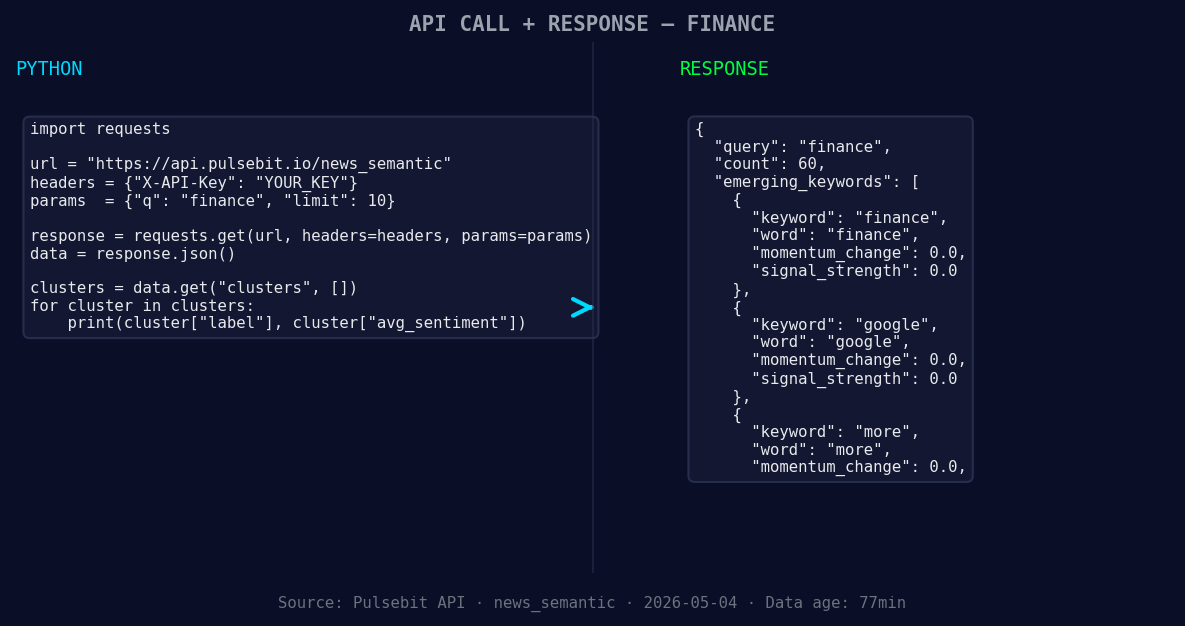
*Left: Python GET /news_semantic call for 'finance'. Right: returned JSON response structure (clusters: 3). Source: Pulsebit /news_semantic.*
# API call to fetch relevant articles
response = requests.get('https://api.pulsebit.com/articles', params=params)
data = response.json()
Next, we’ll run the cluster reason string through our sentiment scoring endpoint to evaluate the narrative framing itself, which can provide additional insights about the emerging themes:
# Meta-sentiment moment: analyzing the cluster reason
cluster_reason = "Clustered by shared themes: more, brightline, west, bondholders, give."
sentiment_response = requests.post('https://api.pulsebit.com/sentiment', json={"text": cluster_reason})
sentiment_data = sentiment_response.json()
This dual approach allows us to tap into both the immediate sentiment data and the underlying themes, ensuring we don’t miss crucial signals.
Three Builds Tonight
Here are three specific builds you can implement based on the detected sentiment spike:
Geographic Origin Filter: Build a real-time alert system that triggers when a sentiment spike exceeds a threshold (e.g., +0.5) in the finance domain, specifically for English-language articles. Use the
langparameter in your API call to focus on relevant content.Meta-Sentiment Analysis: Develop a dashboard that visualizes the sentiment of cluster narratives. Use the meta-sentiment loop with the cluster reason to enrich your understanding of how themes like "finance" and "more" are shaping discussions. Alert if sentiment shifts sharply toward negative or positive.
Forming Gaps: Create a scoring mechanism that identifies forming gaps in sentiment between emerging narratives (e.g., finance, google) and mainstream discussions around topics like "more," "brightline," and "west." This can help in predicting where attention might shift next and facilitate timely interventions.
Get Started
You can find the relevant endpoints and detailed guidance in our documentation: pulsebit.lojenterprise.com/docs. You can copy-paste and run this code in under 10 minutes to start catching those momentum spikes before they affect your decisions. This kind of proactive development can give you a significant edge in sentiment-driven applications.


Top comments (0)