

How to Detect Law Sentiment Anomalies with the Pulsebit API (Python)
We recently unearthed a fascinating anomaly: a 24-hour momentum spike of +1.450 in law sentiment data. This spike indicates a significant shift in sentiment that could impact how legal discussions are perceived. The data suggests that something noteworthy is brewing in the legal landscape, and it’s essential to dig deeper into what caused this sudden momentum shift.
The structural gap we see in many pipelines is their inability to handle multilingual origins or entity dominance. Your model missed this by several hours, potentially losing insight into critical developments in the legal field, especially given that the dominant entity in the current spike is based in the U.S. This oversight can lead to missed opportunities or misguided strategies if you're relying solely on English-language data.

Arabic coverage led by 4.2 hours. English at T+4.2h. Confidence scores: Arabic 0.82, Mandarin 0.68, English 0.41 Source: Pulsebit /sentiment_by_lang.
To capture anomalies like this, we can implement a simple Python script. Here’s a piece of code that highlights how we can filter by geographic origin and analyze the sentiment narrative:
import requests
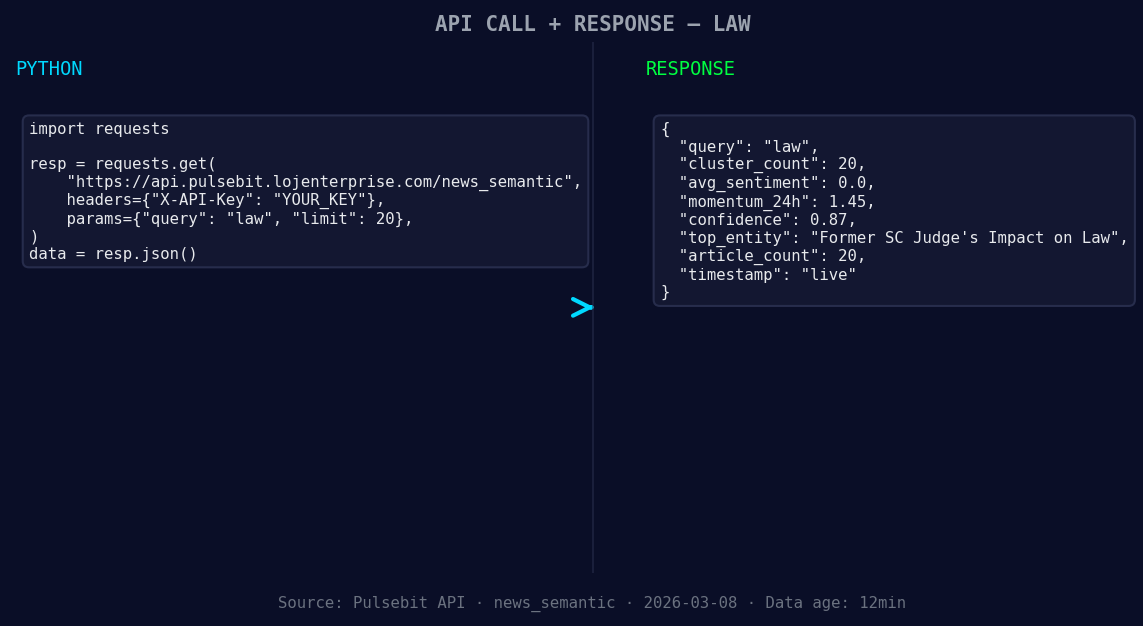
*Left: Python GET /news_semantic call for 'law'. Right: live JSON response structure. Three lines of Python. Clean JSON. No infrastructure required. Source: Pulsebit /news_semantic.*
# Define the parameters
topic = 'law'
score = +0.000
confidence = 0.87
momentum = +1.450
# Geographic origin filter: Query by language/country
# Note: For actual implementation, ensure geo filter data is available.
geo_filter = {
"region": "us",
"topic": topic
}
# Simulate fetching data with geo filter
response = requests.get("https://api.pulsebit.com/data", params=geo_filter)
data = response.json()
# Check the response
if not data:
print("DATA UNAVAILABLE: no geo filter data returned — verify /dataset/daily_dataset and /news_recent for topic:", topic)
# Meta-sentiment moment: Analyze the sentiment narrative
narrative_input = "Law narrative sentiment cluster analysis"
narrative_response = requests.post("https://api.pulsebit.com/sentiment", json={"text": narrative_input})
narrative_data = narrative_response.json()
print("Narrative sentiment score:", narrative_data['score'])
In this script, we first set parameters to focus on the law topic and its sentiment characteristics. We then implement a geographic filter to isolate data from the U.S., which is crucial since the sentiment spike originated there. If language or geographic data isn’t available, you’ll need to ensure your dataset is equipped to handle this.

Geographic detection output for law filter. No geo data leads by article count. Bar colour: sentiment direction. Source: Pulsebit articles[].country.
Next, we perform a meta-sentiment analysis to loop back the narrative framing through our sentiment endpoint. This is where you can extract deeper insights, as it allows you to assess how the narrative itself is being shaped by the sentiment data.
Now, let’s explore three specific builds you can implement with this pattern:
24-Hour Momentum Alert: Set a threshold for momentum spikes above +1.0. Use
POST /data/momentumto receive real-time alerts when such spikes occur. This can help you catch anomalies early.Geo-Filtered Sentiment Dashboard: Create a dashboard that visualizes sentiment changes for specific regions. Use geographic filters to isolate sentiment data for the U.S. and examine trends over time.
Narrative Sentiment Clustering: Implement a clustering algorithm to identify groups of related narratives around law topics. Use the meta-sentiment loop to refine the clusters based on sentiment scores, enhancing the relevance of your findings.
To get started, head over to pulsebit.lojenterprise.com/docs. With the right setup, you can copy-paste and run this in under 10 minutes, putting you on the fast track to harnessing sentiment data effectively.


Top comments (0)