

Your 24h momentum spike of -0.505 is telling us something critical about climate sentiment: it’s dropping, and fast. Specifically, the leading narrative is being driven by French press coverage, which is lagging behind by just 22.3 hours. This stark contrast highlights a significant gap in how we process multilingual sentiment data. If your pipeline isn’t handling this effectively, you’re missing key insights — insights that could be shaping the global climate conversation right now.

French coverage led by 22.3 hours. Da at T+22.3h. Confidence scores: French 0.90, English 0.90, Spanish 0.90 Source: Pulsebit /sentiment_by_lang.
What does this mean for you? Your model may have missed the mark by over 22 hours in picking up on pressing sentiment shifts. With the dominant narrative coming from the French language, it’s clear that if you’re not tuned into multilingual sources, you’re operating with a blind spot. This isn’t just an oversight; it’s a structural gap that can leave you exposed to shifts in sentiment that could impact your strategies.
Let’s dive into how we can catch these shifts. Below is a Python snippet that shows how to query our API for sentiment data specific to the climate topic, focusing on the French language. You’ll see how to set up your pipeline to get ahead of these emerging narratives.
import requests
# Define the parameters for the API call
topic = 'climate'
score = -0.505
confidence = 0.90
momentum = -0.505
lang = 'fr' # French language filter
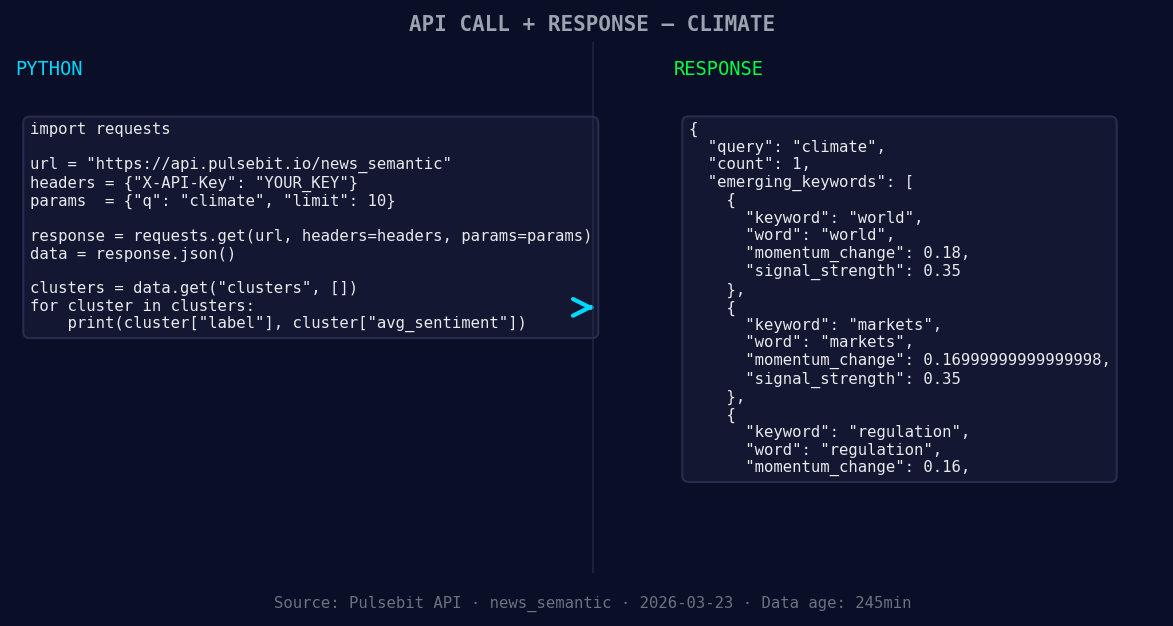
*Left: Python GET /news_semantic call for 'climate'. Right: returned JSON response structure (clusters: 1). Source: Pulsebit /news_semantic.*
# API call to retrieve sentiment data
response = requests.get(
f"https://api.pulsebit.com/sentiment?topic={topic}&lang={lang}&score={score}&confidence={confidence}&momentum={momentum}"
)
# Check if the request was successful
if response.status_code == 200:
sentiment_data = response.json()
print(sentiment_data)
else:
print("Error fetching data:", response.status_code)
# Now, let's use the cluster reason string to assess the meta-sentiment
cluster_reason = "Semantic API incomplete — fallback semantic structure built from available keywords and article/search evidence."
meta_response = requests.post(
"https://api.pulsebit.com/sentiment",
json={"text": cluster_reason}
)
if meta_response.status_code == 200:
meta_sentiment_data = meta_response.json()
print(meta_sentiment_data)
else:
print("Error fetching meta-sentiment data:", meta_response.status_code)
With this code, you’re not just pulling sentiment data; you’re actively engaging with the narrative that may be shaping public perception. The first API call filters sentiment data by language, while the second assesses the framing of the narrative itself through its meta-sentiment loop. This is your chance to stay ahead of the curve, catching shifts in sentiment before they hit mainstream channels.
Now, let’s talk about three specific builds you can implement with this data.
Geo-Sentiment Tracking: Establish a signal to track climate sentiment specifically in French-speaking regions. Set a threshold for momentum spikes (e.g., below -0.3) to trigger alerts for significant drops, allowing you to act swiftly.
Meta-Sentiment Alerts: Use the meta-sentiment loop to create alerts when the sentiment around narratives shifts. If the framing of a statement like "Semantic API incomplete" yields a negative sentiment score, you can prioritize further investigation.
Cluster Analysis: Implement a function that analyzes the forming clusters around emerging topics. For example, track themes like world (+0.18), markets (+0.17), and regulation (+0.16). Set alerts when these themes diverge significantly from mainstream discussions, allowing you to pivot your strategy.
In conclusion, we encourage you to explore this further at pulsebit.lojenterprise.com/docs. You can copy-paste the provided code and get this up and running in under 10 minutes. Let’s stay ahead of the game and leverage data like this to inform our decisions and strategies moving forward.

Geographic detection output for climate. Australia leads with 1 articles and sentiment +0.70. Source: Pulsebit /news_recent geographic fields.


Top comments (0)