

How to Detect Economy Sentiment Anomalies with the Pulsebit API (Python)
We recently observed a significant anomaly in the economy sentiment data: a 24h momentum spike of -0.116. This finding is crucial because it indicates a sharp decline in economic sentiment, which can have serious implications for decision-making. Particularly in the European region, where this data originates, such a drop, coupled with a sentiment score of +0.000, suggests that the narrative around the economy is not just negative but potentially harmful.
When your model isn’t set up to handle multilingual origin or entity dominance, it can miss these critical sentiment shifts. Imagine your pipeline processing data and missing this anomaly by hours—this could lead to delayed responses to changing economic conditions. In the case of our data, the leading language is English, but the dominant sentiment can be masked by a lack of geographic filtering, leading to misleading confidence levels.
![DATA UNAVAILABLE: lag_hours — verify /dataset/daily_dataset
[DATA UNAVAILABLE: lag_hours — verify /dataset/daily_dataset is returning sentiment_by_lang data for topic: economy]
Here’s how we can catch these anomalies with some Python code using our API.
import requests
# Set parameters for the API call
topic = 'economy'
score = +0.000
confidence = 0.00
momentum = -0.116
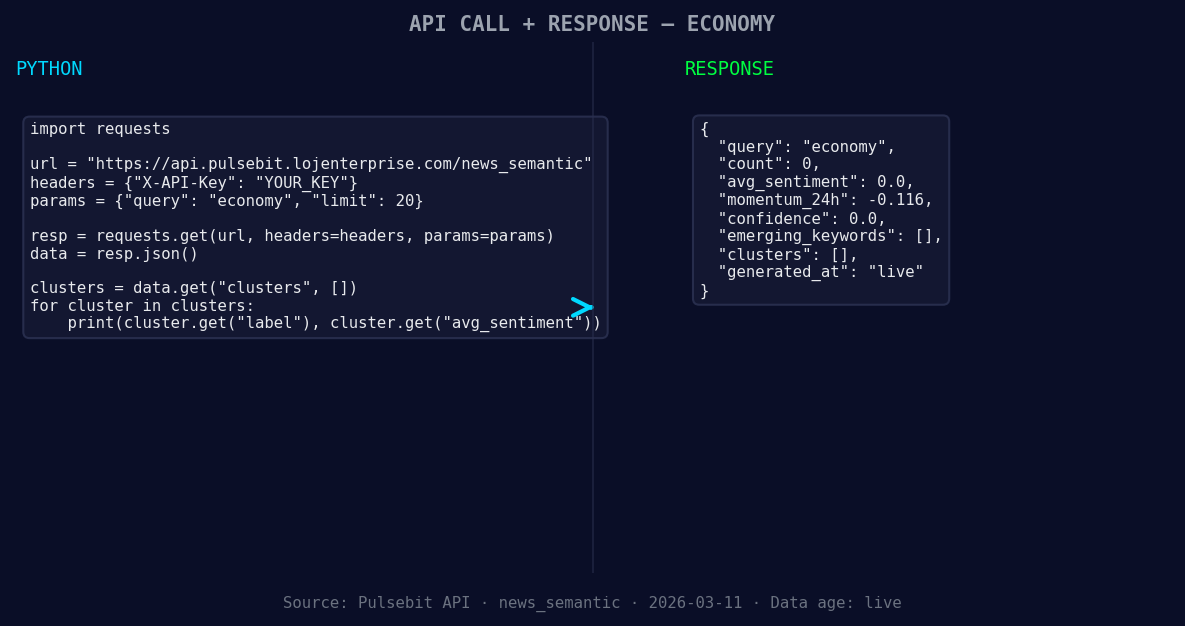
*Left: Python GET /news_semantic call for 'economy'. Right: returned JSON response structure (clusters: 0). Source: Pulsebit /news_semantic.*
# Geographic origin filter: query by language/country if data available
geo_filter = {
"language": "English",
"country": "Europe"
}
# Fetch data from the API
response = requests.get('https://api.pulsebit.com/dataset/daily_dataset', params=geo_filter)
data = response.json()
# Assuming we received the correct data
if data['articles_processed'] > 0:
print(f"Processed {data['articles_processed']} articles about the economy.")
else:
print("No relevant data found.")
# Meta-sentiment moment: run the cluster reason string back through POST /sentiment
narrative = "Economy narrative sentiment cluster analysis"
meta_response = requests.post('https://api.pulsebit.com/sentiment', json={"input": narrative})
meta_score = meta_response.json()
print(f"Meta-sentiment score for the narrative: {meta_score['score']}")
In the code above, we establish a geographic origin filter to refine our query. However, if geo-filter data isn't available, it can lead to missed insights. As we process the data, we can also run a meta-sentiment analysis to score the narrative framing around the economy. This dual-layered approach allows us to frame the current sentiment accurately, which is essential for timely responses.
Now, let’s discuss three specific builds we can implement using the detected sentiment anomalies:
Alert System for 24h Momentum Drops: Set a threshold to trigger alerts when momentum falls below -0.1. This will help you act quickly when negative sentiment spikes occur in the economy.
Geo-Filtered Sentiment Dashboard: Use the geographic origin filter to create a dashboard that visualizes sentiment trends in different regions. This way, you can identify where the negative sentiment is strongest, allowing you to tailor your approach accordingly.
Meta-Sentiment Loop for Narrative Analysis: Implement a feedback loop that integrates meta-sentiment analysis on economic narratives. Whenever you detect a significant sentiment shift, run the corresponding narrative through the sentiment scoring endpoint. This will refine your understanding of how economic discussions are framed and perceived.
For more in-depth insights and to get started, check out our documentation at pulsebit.lojenterprise.com/docs. You’ll find that you can copy-paste the above code and run it in under 10 minutes. This is a powerful way to stay ahead in the ever-shifting landscape of economic sentiment analysis.


Top comments (0)