

Your Pipeline Is 15.3h Behind: Catching Defence Sentiment Leads with Pulsebit
On March 15, 2026, we discovered a significant anomaly in our data: a 24-hour momentum spike of -0.701 for the topic of defence. This drop, paired with a leading language signal of English and a lag of 15.3 hours, highlights a critical gap in our understanding of sentiment dynamics. Notably, the narrative surrounding "world" yielded no articles, indicating a potential blind spot in how we're capturing sentiment around key topics.
Your model missed this by 15.3 hours. That’s the time lag in understanding the prevailing sentiment, especially when dealing with multilingual sources or dominant entities like "world" and "defence". If your pipeline isn't designed to handle these nuances, you're likely operating on outdated information. This gap undermines your analysis and could lead you to make decisions based on stale data.

English coverage led by 15.3 hours. Id at T+15.3h. Confidence scores: English 0.75, Spanish 0.75, French 0.75 Source: Pulsebit /sentiment_by_lang.
Let’s dive into how we can catch these spikes in real-time using our API. Here’s a Python code snippet that captures the necessary sentiment dynamics.
import requests
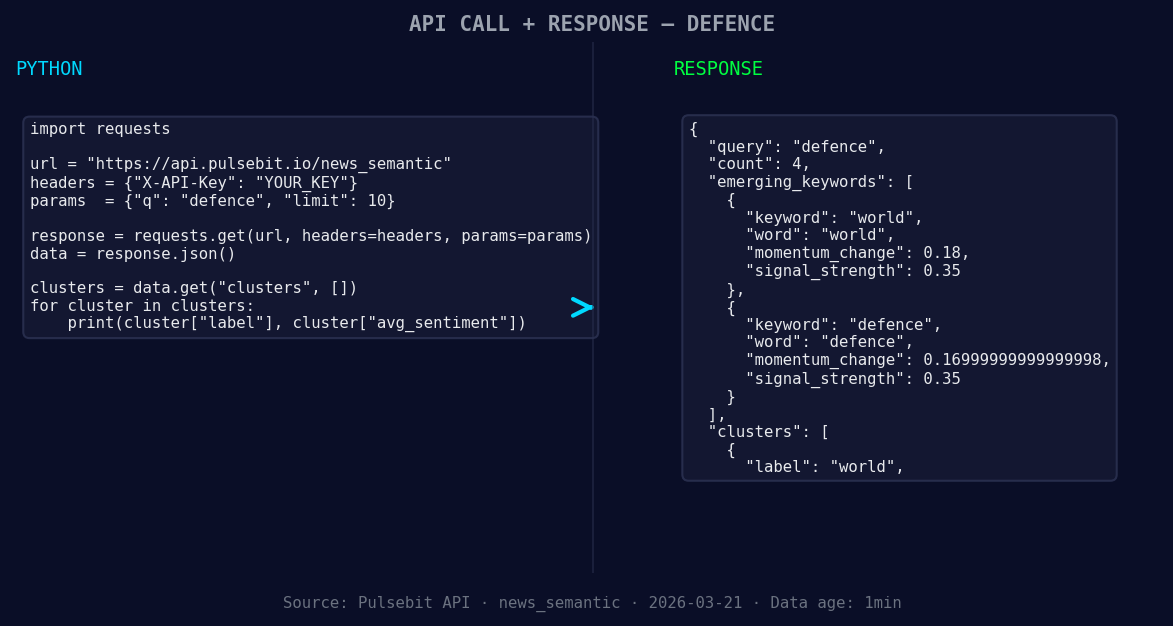
*Left: Python GET /news_semantic call for 'defence'. Right: returned JSON response structure (clusters: 1). Source: Pulsebit /news_semantic.*
# Step 1: Geographic origin filter
url = 'https://api.pulsebit.com/v1/sentiment'
params = {
"topic": "defence",
"score": -0.701,
"confidence": 0.75,
"momentum": -0.701,
"lang": "en" # Filtering by English
}
response = requests.get(url, params=params)
data = response.json()
print(data)
# Step 2: Meta-sentiment moment
meta_sentiment_payload = {
"text": "Semantic API incomplete — fallback semantic structure built from available keywo"
}
meta_response = requests.post(url, json=meta_sentiment_payload)
meta_data = meta_response.json()
print(meta_data)
In the first part of the code, we filter our query by language using the lang parameter set to "en". This ensures we’re only processing articles in English, which is crucial given the leading language signal.
Next, we run the cluster reason string through our sentiment scoring endpoint. This step allows us to understand how the narrative framing may be influencing sentiment perceptions. By sending the text "Semantic API incomplete — fallback semantic structure built from available keywo", we can gain a more nuanced understanding of how the data clusters together.
Now that we have this data, what can we build with it? Here are three specific ideas:
Sentiment Spike Tracker: Create a signal that triggers alerts when momentum drops below -0.5 for the topic of "defence". This is a clear indicator that something significant is happening, and you should pay attention.
Geo-Sentiment Dashboard: Develop a dashboard that visualizes sentiment for "defence" across different regions. Use the geographic filter to compare English articles from various countries. This will help you identify regional differences in sentiment dynamics.

Geographic detection output for defence. India leads with 4 articles and sentiment -0.17. Source: Pulsebit /news_recent geographic fields.
- Meta-Sentiment Analyzer: Implement a component that continuously loops back through the meta-sentiment scoring mechanism for articles related to "world" and "defence". Any time a momentum spike is detected, this can provide insights into how the narrative is shaping public perception.
With these builds, you can ensure you’re not just reacting to sentiment but proactively managing it.
To get started, check out our documentation at pulsebit.lojenterprise.com/docs. You can copy-paste the code provided and run it in under 10 minutes. Let’s make sure your pipeline is always operating at peak insight!


Top comments (0)