

Your Pipeline Is 29.0h Behind: Catching Renewable Energy Sentiment Leads with Pulsebit
We recently uncovered an intriguing anomaly: a 24-hour momentum spike of +0.264 in the realm of renewable energy. This spike indicates a significant shift in sentiment surrounding investment strategies in renewable energy, backed by a cluster of two relevant articles. The leading language for this sentiment is English, with a dominant 29.0-hour lead, suggesting a clear signal we need to act upon.
But here’s the catch: if your pipeline doesn’t account for multilingual origins or entity dominance, you might have missed this crucial insight by a staggering 29 hours. The dominant story is being driven by English-language articles, but what happens when you only focus on a single language or overlook emerging themes? Your model misses the mark, and you risk being outpaced by sentiment shifts that could influence strategic decisions in your investment portfolio.

English coverage led by 29.0 hours. Ca at T+29.0h. Confidence scores: English 0.85, Spanish 0.85, French 0.85 Source: Pulsebit /sentiment_by_lang.
Here’s how we can catch this spike programmatically using our API. First, we’ll filter the sentiment data by geographic origin, specifically targeting English-language content. The following Python code demonstrates how to do this:

Geographic detection output for renewable energy. India leads with 4 articles and sentiment +0.55. Source: Pulsebit /news_recent geographic fields.
import requests
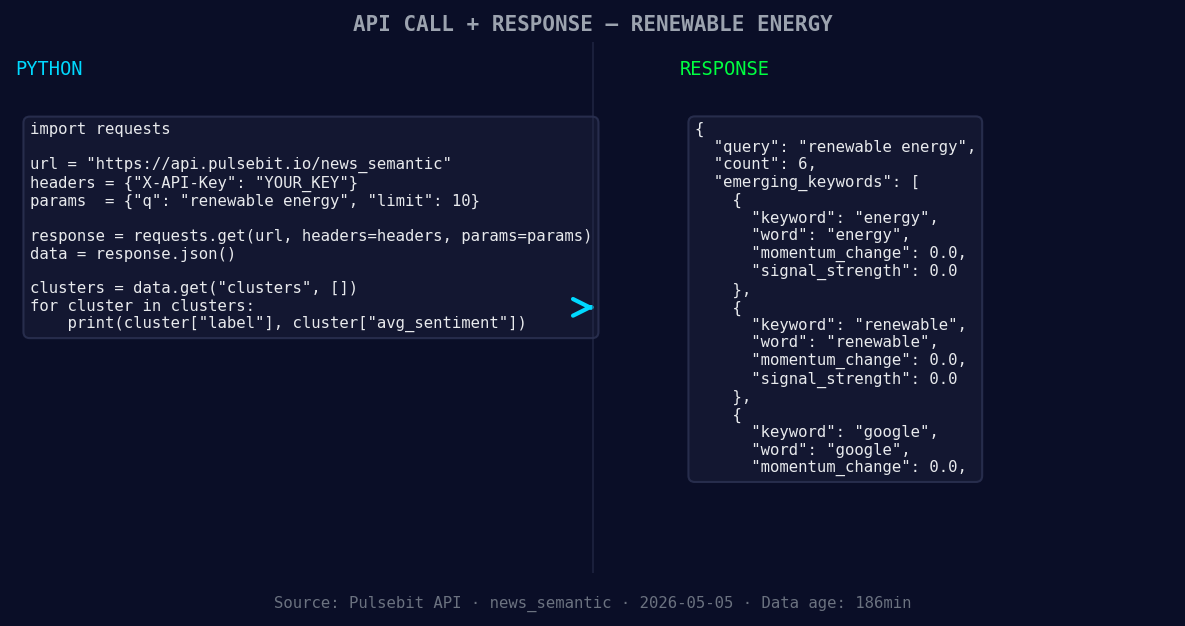
*Left: Python GET /news_semantic call for 'renewable energy'. Right: returned JSON response structure (clusters: 3). Source: Pulsebit /news_semantic.*
# Step 1: Geographic origin filter
url = "https://api.pulsebit.com/your_endpoint"
params = {
"topic": "renewable energy",
"lang": "en"
}
response = requests.get(url, params=params)
data = response.json()
# Step 2: Meta-sentiment moment
narrative = "Clustered by shared themes: energy, cheaper, need, more, renewable."
sentiment_url = "https://api.pulsebit.com/sentiment"
sentiment_response = requests.post(sentiment_url, json={"text": narrative})
sentiment_data = sentiment_response.json()
print(data)
print(sentiment_data)
In this example, we set our parameters to target "renewable energy" while filtering for English-language articles. We then use the narrative string derived from our cluster reason to get a sentiment score that reveals how the narrative itself is framing the conversation. This dual approach allows us to not just capture the sentiment but also assess how the narrative elements might influence future spikes.
Now, let's take this discovery a step further. We can build three specific signals:
Geo-Filtered Signal: Set a threshold for sentiment score. For instance, if we see a sentiment score above +0.730 for English-language articles in the renewable energy cluster, we trigger alerts for potential investment opportunities. This ensures you’re reacting to localized sentiment shifts.
Meta-Sentiment Loop: Create a monitoring endpoint that continuously feeds narratives like "Clustered by shared themes: energy, cheaper, need" back through our sentiment scoring system. This gives you real-time insights into how emerging themes of "energy" and "renewable" are being discussed compared to mainstream narratives.
Forming Gap Analysis: Implement a gap analysis that tracks themes like energy(+0.00), renewable(+0.00), and google(+0.00) against mainstream topics such as energy, cheaper, and need. If the forming gap exceeds a certain threshold (e.g., 0.1), it could indicate a ripe opportunity for investment strategies aligned with emerging trends.
By leveraging these patterns, you can ensure your models remain responsive to real-world shifts in sentiment and narrative, helping you stay ahead of the curve.
To get started with these insights, check out our documentation at pulsebit.lojenterprise.com/docs. You can copy-paste and run the above code in under 10 minutes, and start catching those sentiment leads that matter.


Top comments (0)