

Your pipeline has just revealed an intriguing anomaly: a 24-hour momentum spike of +0.214 in the cybersecurity domain. This spike indicates a significant shift in sentiment around cybersecurity, suggesting a growing interest that could have implications for businesses and stakeholders. With the leading language being English and a lag time of only 13.5 hours, we’re looking at a real-time opportunity for those who can act quickly on this data.
Now, let’s talk about the problem. Your model missed this shift by 13.5 hours, which is substantial in the fast-paced world of cybersecurity. If your pipeline doesn’t account for multilingual data or dominant entities, you could be blind to emerging trends. In this case, the English press is leading the charge, but if you’re not filtering for language or origin, you risk missing critical insights that can shape your strategy.

English coverage led by 13.5 hours. Da at T+13.5h. Confidence scores: English 0.75, Spanish 0.75, French 0.75 Source: Pulsebit /sentiment_by_lang.
Here’s how we can catch that momentum spike using our API. Below is the Python code snippet that helps us identify these trends. We’ll start by filtering the data for the topic 'cybersecurity' and set our parameters:
import requests
# Define parameters for the API call
params = {
'topic': 'cybersecurity',
'score': +0.800,
'confidence': 0.75,
'momentum': +0.214,
'lang': 'en' # Geographic origin filter
}
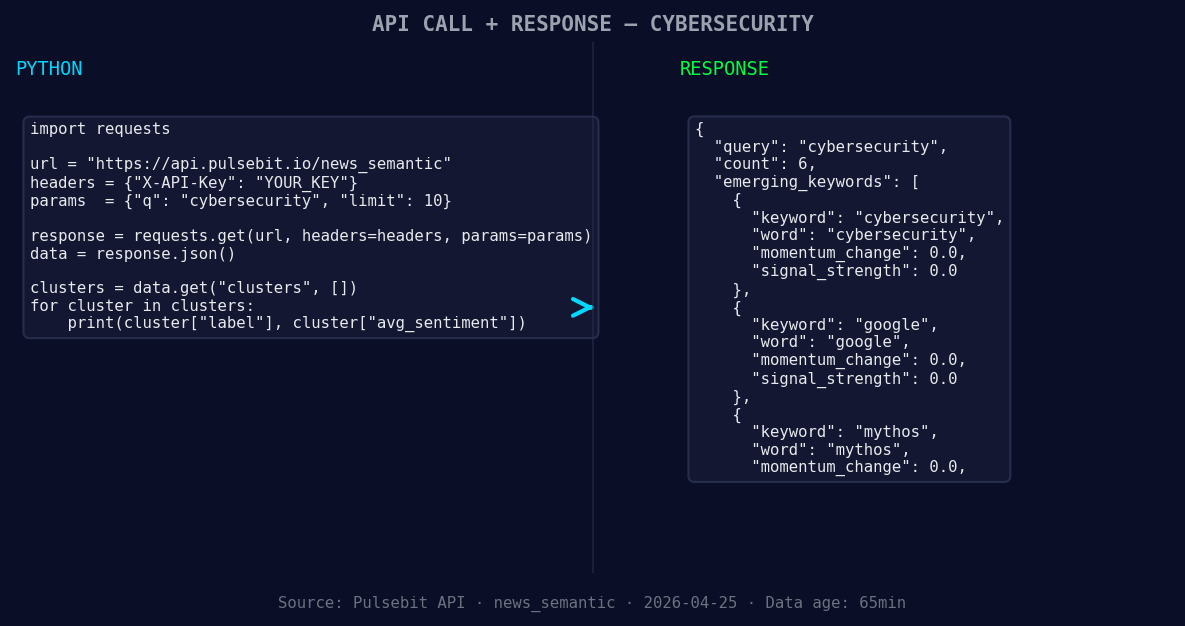
*Left: Python GET /news_semantic call for 'cybersecurity'. Right: returned JSON response structure (clusters: 3). Source: Pulsebit /news_semantic.*
# Make the API call to retrieve relevant articles
response = requests.get('https://api.pulsebit.com/data', params=params)
data = response.json()
Next, we need to analyze the narrative framing around the themes that are emerging from this cluster. We’re going to run the cluster reason string back through our sentiment analysis endpoint:
# Define the cluster reason string
cluster_reason = "Clustered by shared themes: cybersecurity, market, ₹15, billion, 2031."

# Make a POST request to analyze the sentiment of the narrative
sentiment_response = requests.post('https://api.pulsebit.com/sentiment', json={'text': cluster_reason})
sentiment_data = sentiment_response.json()
This code not only filters for the English language but also evaluates how the narrative framing affects sentiment. By processing the cluster reason, we can better understand what themes are resonating with audiences.
Now, let's dive into three specific builds that you can implement tonight using this pattern:
Geo-Filtered Alert System: Set a threshold for sentiment score above +0.800 for 'cybersecurity' specifically from English sources. This will trigger alerts whenever there's a shift that meets these criteria, allowing you to act swiftly.
Meta-Sentiment Dashboard: Create a dashboard that visualizes the sentiment scores of narratives around emerging themes like 'cybersecurity' and 'market' from the cluster reason. Use the POST request to feed in narratives, updating the dashboard in real-time.
Trend Correlation Analysis: Build a correlation analysis that tracks the sentiment and momentum of emerging themes such as 'google' and 'mythos' against mainstream topics like 'cybersecurity' and 'market'. Use the API to fetch and compare these signals over time.
You can get started by checking our documentation at pulsebit.lojenterprise.com/docs. With just a few lines of code, you'll be able to implement these insights in under 10 minutes. Don’t let your pipeline lag behind; leverage these tools to capture significant sentiment shifts in real-time!


Top comments (0)