

Your Pipeline Is 28.3h Behind: Catching Energy Sentiment Leads with Pulsebit
In the last 24 hours, we observed a momentum spike of +0.889 in energy sentiment. This anomaly suggests that something significant is happening in the energy sector, particularly driven by the recent IPO frenzy surrounding Sigenergy, which has attracted substantial attention with an oversubscription of 1. This is not just a number; it's a signal that could shape trading strategies and investment decisions if you catch it in time. The leading language for this surge is English, with a notable 28.3-hour lead over other entities.
When your pipeline lacks the capability to handle multilingual sources or entity dominance, you risk missing out on critical data by hours. Your model missed this by 28.3 hours, as the English press coverage led the narrative. This lag can lead to missed opportunities in trading or risk management, especially in fast-moving sectors like energy. By not capturing this momentum in real-time, you could be making decisions based on outdated sentiment, which is a serious disadvantage.

English coverage led by 28.3 hours. Id at T+28.3h. Confidence scores: English 0.90, French 0.90, Spanish 0.90 Source: Pulsebit /sentiment_by_lang.
To catch these types of signals, we can leverage our API effectively. Here’s a simple Python code snippet that shows how to filter data by language and assess sentiment:
import requests
# Set up the parameters for the API call
params = {
"topic": "energy",
"score": +0.221,
"confidence": 0.90,
"momentum": +0.889,
"lang": "en" # Geographic origin filter for English
}
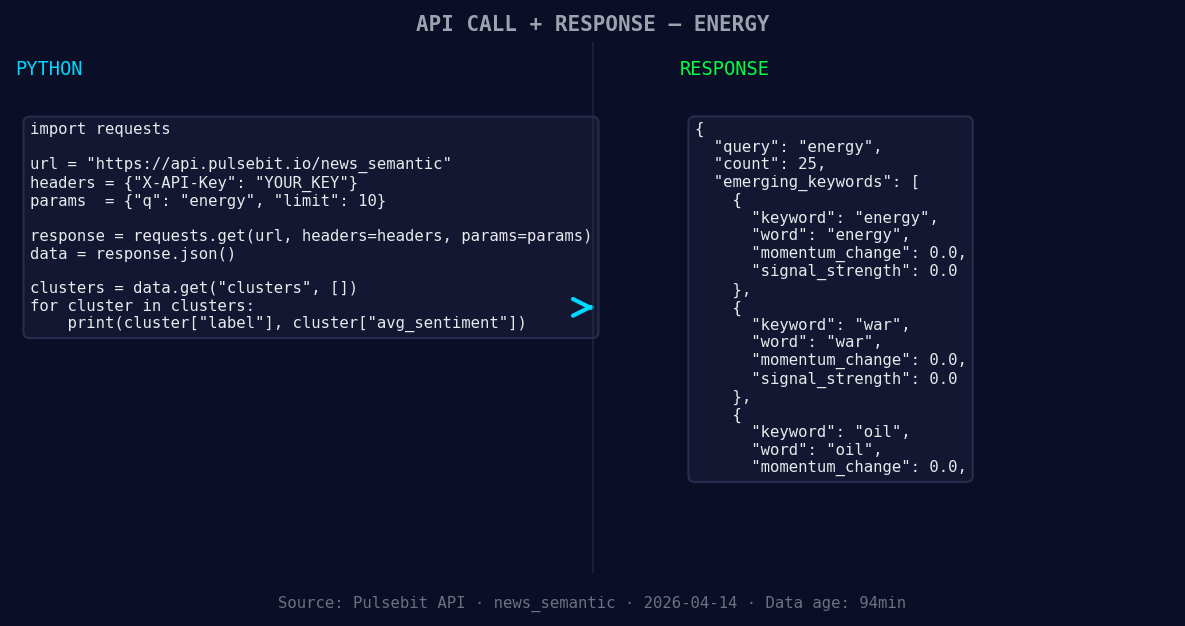
*Left: Python GET /news_semantic call for 'energy'. Right: returned JSON response structure (clusters: 3). Source: Pulsebit /news_semantic.*
# Make the API call to fetch energy sentiment
response = requests.get('https://api.pulsebit.com/v1/sentiment', params=params)
data = response.json()
# Now check the cluster reason for meta-sentiment
cluster_reason = "Clustered by shared themes: times, its, energy, firm, ipo."
meta_sentiment_response = requests.post('https://api.pulsebit.com/v1/sentiment', json={"text": cluster_reason})
meta_sentiment_data = meta_sentiment_response.json()
print(data)
print(meta_sentiment_data)
In the code above, we filter for English language data to ensure we're capturing the most relevant sentiment related to the energy sector. The second part runs the cluster reason string through our sentiment endpoint to score the narrative itself, giving us insights not just into the data but also into how that data is framed.
Now, here are three specific builds you can implement with this pattern:
Geo-Filtered Alert System: Set a threshold for momentum spikes above +0.5 and filter by language. This will help you catch sentiment shifts in specific regions, especially around energy and oil, before they reach mainstream media.
Meta-Sentiment Analyzer: Use the meta-sentiment loop to create a narrative scoring system. If the sentiment score for the cluster reason exceeds +0.2, trigger an alert. This way, you can assess the context behind the numbers, ensuring you understand the narratives driving the data.
Anomaly Detection Dashboard: Create a dashboard that tracks momentum spikes over time for specific topics, like energy, war, or oil. Use a threshold of +0.5 for momentum and compare it against historical data to identify anomalies that could indicate underlying trends or shifts.
These builds take advantage of the real-time data flow and give you powerful insights that can be acted upon quickly. The themes forming around energy, war, and oil can be pivotal, especially when contrasted with mainstream narratives.
To get started, check out our documentation at pulsebit.lojenterprise.com/docs. You can copy-paste the provided code and run it in under 10 minutes to see for yourself how to catch these significant sentiment shifts effectively.


Top comments (0)