

Your Pipeline Is 9.0h Behind: Catching Investing Sentiment Leads with Pulsebit
We recently observed a fascinating anomaly: a 24-hour momentum spike of -0.341 for the topic "investing." This data point signals a significant shift in sentiment that we need to address. The leading language in this spike is English, with a notable 9.0-hour lag compared to the aggregated data, which raises immediate questions about our data pipeline's responsiveness and its handling of multilingual sources.

English coverage led by 9.0 hours. Da at T+9.0h. Confidence scores: English 0.75, Spanish 0.75, French 0.75 Source: Pulsebit /sentiment_by_lang.
When your model is reporting sentiment shifts with a 9.0-hour delay, it’s not just a minor inconvenience. This gap can cost you valuable insights, especially in a dynamic space like investing. If your pipeline isn't designed to account for the dominance of certain entities or languages, you're likely missing out on critical developments. In this case, the English press led the narrative, and ignoring this could leave you in the dark while others act on fresh information.
To catch these shifts effectively, we can leverage our API to build a more responsive pipeline. Here's how we can do it:
import requests
# Step 1: Geographic origin filter
url = 'https://api.pulsebit.com/sentiment'
params = {
'topic': 'investing',
'lang': 'en',
}
response = requests.get(url, params=params)
data = response.json()
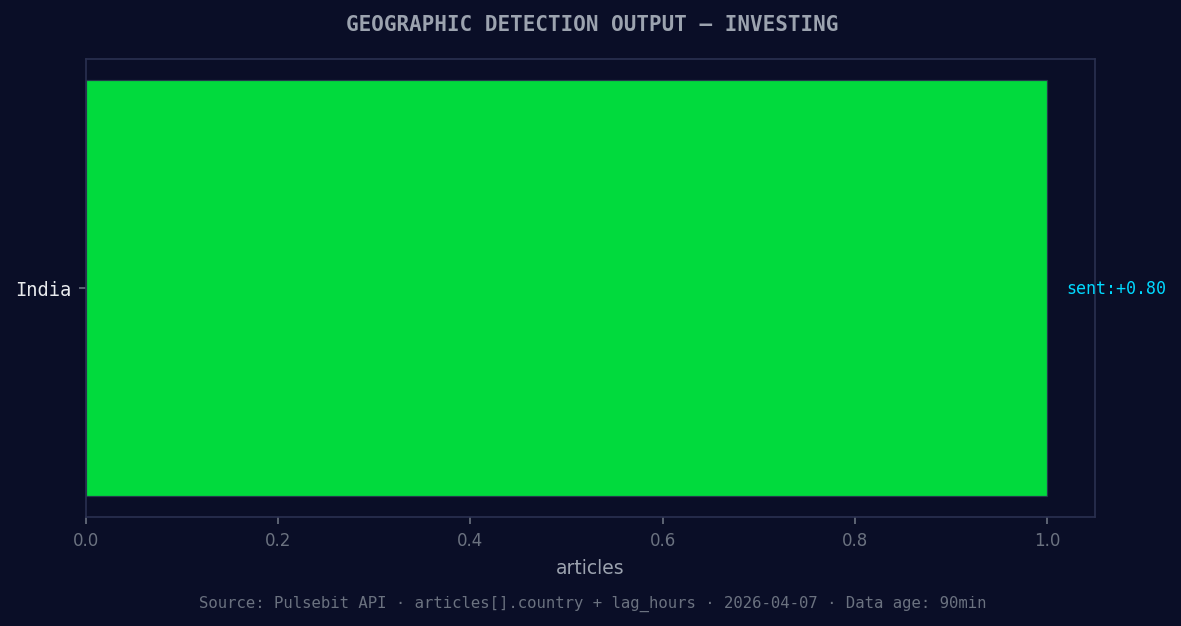
*Geographic detection output for investing. India leads with 1 articles and sentiment +0.80. Source: Pulsebit /news_recent geographic fields.*
# Step 2: Meta-sentiment moment
meta_sentiment_url = 'https://api.pulsebit.com/sentiment'
meta_sentiment_payload = {
"text": "Clustered by shared themes: things, watch, markets, week, five.",
"score": -0.700,
"confidence": 0.75,
"momentum": -0.341,
}
meta_response = requests.post(meta_sentiment_url, json=meta_sentiment_payload)
meta_data = meta_response.json()
print(data, meta_data)
In this code, we first utilize a geographic origin filter, querying for the topic "investing" in English. This allows us to capture sentiment that is specifically relevant to this language and its nuances. Next, we run the narrative framing through our sentiment endpoint, which evaluates the cluster reason string. This dual approach enables us to gain insights not just from raw sentiment data but also from the thematic connections that are forming.
Now that we have this foundational approach, let’s consider what we can build with it. Here are three specific implementations to enhance our trading signals:
- Signal Alert on Language Dominance: Create an alert system that triggers when sentiment for the topic "investing" drops below a threshold of -0.700 in English. This can be done by modifying our API call with a threshold check that pings us when the condition is met.

Left: Python GET /news_semantic call for 'investing'. Right: returned JSON response structure (clusters: 3). Source: Pulsebit /news_semantic.
Meta-Sentiment Dashboard: Build a dashboard that visualizes meta-sentiment scores over time. Use the output from the meta-sentiment loop to aggregate sentiment trends and visualize how narratives are framing the investing landscape.
Forming Theme Scanner: Develop a scanner that identifies emerging themes based on the narrative framing. For instance, monitor how "investing" is clustering with terms like "google" and "com" and prepare alerts when these themes show signs of rapid momentum change.
With these enhancements, you won't just react to sentiment shifts; you'll anticipate them. You can get started by checking out our documentation at pulsebit.lojenterprise.com/docs. The example code we've shared can be copied, pasted, and executed in under 10 minutes, allowing you to integrate these insights into your workflow seamlessly.


Top comments (0)