

Your 24-hour momentum spike of +0.204 in sentiment around the topic "cloud" is a striking anomaly that demands your attention. With the leading language being English, driven by a cluster story titled "AI PCs Becoming Standard with Mainstream Pricing," we see how quickly the narrative is evolving. The data highlights a shift in sentiment that you simply cannot ignore if you want to stay ahead in your analysis.
The problem here is clear: your model might have missed this by a hefty 29.4 hours. When you fail to account for multilingual origins and the dominance of specific entities, you risk being outpaced by crucial developments. In this case, the sentiment surrounding cloud technology is rapidly shifting, while your pipeline hasn’t even registered the change. The leading entity, English press, has been leading the conversation, but without proper handling of these dynamics, you’re left in the dust.

English coverage led by 29.4 hours. No at T+29.4h. Confidence scores: English 0.80, Spanish 0.80, French 0.80 Source: Pulsebit /sentiment_by_lang.
To catch the latest trends, we can utilize a straightforward Python script that taps into our API. Here's how you can do it:
import requests
# Define parameters for the API call
topic = 'cloud'
score = +0.800
confidence = 0.80
momentum = +0.204
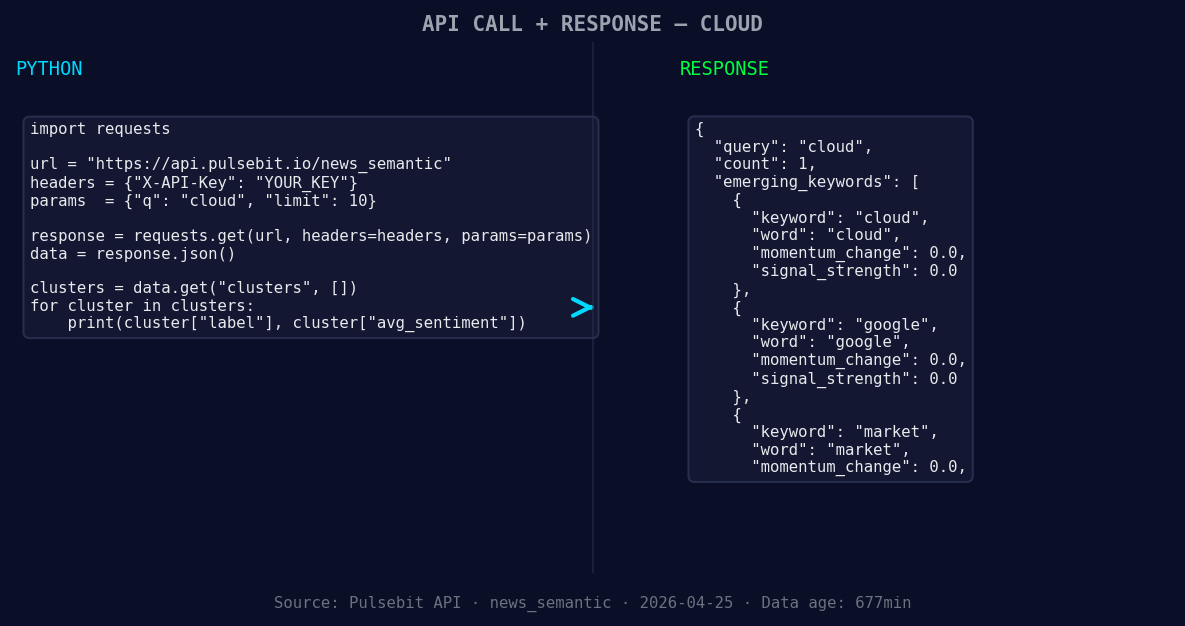
*Left: Python GET /news_semantic call for 'cloud'. Right: returned JSON response structure (clusters: 3). Source: Pulsebit /news_semantic.*
# Geographic origin filter: query by language
url = "https://api.pulsebit.lojenterprise.com/topics"
params = {
"topic": topic,
"lang": "en",
"momentum": momentum
}
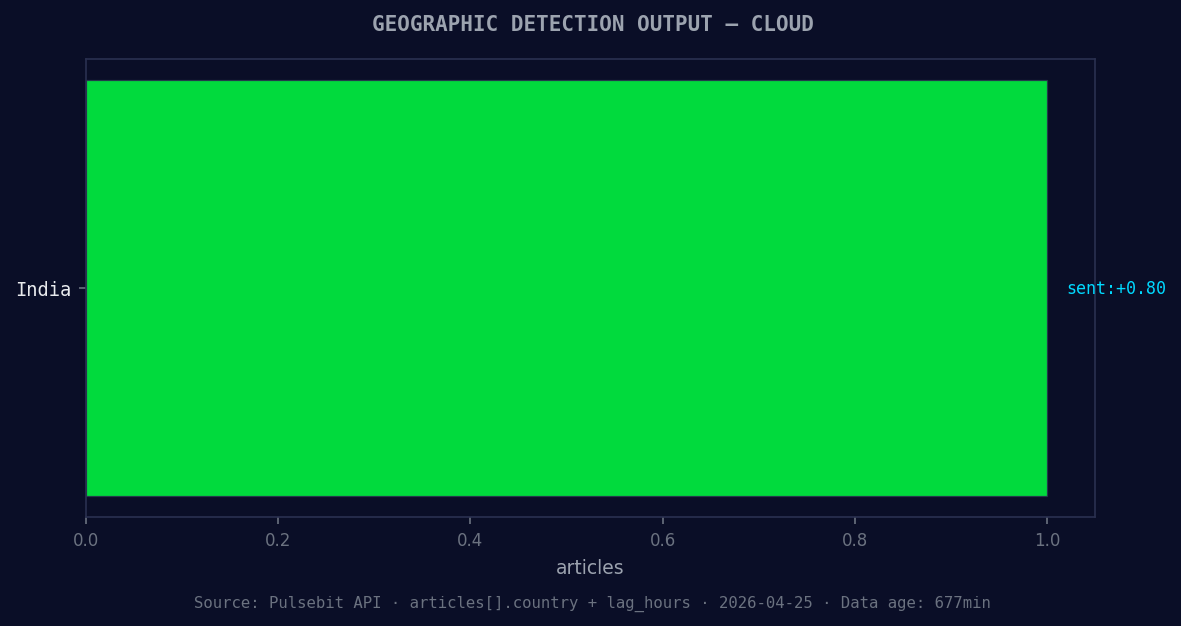
*Geographic detection output for cloud. India leads with 1 articles and sentiment +0.80. Source: Pulsebit /news_recent geographic fields.*
# Make the API call
response = requests.get(url, params=params)
data = response.json()
# Run the cluster reason string through POST /sentiment
cluster_reason = "Clustered by shared themes: pcs, will, become, standard, pricing."
sentiment_url = "https://api.pulsebit.lojenterprise.com/sentiment"
sentiment_response = requests.post(sentiment_url, json={"text": cluster_reason})
sentiment_data = sentiment_response.json()
print(data)
print(sentiment_data)
In this code, we filter our API call by the English language to capture relevant sentiment data. Then, we send the narrative framing of the cluster back through the sentiment scoring endpoint, allowing us to understand the context in which this spike is occurring.
Now, let’s discuss three specific builds you can implement tonight, taking advantage of this momentum spike:
Geo-Filtered Alert System: Set up an alert that triggers when the momentum for the topic "cloud" exceeds a threshold of +0.200, filtering specifically for English language articles. This ensures that you’re immediately notified about significant shifts.
Meta-Sentiment Dashboard: Create a dashboard that visualizes the sentiment score derived from the narrative framing—like "Clustered by shared themes: pcs, will, become, standard, pricing." This would help you track how narrative themes develop in relation to sentiment scores over time.
Cloud Sentiment Trend Analysis: Implement a script that continuously monitors the sentiment on "cloud" and related topics like "Google" or "market." Use the POST /sentiment endpoint to analyze how shifts in sentiment correlate with the forming themes, allowing you to anticipate market movements more accurately.
To get started, check out our documentation at pulsebit.lojenterprise.com/docs. You can copy-paste the above code and have it running in under 10 minutes. Don't let your pipeline stay 29.4 hours behind; capitalize on these insights for your next development sprint.


Top comments (0)