

Your Pipeline Is 27.8h Behind: Catching Economy Sentiment Leads with Pulsebit
We recently stumbled upon a striking anomaly in our sentiment analysis: a 24-hour momentum spike of +0.330. This spike is particularly intriguing because it highlights a significant shift in sentiment around the topic of economy, which is currently clustered in discussions led by English press articles. With the leading language showing a 27.8-hour lead over the rest of the conversation, this is a clear indication that our systems need to adapt quickly to handle such discrepancies.
Many developers like us often rely on sentiment data to inform decision-making. However, if your pipeline isn't set up to handle multilingual origins or entity dominance, you might find yourself lagging behind. In this case, your model missed crucial insights about the economy by a staggering 27.8 hours. The leading language here is English, and the dominant narrative is being shaped by discussions surrounding the IMF and global economic challenges.

English coverage led by 27.8 hours. Ro at T+27.8h. Confidence scores: English 0.80, Spanish 0.80, French 0.80 Source: Pulsebit /sentiment_by_lang.
To catch this momentum spike, we can leverage our API effectively. Here’s how you can do it with a simple Python snippet:
import requests
# Set your parameters
topic = 'economy'
score = -0.125
confidence = 0.80
momentum = +0.330
# Geographic origin filter: query by language/country
url = "https://api.pulsebit.com/sentiment"
params = {
"topic": topic,
"lang": "en",
"score": score,
"confidence": confidence,
"momentum": momentum
}
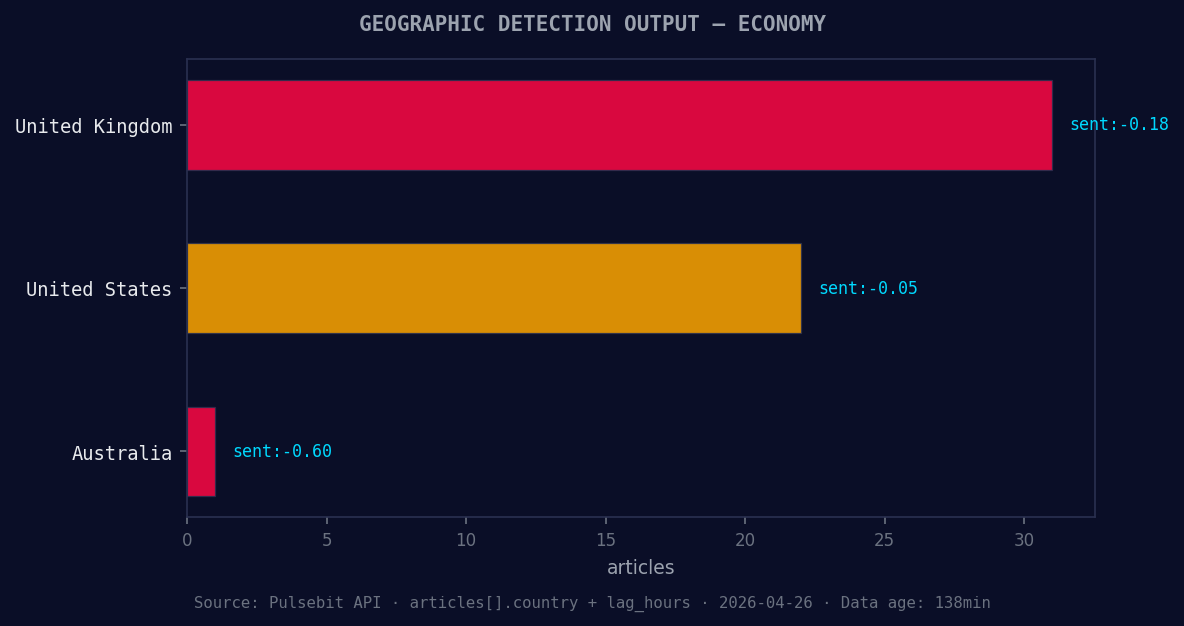
*Geographic detection output for economy. United Kingdom leads with 31 articles and sentiment -0.18. Source: Pulsebit /news_recent geographic fields.*
# Make the API call
response = requests.get(url, params=params)
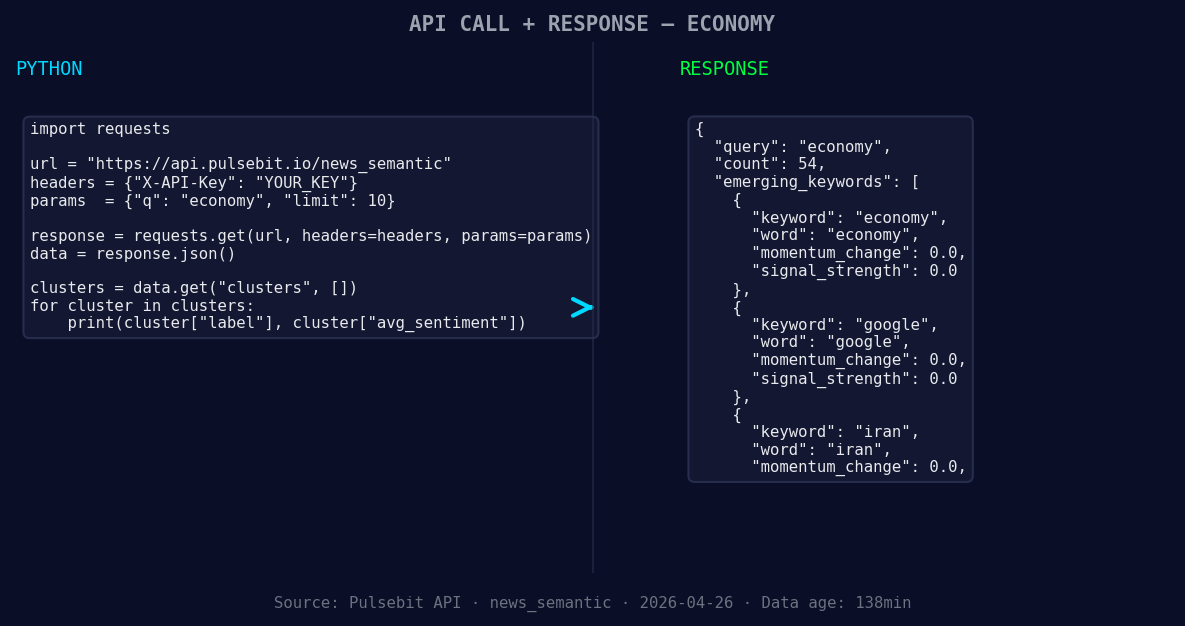
*Left: Python GET /news_semantic call for 'economy'. Right: returned JSON response structure (clusters: 3). Source: Pulsebit /news_semantic.*
# Print the response
print(response.json())
Next, we want to dive deeper into the narrative framing itself. The reason string associated with our cluster is: "Clustered by shared themes: imf, world’s, its, same, says." We can run this through our sentiment analysis endpoint to get a better understanding of how it’s being perceived:
# Meta-sentiment moment: run the cluster reason string through POST /sentiment
cluster_reason = "Clustered by shared themes: imf, world’s, its, same, says."
response = requests.post(url, json={"text": cluster_reason})

# Print the sentiment score for the narrative framing
print(response.json())
With these two calls, we can track the momentum effectively and understand the underlying narratives shaping the economy sentiment.
Now let's talk about three specific builds you can create using this pattern:
Geo-Filtered Sentiment Dashboard: Build a real-time dashboard that uses the geo filter to visualize sentiment shifts in the economy. Set a threshold of momentum greater than +0.200 to trigger alerts for significant spikes.
Meta-Sentiment Tracker: Create a background service that continuously polls the meta-sentiment endpoint using the cluster reason strings. This service can aggregate scores and provide a daily summary of narrative shifts in economic discussions, focusing on terms like "imf" and "world’s."
Comparison Alerts: Implement a routine that compares the current sentiment scores of forming topics like "economy," "google," and "iran" against the mainstream narratives. If any of these scores deviate by more than 0.100 from the mainstream cluster, trigger a notification for further investigation.
By implementing these builds, we can ensure that our systems are agile enough to catch sentiment leads and react accordingly to emerging trends.
To get started, visit our documentation at pulsebit.lojenterprise.com/docs. You can copy-paste the provided code and run this in under 10 minutes. Don’t let your models lag behind!


Top comments (0)