

Your pipeline is 9.0h behind: catching world sentiment leads with Pulsebit
Our latest discovery revealed a remarkable 24-hour momentum spike of +0.703, fueled by Spanish press coverage. The leading story, "AI wins have Alphabet poised to become world’s biggest company" from Fortune, drove this surge, clustering around themes of wins, have, alphabet, poised, and become. It's a clear example of how sentiment can shift rapidly based on emerging narratives, and if you're not tuned into multilingual sources, you might just miss it.

Spanish coverage led by 9.0 hours. Id at T+9.0h. Confidence scores: Spanish 0.75, French 0.75, English 0.75 Source: Pulsebit /sentiment_by_lang.
If your model isn't designed to handle multilingual entities or track dominant narratives, it likely missed this spike by a staggering 9 hours. That's a significant gap in your ability to respond to emerging trends. In this case, the Spanish language led the charge, and if your pipeline only processes English or fails to factor in entity dominance, you're operating at a distinct disadvantage. Time is of the essence in sentiment analysis, and being late to the party can cost you valuable insights.
To help you catch these signals, here’s how you can leverage our API to stay ahead. First, we’ll filter for the Spanish language with the topic "world." Here’s the code that makes this happen:
import requests
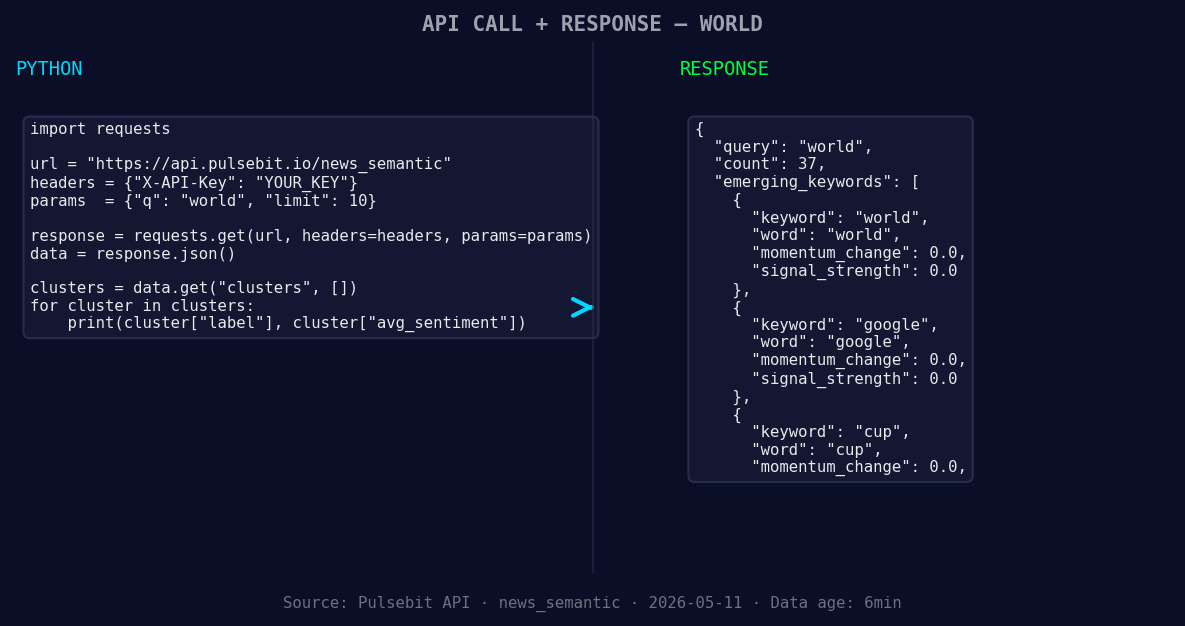
*Left: Python GET /news_semantic call for 'world'. Right: returned JSON response structure (clusters: 3). Source: Pulsebit /news_semantic.*
# Step 1: Geographic origin filter
url = "https://api.pulsebit.com/v1/sentiment"
params = {
"lang": "sp",
"topic": "world",
"score": +0.079,
"confidence": 0.75,
"momentum": +0.703
}
response = requests.get(url, params=params)
data = response.json()
print(data)
Next, we want to analyze the narrative framing itself. We can run the cluster reason string back through our sentiment endpoint to score it:
# Step 2: Meta-sentiment moment
cluster_reason = "Clustered by shared themes: wins, have, alphabet, poised, become."
meta_sentiment_url = "https://api.pulsebit.com/v1/sentiment"

meta_sentiment_response = requests.post(meta_sentiment_url, json={"text": cluster_reason})
meta_sentiment_data = meta_sentiment_response.json()
print(meta_sentiment_data)
This snippet captures both the geographic origin and the meta-sentiment surrounding the emerging narrative. By harnessing these insights, we can better predict sentiment shifts and respond proactively.
Now that we’ve harnessed this pattern, here are three specific builds you should consider implementing tonight:
- Real-Time Alert System: Set a threshold for a momentum spike greater than +0.500 using the geographic filter. This allows you to catch emerging trends in Spanish-speaking regions before they hit mainstream coverage.

Geographic detection output for world. India leads with 27 articles and sentiment +0.05. Source: Pulsebit /news_recent geographic fields.
Narrative Scoring Dashboard: Build a dashboard that continuously monitors meta-sentiment around key narratives like "world", "google", and "cup". Use a threshold score of +0.070 to trigger alerts if narratives trend positively, indicating growing sentiment that could lead to future developments.
Cluster Analysis Visualization: Leverage the cluster data to visualize themes over time. Focus on the keywords forming around "wins", "have", and "alphabet". Set your visualization parameters to highlight shifts when articles cross a threshold of 10 articles processed.
These builds will empower you to react swiftly to sentiment shifts, ensuring you’re never left behind in interpreting the narrative landscape.
If you’re ready to dive in, check out our documentation at pulsebit.lojenterprise.com/docs. You can copy, paste, and run this code in under 10 minutes to start catching those critical sentiment leads.


Top comments (0)