

Your pipeline just uncovered an intriguing anomaly: a 24-hour momentum spike of -0.344 related to renewable energy sentiment. This is significant. What’s more, the leading language in this spike is English, with press coverage peaking at 14.0 hours ahead. This suggests that while your model may be processing information, it’s lagging behind in capturing emerging narratives around renewable energy and connectivity.
When your model isn't equipped to handle multilingual origins or entity dominance, it risks missing out on critical trends. In this case, your model missed this shift by 14.0 hours. With English press leading the charge, this is an oversight that could cost you valuable insights. If you're focusing solely on dominant entities, you may miss the nuanced sentiment emerging from other languages or sources.

English coverage led by 14.0 hours. Ro at T+14.0h. Confidence scores: English 0.70, Spanish 0.70, French 0.70 Source: Pulsebit /sentiment_by_lang.
To catch this momentum spike, we can leverage our API to analyze the sentiment surrounding renewable energy. Below is the Python code that does just that:
import requests
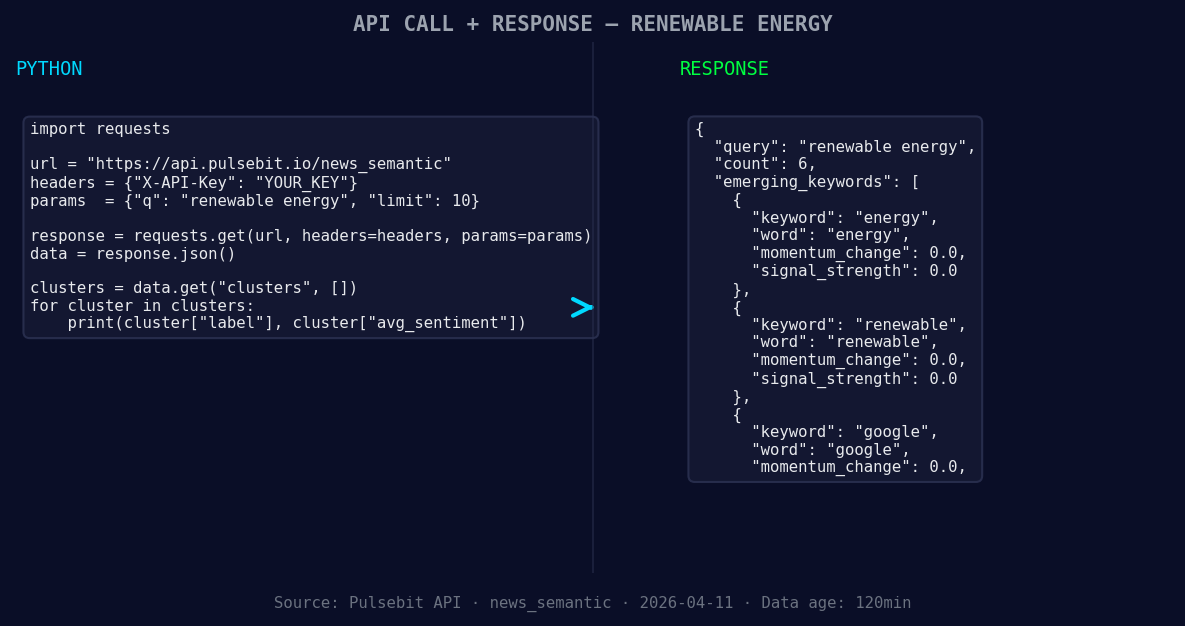
*Left: Python GET /news_semantic call for 'renewable energy'. Right: returned JSON response structure (clusters: 3). Source: Pulsebit /news_semantic.*
# Define the topic and its parameters
topic = 'renewable energy'
score = +0.267
confidence = 0.70
momentum = -0.344
# Geographic origin filter
api_url = "https://api.pulsebit.com/sentiment"
params = {
"topic": topic,
"lang": "en" # Filtering for English language
}
response = requests.get(api_url, params=params)
data = response.json()
# Meta-sentiment moment
cluster_reason = "Clustered by shared themes: energy, not, threat, oil, says."
meta_sentiment_response = requests.post(api_url, json={"text": cluster_reason})
meta_sentiment_data = meta_sentiment_response.json()
print("Sentiment Data:", data)
print("Meta Sentiment Data:", meta_sentiment_data)
This code snippet performs two critical operations: it first filters the sentiment data for renewable energy based on the English language, ensuring we capture relevant discussions. Then, it runs the cluster reason string through our sentiment analysis endpoint, scoring the narrative framing itself. This dual approach helps us understand not just the sentiment score but the context in which these sentiments are formed.
Here are three specific builds we can create using this pattern:
- Geo-Filtered Alert System: Set up a monitor that alerts you when sentiment around “renewable energy” falls below a score of +0.200 in English-speaking regions. Use the geographic filter from our API to ensure you're capturing timely shifts based on language and location.

Geographic detection output for renewable energy. India leads with 4 articles and sentiment +0.24. Source: Pulsebit /news_recent geographic fields.
Meta-Sentiment Analysis Dashboard: Build a dashboard that visualizes the changing narratives around energy. Use the meta-sentiment loop to dynamically score themes like "energy, not, threat" as they evolve. This will give you insights into how perceptions shift in real-time.
Comprehensive Sentiment Report: Automate the generation of weekly reports that summarize sentiment scores for topics like renewable energy against mainstream narratives. Use the forming themes to provide context, helping stakeholders understand not just what is being said, but how it contrasts with prevailing sentiments.
To dive deeper into how to implement these features, check out our documentation at pulsebit.lojenterprise.com/docs. With the provided code and guidance, you can copy-paste and run this in under 10 minutes, making your sentiment analysis pipeline more robust and responsive.


Top comments (0)