

Your Pipeline Is 28.3h Behind: Catching Business Sentiment Leads with Pulsebit
We just uncovered a fascinating anomaly in the sentiment data: a 24-hour momentum spike of -0.587 in the business sector. What’s more intriguing is that the English press is leading this conversation with a 28.3-hour head start. In a world driven by rapid information flows, this lag is a wake-up call for anyone relying on sentiment analysis without considering multilingual origins or entity dominance. The narrative shaping around this topic is crucial, especially as we see the cluster story titled "How Undergraduate Business Education Is Evolving For Real-World Impact" surfacing.

English coverage led by 28.3 hours. Sv at T+28.3h. Confidence scores: English 0.90, Spanish 0.90, French 0.90 Source: Pulsebit /sentiment_by_lang.
The Problem
Your model missed this by 28.3 hours. When you ignore the nuances of multilingual content or the dominance of certain narratives, you risk falling behind critical sentiment shifts. In this case, the English press is leading, yet your pipeline may only be focused on mainstream narratives, potentially skewing your analysis. By failing to account for this, you might miss out on key insights that could inform your strategy. The dominant entity of "undergraduate business education" is emerging, but are you ready to seize that insight before it becomes stale?
The Code
Let’s jump into how we can catch this sentiment shift using our API. First, we’ll filter the data by geographic origin to focus on English content specifically.
Here’s how we can do that in Python:
import requests
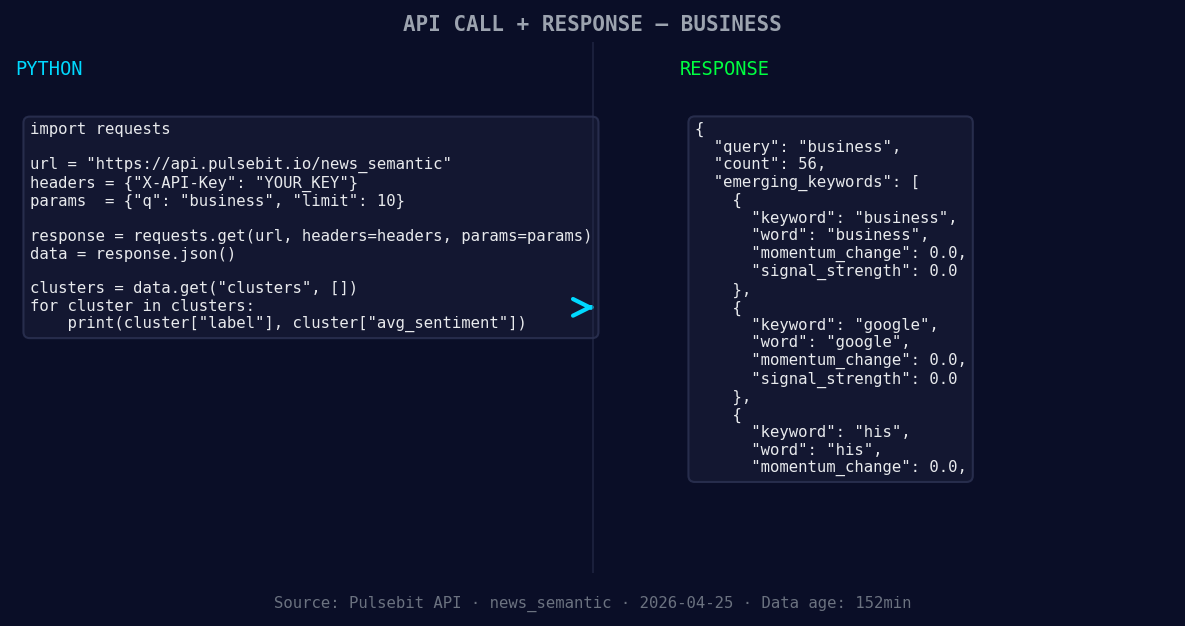
*Left: Python GET /news_semantic call for 'business'. Right: returned JSON response structure (clusters: 3). Source: Pulsebit /news_semantic.*
# Define parameters
topic = 'business'
score = -0.169
confidence = 0.90
momentum = -0.587
lang = 'en'
# Query the API for sentiment analysis
response = requests.get(f"https://api.pulsebit.com/sentiment?topic={topic}&lang={lang}")
# Check if the response is successful
if response.status_code == 200:
data = response.json()
print("Sentiment Data:", data)
else:
print("Failed to retrieve data")
Next, we’ll run the cluster reason string through our sentiment analysis endpoint to score the narrative framing itself. This will allow us to validate the context around our findings.
# Define the cluster reason string
cluster_reason = "Clustered by shared themes: undergraduate, business, education, evolving, real-world."

# POST request for meta-sentiment analysis
meta_response = requests.post("https://api.pulsebit.com/sentiment", json={"text": cluster_reason})

# Check if the response is successful
if meta_response.status_code == 200:
    meta_data = meta_response.json()
    print("Meta-Sentiment Data:", meta_data)
else:
    print("Failed to retrieve meta-sentiment data")
Three Builds Tonight
Here are three specific builds you can implement using this momentum spike:
- Geographic Filter for Real-Time Analysis: Build an endpoint that pulls sentiment data filtered by geographic origin, specifically for English sources. Set a threshold for momentum spikes like -0.587 to trigger alerts for deeper analysis.

Geographic detection output for business. India leads with 2 articles and sentiment +0.08. Source: Pulsebit /news_recent geographic fields.
Meta-Sentiment Loop: Develop a function that runs cluster narratives through the sentiment API to score their framing. This can help gauge the potential impact of emerging stories before they hit mainstream channels.
Forming Themes Dashboard: Create a dashboard that visualizes forming themes like "business," "Google," and "his" against mainstream narratives. This will help you track sentiment scores and identify potential shifts in public opinion early on.
Get Started
For more details, you can explore our documentation at pulsebit.lojenterprise.com/docs. With the provided code, you can copy, paste, and run this in under 10 minutes to catch those sentiment leads before they become yesterday's news.


Top comments (0)