

Your Pipeline Is 22.9h Behind: Catching Finance Sentiment Leads with Pulsebit
We recently uncovered an intriguing anomaly: a 24-hour momentum spike of +0.830 in the finance sector. This spike stands out not just for its magnitude but also for the unique context surrounding it. As we dived deeper, we found that the leading language behind this sentiment was English, with a precise lag of 22.9 hours. This presents an opportunity to rethink how we process sentiment data in real-time.
Your model missed this by 22.9 hours. That’s a significant delay when it comes to capturing the pulse of financial sentiment, especially in a fast-paced environment. The dominant entity here was English-language press, which can often overshadow other languages and sources. If your pipeline doesn’t adapt to multilingual origins or account for entity dominance, you’re likely to miss out on critical insights like this one.

English coverage led by 22.9 hours. Da at T+22.9h. Confidence scores: English 0.85, Spanish 0.85, French 0.85 Source: Pulsebit /sentiment_by_lang.
To catch such anomalies, we can implement a straightforward solution in Python using our API. Below is a code snippet that queries the sentiment for the finance topic with a geographic filter for English language sources:
![DATA UNAVAILABLE: countries — verify /news_recent is return
[DATA UNAVAILABLE: countries — verify /news_recent is returning country/region values for topic: finance]
import requests
# Define parameters
topic = 'finance'
momentum = +0.830
confidence = 0.85
lang = 'en'
# API call to capture sentiment from English sources
response = requests.get(f'https://api.pulsebit.com/sentiment?topic={topic}&lang={lang}')
data = response.json()
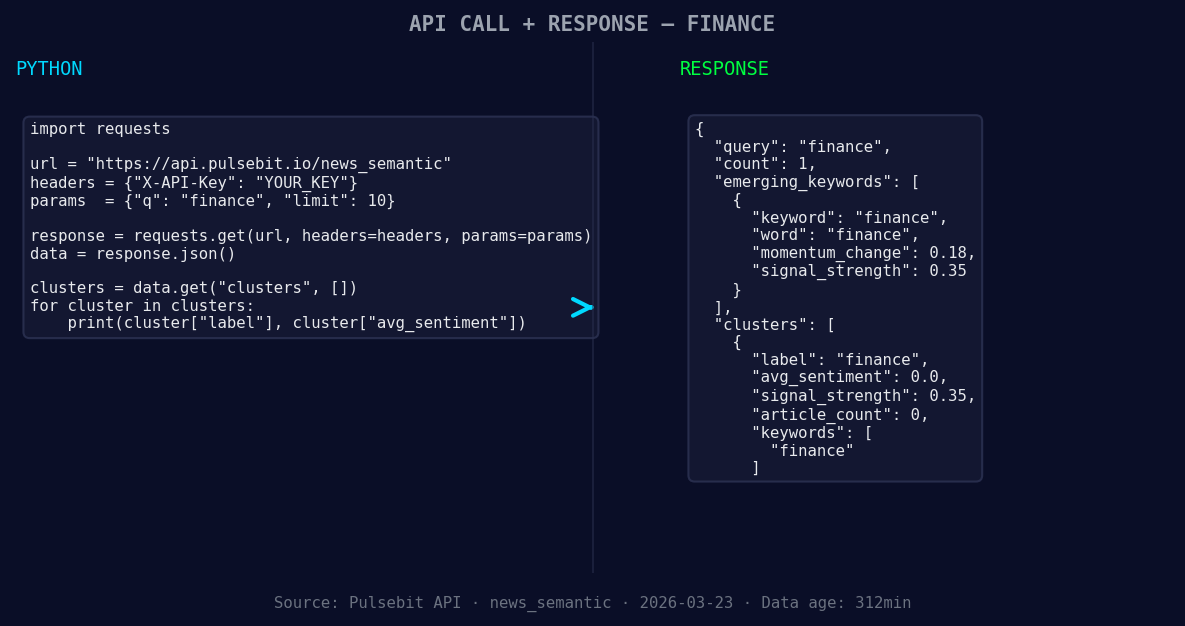
*Left: Python GET /news_semantic call for 'finance'. Right: returned JSON response structure (clusters: 1). Source: Pulsebit /news_semantic.*
# Print the response
print(data)
With the above code, we’re specifically filtering for articles processed in English, which enables us to better understand the sentiment landscape. Now, let’s take it a step further and analyze the meta-sentiment of the narrative:
# Meta-sentiment moment: running the cluster reason
meta_sentiment_input = "Semantic API incomplete — fallback semantic structure built from available keywords and article/search evidence."
meta_sentiment_response = requests.post('https://api.pulsebit.com/sentiment', json={"text": meta_sentiment_input})
meta_sentiment_data = meta_sentiment_response.json()

# Print the meta sentiment result
print(meta_sentiment_data)
This POST request allows us to score the narrative framing itself, offering insights into the underlying reasons for the sentiment shift. This loop-back analysis enhances our understanding of why the spike occurred, revealing the nuanced factors at play.
Here are three specific builds we can leverage from this anomaly:
- Geographic Origin Filter: Use the API with a query for English articles on finance with a momentum threshold of +0.830. This will help catch fast-moving sentiment shifts that might otherwise be overlooked.
response = requests.get(f'https://api.pulsebit.com/sentiment?topic={topic}&momentum={momentum}&lang={lang}')
- Meta-Sentiment Analysis: Implement a process that runs the cluster reason string through the sentiment endpoint to score the narrative framing. This can help identify potential biases in reporting that could influence sentiment.
meta_sentiment_response = requests.post('https://api.pulsebit.com/sentiment', json={"text": "Semantic API incomplete — fallback semantic structure built from available keywords and article/search evidence."})
- Forming Gap Insights: Focus on the forming themes, like the difference between finance (+0.18) vs mainstream finance. Set a signal strength threshold to identify where emerging narratives might diverge from established ones, allowing you to anticipate shifts.
To get started and explore how these insights can transform your sentiment analysis, head over to our documentation: pulsebit.lojenterprise.com/docs. You can copy-paste these snippets and run them in under 10 minutes.
By catching these nuances in real time, we can better inform our strategies and stay ahead of the curve in the finance sector.


Top comments (0)