

Your Pipeline Is 20.0h Behind: Catching Climate Sentiment Leads with Pulsebit
We recently uncovered an intriguing data point: a 24-hour momentum spike of +0.793 in climate sentiment. This surge indicates a significant shift in public opinion, primarily driven by English-language articles discussing how spring is arriving earlier this year and its implications for agriculture. Two articles clustered around this narrative suggest a growing awareness of climate issues, but our pipeline might have missed this crucial moment.
If your model isn’t equipped to handle multilingual sources or entity dominance, it could be lagging behind by as much as 20 hours. In this case, the leading language was English, and a critical sentiment was forming around climate change. This structural gap highlights the risks of not being able to adapt to emerging narratives in real-time. You might find yourself missing out on valuable insights while your competition capitalizes on these early signals.

English coverage led by 20.0 hours. Sv at T+20.0h. Confidence scores: English 0.85, French 0.85, Spanish 0.85 Source: Pulsebit /sentiment_by_lang.
To catch this momentum spike, we can leverage our API effectively. Here’s how you can do it in Python:
import requests
# Define parameters for the API call
topic = 'climate'
score = +0.700
confidence = 0.85
momentum = +0.793
lang = 'en'
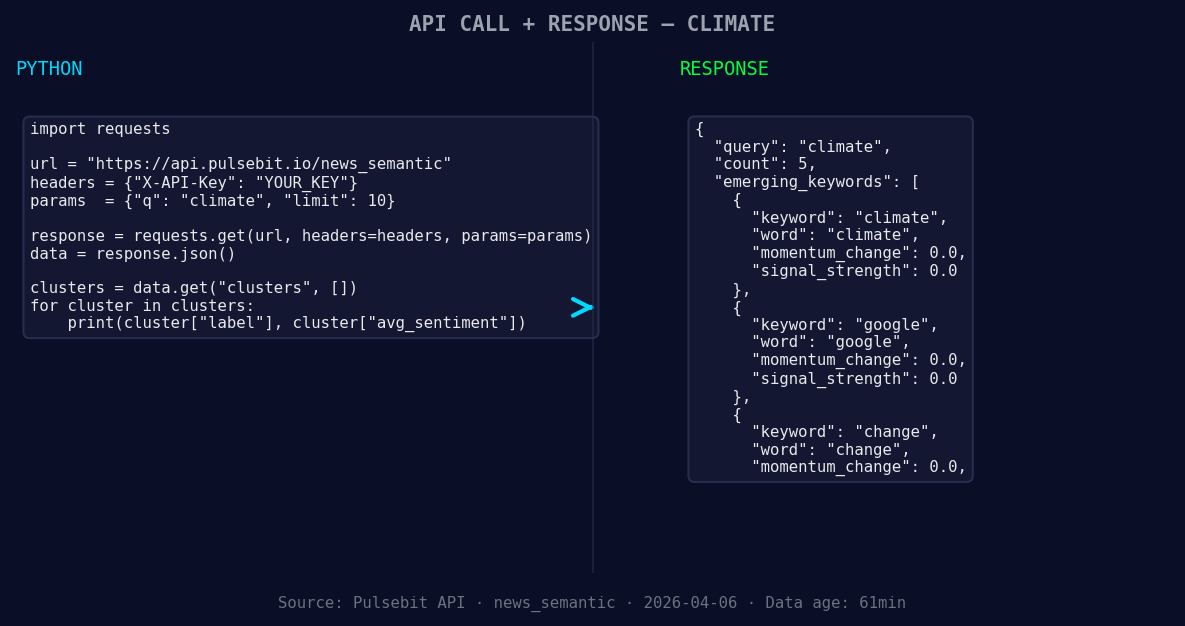
*Left: Python GET /news_semantic call for 'climate'. Right: returned JSON response structure (clusters: 3). Source: Pulsebit /news_semantic.*
# Geographic origin filter: query by language
geo_filter_url = f"https://api.pulsebit.com/sentiment?topic={topic}&lang={lang}"
response = requests.get(geo_filter_url)
data = response.json()
print(data)
# Now, let's run the cluster reason string through POST /sentiment
cluster_reason = "Clustered by shared themes: weighing, whether, soften, climate, laws."
meta_sentiment_url = "https://api.pulsebit.com/sentiment"
meta_response = requests.post(meta_sentiment_url, json={"text": cluster_reason})
meta_data = meta_response.json()
print(meta_data)
This code snippet demonstrates how to filter sentiment data based on geographic origin, specifically focusing on English-language articles. After retrieving the relevant data, we also score the narrative framing of the cluster reason to understand how it shapes public sentiment.
With this foundational work in place, here are three specific builds you can implement using this momentum spike:
Signal Detection: Set a threshold for momentum spikes at +0.700 or higher. Monitor the sentiment surrounding climate topics, looking for similar trends. This can help you identify emerging narratives before they become mainstream.
Geo-Filter Integration: Implement a real-time alert system that triggers when sentiment in English-speaking regions exceeds a score of +0.700. Use the geographic filter to refine your alerts to the most relevant content, ensuring you’re always ahead of the curve.

Geographic detection output for climate. India leads with 2 articles and sentiment +0.00. Source: Pulsebit /news_recent geographic fields.
- Meta-Sentiment Analysis: Create a reporting tool that aggregates meta-sentiment scores for clustered themes. For instance, analyze the framing around "climate" and "change." If the sentiment is rising while mainstream narratives like "weighing" and "soften" remain neutral, it indicates a potential shift worth monitoring closely.
If you’re interested in getting started, check out our documentation at pulsebit.lojenterprise.com/docs. You can copy, paste, and run this solution in under 10 minutes, and start catching those critical sentiment shifts that could impact your work.


Top comments (0)