

Your Pipeline Is 9.9h Behind: Catching World Sentiment Leads with Pulsebit
We recently uncovered a striking anomaly: a 24-hour momentum spike of +0.194. This spike highlights a crucial shift in sentiment related to "Japan's Bond Market and East Asia's Financing Model," where English press coverage is leading by 9.9 hours. If you’re monitoring sentiment in real-time, this is a clear signal that your pipeline might be lagging when it comes to multilingual content and entity dominance.

English coverage led by 9.9 hours. Sl at T+9.9h. Confidence scores: English 0.85, French 0.85, Spanish 0.85 Source: Pulsebit /sentiment_by_lang.
The Problem
Imagine you're relying on a sentiment analysis pipeline that doesn’t account for different languages or the dominance of specific entities. This gap could have cost you valuable insights—your model missed this by 9.9 hours, while the leading language, English, was already hot on the trail of significant shifts in sentiment regarding East Asia's financial landscape. Ignoring this could lead to missed opportunities or misguided strategies in decision-making.
The Code
Here’s a quick Python snippet to catch this momentum spike and analyze the associated sentiment. First, we’ll filter the content by geographic origin using the language parameter, and then we’ll run the cluster reason string through our sentiment analysis endpoint.

Geographic detection output for world. India leads with 30 articles and sentiment +0.17. Source: Pulsebit /news_recent geographic fields.
import requests
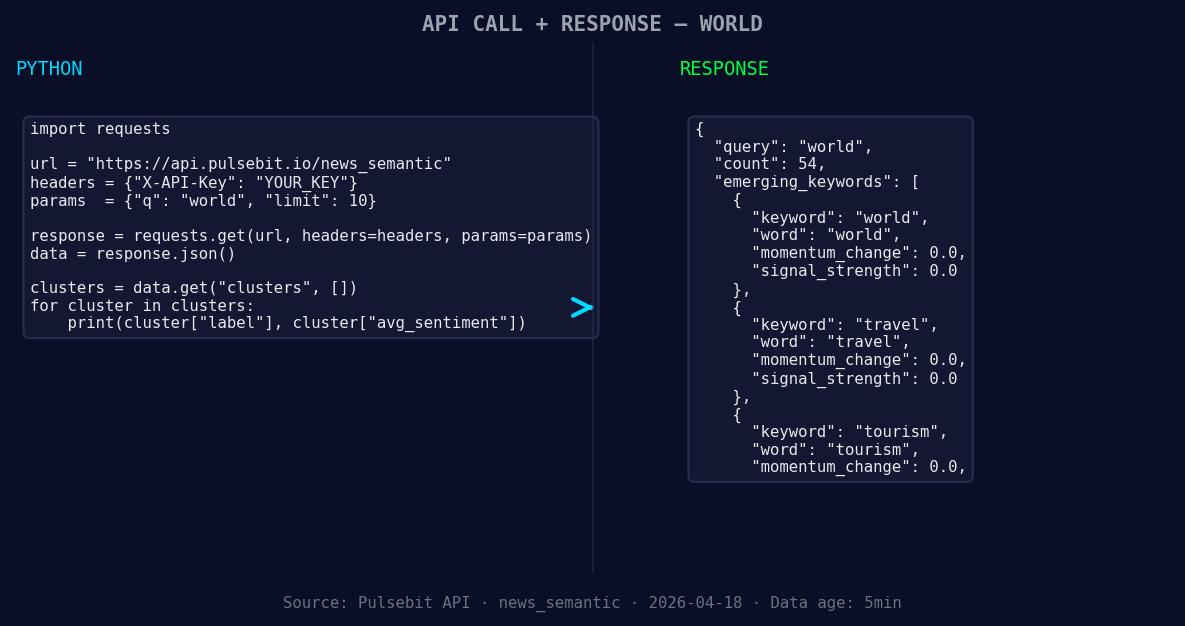
*Left: Python GET /news_semantic call for 'world'. Right: returned JSON response structure (clusters: 3). Source: Pulsebit /news_semantic.*
# Step 1: Geographic origin filter
url = "https://api.pulsebit.com/v1/articles"
params = {
"topic": "world",
"lang": "en",
"score": +0.007,
"confidence": 0.85,
"momentum": +0.194
}
response = requests.get(url, params=params)
data = response.json()
print(data)
# Step 2: Meta-sentiment moment
cluster_reason = "Clustered by shared themes: east, asia’s, financing, model, such."
sentiment_url = "https://api.pulsebit.com/v1/sentiment"
sentiment_response = requests.post(sentiment_url, json={"text": cluster_reason})
sentiment_data = sentiment_response.json()
print(sentiment_data)
This code effectively captures sentiment around the topic "world" while filtering for English-language articles. The second step, where we assess the cluster reason, allows us to gauge the narrative framing itself. This is where we can derive deeper insights into how these themes resonate.
Three Builds Tonight
Here are three specific builds we can implement using this momentum spike:
Real-Time Alerts: Set up a monitoring endpoint that triggers alerts when a momentum spike exceeds a threshold (e.g., +0.1). This can help you stay ahead of breaking news in specific regions, particularly useful for topics like world events or financial shifts.
Dynamic Content Curation: Create a content curation tool that utilizes the geo-filter to present the latest articles based on sentiment scores. When you see a spike in the "world" topic, you can curate articles that are relevant to that sentiment.
Narrative Framing Analysis: Implement a feedback loop that uses the meta-sentiment analysis to score narratives. This can help you understand how effectively your content aligns with trending themes such as world (+0.00), travel (+0.00), and tourism (+0.00) as opposed to mainstream themes like east or asia’s financing.
Get Started
Ready to tap into these insights? Check out our documentation at pulsebit.lojenterprise.com/docs. You can copy, paste, and run the code above in under 10 minutes to start catching those crucial sentiment leads.


Top comments (0)