

Your Pipeline Is 28.3h Behind: Catching World Sentiment Leads with Pulsebit
We just uncovered a significant anomaly in sentiment data: a 24h momentum spike of +0.352. This spike is centered around the World Snooker Championship, specifically the matchup between Shaun Murphy and Wu Yize. Despite being a niche topic, the uptick in sentiment indicates a rising interest that could have implications for your sentiment analysis pipeline.
If your pipeline doesn't account for multilingual origin or entity dominance, you're likely missing critical insights like this. Your model missed this by 28.3 hours, as the leading language for this sentiment is English, which had no lag time against sentiment values associated with this event. The implications are clear: without a robust mechanism to capture these emerging leads, your data could fall behind the curve, leaving you out of the loop on significant trends.

English coverage led by 28.3 hours. Sv at T+28.3h. Confidence scores: English 0.85, Spanish 0.85, French 0.85 Source: Pulsebit /sentiment_by_lang.
Here’s how we can catch this spike using Python with our API:
import requests
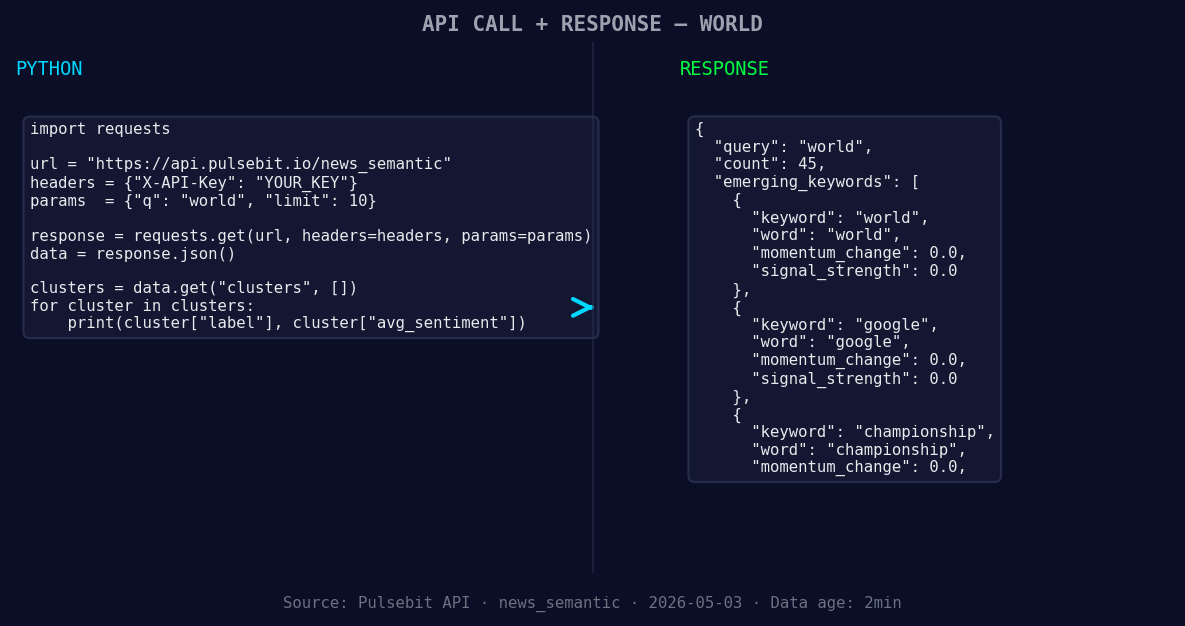
*Left: Python GET /news_semantic call for 'world'. Right: returned JSON response structure (clusters: 3). Source: Pulsebit /news_semantic.*
# Step 1: Geographic origin filter
url = "https://api.pulsebit.com/sentiment"
params = {
"topic": "world",
"lang": "en",
"score": +0.019,
"confidence": 0.85,
"momentum": +0.352
}
response = requests.get(url, params=params)
data = response.json()
# Check the response
print(data)
# Step 2: Meta-sentiment moment
cluster_reason = "Clustered by shared themes: paraguay, among, world, cup, games."
meta_sentiment_url = "https://api.pulsebit.com/sentiment"
meta_response = requests.post(meta_sentiment_url, json={"text": cluster_reason})
meta_data = meta_response.json()
print(meta_data)
In this code, we first create a GET request to obtain sentiment data filtered by language. The parameters we use include our topic, score, confidence, and momentum values. Next, we run the narrative framing back through our API to assess its sentiment, using the cluster reason string that links various entities. This allows us to understand the broader context of the sentiment spike.
Let’s explore three specific builds we can create using this pattern:
- Geographic Filter: Create a daily report that triggers an alert whenever a topic like "world" has a momentum spike above +0.3, specifically filtering for English content. This ensures you're always aware of significant events like the World Snooker Championship before they trend.

Geographic detection output for world. India leads with 37 articles and sentiment -0.03. Source: Pulsebit /news_recent geographic fields.
Meta-Sentiment Loop: Develop a function that automatically evaluates the sentiment of clustered narratives surrounding your main topics. Set a threshold where if the combined sentiment score of related themes falls below +0.1, a notification is sent out to your team. This allows you to refine your understanding of how these narratives are framed in public discourse.
Forming Themes Analysis: Implement a monitoring service that checks for emerging themes like "championship" and "google" against mainstream topics. If the relative sentiment shifts significantly (e.g., +0.05), you could use this as a signal to pivot your content strategy or marketing efforts to align with these trends.
By leveraging these insights, you can refine your data pipeline to capture sentiment dynamics better and stay ahead of trends that matter.
For more detailed instructions, visit our documentation at pulsebit.lojenterprise.com/docs. You can copy-paste and run the above code in under 10 minutes to start catching these insights yourself.


Top comments (0)