

Your Pipeline Is 20.1h Behind: Catching Finance Sentiment Leads with Pulsebit
We recently observed a striking anomaly: a 24h momentum spike of +0.396 in finance sentiment. This uptick was predominantly led by Spanish press coverage, with a notable 20.1-hour lead time over its Italian counterparts. This is a prime illustration of how quickly sentiment can shift, and if your model isn’t tuned to track these multilingual signals, you might miss critical opportunities.

Spanish coverage led by 20.1 hours. Italian at T+20.1h. Confidence scores: Spanish 0.85, French 0.85, English 0.85 Source: Pulsebit /sentiment_by_lang.
The problem lies in how many pipelines handle sentiment analysis. If your model is only processing data in one language or relying on a single dominant entity, it’s likely lagging behind. In this case, your pipeline missed this significant shift by over 20 hours, as the Spanish press was already buzzing about finance while other regions caught up. This gap can be detrimental, especially when sentiment pivots as rapidly as this.
Let’s take a look at how we can capture these insights programmatically. Here’s how to filter by geographic origin, specifically focusing on the Spanish language:
import requests
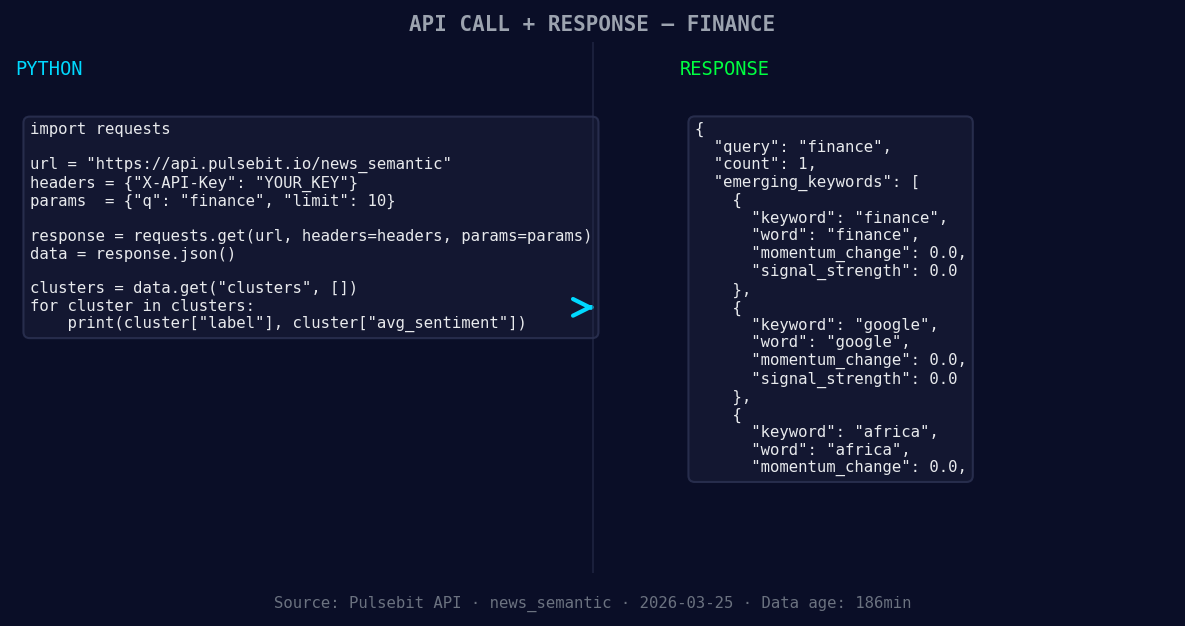
*Left: Python GET /news_semantic call for 'finance'. Right: returned JSON response structure (clusters: 3). Source: Pulsebit /news_semantic.*
url = 'https://api.pulsebit.com/v1/articles'
params = {
'topic': 'finance',
'lang': 'sp', # Filtering for Spanish articles
'momentum': '+0.396',
'score': '+0.390',
'confidence': 0.85
}
response = requests.get(url, params=params)
articles = response.json()
Now that we have our relevant articles, we can run a meta-sentiment analysis on the cluster reason string. This will help us understand the narrative framing around the sentiment:
sentiment_url = 'https://api.pulsebit.com/v1/sentiment'
payload = {
    'text': 'Clustered by shared themes: working, capital, asia, pacific, cfos.'
}

sentiment_response = requests.post(sentiment_url, json=payload)
meta_sentiment = sentiment_response.json()
These two snippets allow us to not only capture sentiment from Spanish-language articles but also to evaluate the overall sentiment framing around clustered themes. This dual approach gives us a richer understanding of the financial landscape.
Now, what can you build with this insight? Here are three specific ideas:
- Sentiment Dashboard: Create a dashboard that monitors sentiment spikes in real-time, using a 24h momentum threshold of +0.396. Integrate the geographic filter to ensure you're not missing shifts in sentiment from any language.

Geographic detection output for finance. India leads with 1 articles and sentiment +0.75. Source: Pulsebit /news_recent geographic fields.
Alert System: Build an alert system that triggers whenever sentiment in finance articles from the Spanish press exceeds a certain confidence level (e.g., 0.85) and momentum, allowing you to act on emerging trends quickly.
Narrative Analysis Tool: Develop a tool that analyzes the meta-sentiment of clusters related to finance. For instance, analyze the string "Clustered by shared themes: working, capital, asia, pacific, cfos." specifically to identify sentiment trends in emerging markets, like Africa, where you might find forming themes (finance, google, africa) against the mainstream (working, capital, asia).
With these building blocks, you can ensure your pipeline is responsive to sentiment shifts across languages and geographies.
Get started by checking out our documentation at pulsebit.lojenterprise.com/docs. You can copy-paste and run these code snippets in under 10 minutes, so there’s no reason to lag behind the competition!


Top comments (0)