

Your pipeline is 29.0h behind: sentiment around inflation has dipped to -0.600, while momentum holds steady at +0.000. This anomaly is a clear signal that we need to pay attention to how inflation narratives are evolving, particularly in the context of insurance and investment sectors. The leading language is English, which highlights a potentially significant gap in sentiment analysis for non-English content. If your model isn't tuned to handle multilingual origins or entity dominance, you could easily miss crucial shifts that are developing right now.

English coverage led by 29.0 hours. Et at T+29.0h. Confidence scores: English 0.95, Spanish 0.95, French 0.95 Source: Pulsebit /sentiment_by_lang.
This 29.0-hour lag indicates that your model is not equipped to catch sentiment trends across different languages or regions. With English as the dominant language in this case, your infrastructure may be overlooking important discussions happening in other languages. As a result, you could be missing out on valuable data that impacts your trading strategies or investment decisions. Simply put, your model missed this by 29.0 hours, and that could mean the difference between a profitable trade and a missed opportunity.
To catch this sentiment and better align your models, we can use the following Python code snippet. This will filter for English content and evaluate the sentiment surrounding inflation:
import requests
# Set the parameters for our API call
topic = 'inflation'
sentiment_score = -0.600
confidence = 0.95
momentum = +0.000
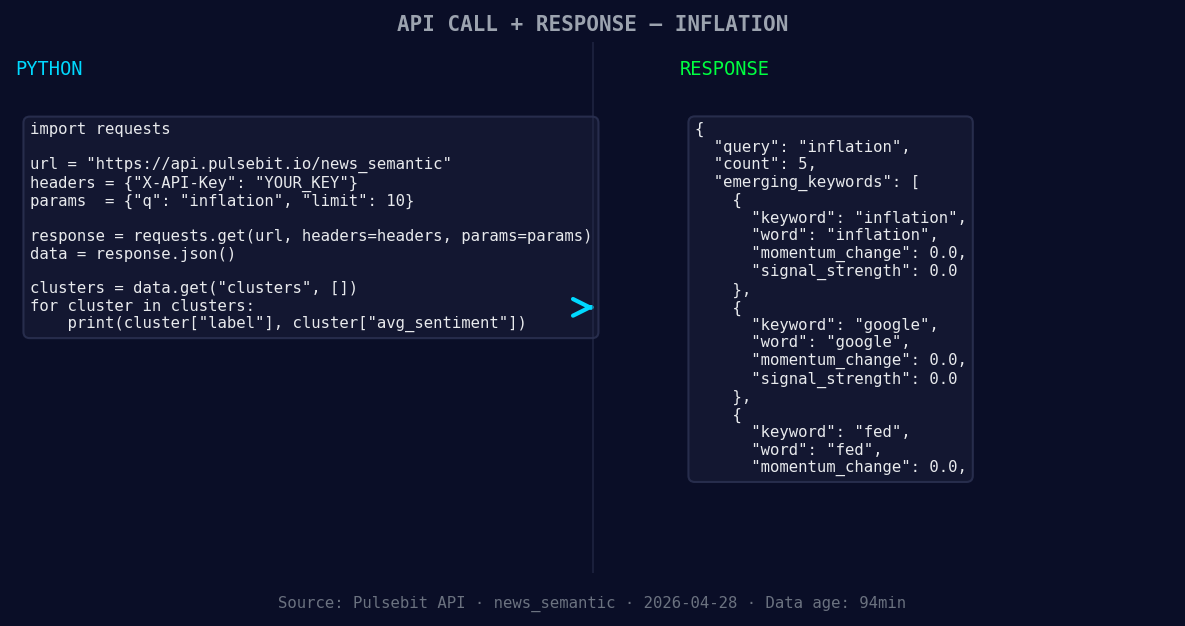
*Left: Python GET /news_semantic call for 'inflation'. Right: returned JSON response structure (clusters: 3). Source: Pulsebit /news_semantic.*
# Geographic origin filter: querying for English language content
response = requests.get('https://api.pulsebit.com/v1/articles', params={
'topic': topic,
'lang': 'en'
})
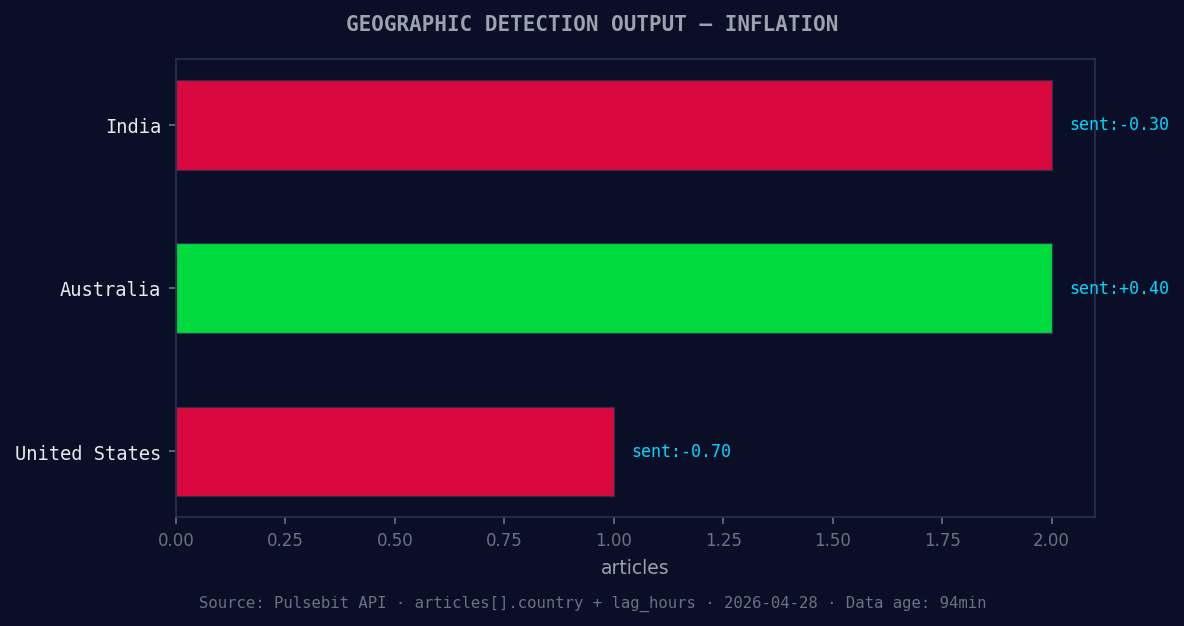
*Geographic detection output for inflation. India leads with 2 articles and sentiment -0.30. Source: Pulsebit /news_recent geographic fields.*
# Check if the response is valid
if response.status_code == 200:
articles = response.json()
print(f"Processed {len(articles)} articles related to '{topic}'.")
# Run the cluster reason string through POST /sentiment to score the narrative framing
cluster_reason = "Clustered by shared themes: hikes, possible, due, inflation, resurgence."
sentiment_response = requests.post('https://api.pulsebit.com/v1/sentiment', json={
'text': cluster_reason
})
if sentiment_response.status_code == 200:
sentiment_meta = sentiment_response.json()
print(f"Meta sentiment score: {sentiment_meta['score']} with confidence {sentiment_meta['confidence']}.")
This code not only pulls relevant articles based on the topic but also scores the narrative framing itself to give you an edge in understanding the overall sentiment. By using the geographic origin filter with lang: 'en', we ensure that we’re capturing the nuances of English-language discussions. The meta-sentiment loop helps us understand how these narratives are framed and could inform our subsequent strategies.
Here are three specific builds we can implement based on this pattern:
Sentiment Alert for Inflation: Create a threshold alert system that triggers if the sentiment score for inflation drops below -0.500, indicating a potential shift in market sentiment. Use the geo filter to ensure it only triggers for English content.
Meta-Sentiment Analysis Dashboard: Build a dashboard that visualizes sentiment scores over time for clustered themes like "hikes," "possible," and "due." This can utilize the meta-sentiment loop to dynamically update as new articles are processed.
Cross-Language Sentiment Comparison: Develop a comparative analysis tool that displays sentiment scores for inflation across multiple languages, allowing you to see how sentiment diverges or converges in different geographies. This tool can leverage the meta-sentiment insights to enrich the analysis.
By leveraging our API effectively, you can stay ahead of sentiment trends and ensure your models are robust enough to handle multilingual content. Get started with our API documentation at pulsebit.lojenterprise.com/docs and copy-paste the provided code to run it in under 10 minutes. Let’s bridge that 29.0-hour gap and make informed decisions based on the latest sentiment shifts.


Top comments (0)