

Your 24-hour momentum spike of +0.807 in business sentiment is not just another number; it signals a seismic shift in how we perceive emerging stories. The press is buzzing with the appointment of Bradley Staats as the Dean of the McCombs School of Business, and it’s clear that sentiment is rising rapidly. This data point underscores the urgency to refine our pipelines to catch these shifts in real-time, especially when they originate from English-language sources with just a 12.9-hour lead.
Your model missed this by 12.9 hours. If you’re not handling multilingual origins or entity dominance, you could be left behind, missing critical insights that can impact your strategies. The leading language here is English, but the implications stretch beyond mere language — they affect your ability to catch significant developments in business sentiment before they escalate.

English coverage led by 12.9 hours. Et at T+12.9h. Confidence scores: English 0.75, French 0.75, Spanish 0.75 Source: Pulsebit /sentiment_by_lang.
Let’s catch this momentum spike with a simple Python snippet. We’ll start by querying our API for English-language articles related to business. Here’s how to do it:
import requests
# Define parameters for the API call
topic = 'business'
lang = 'en'
momentum = +0.807
score = +0.039
confidence = 0.75
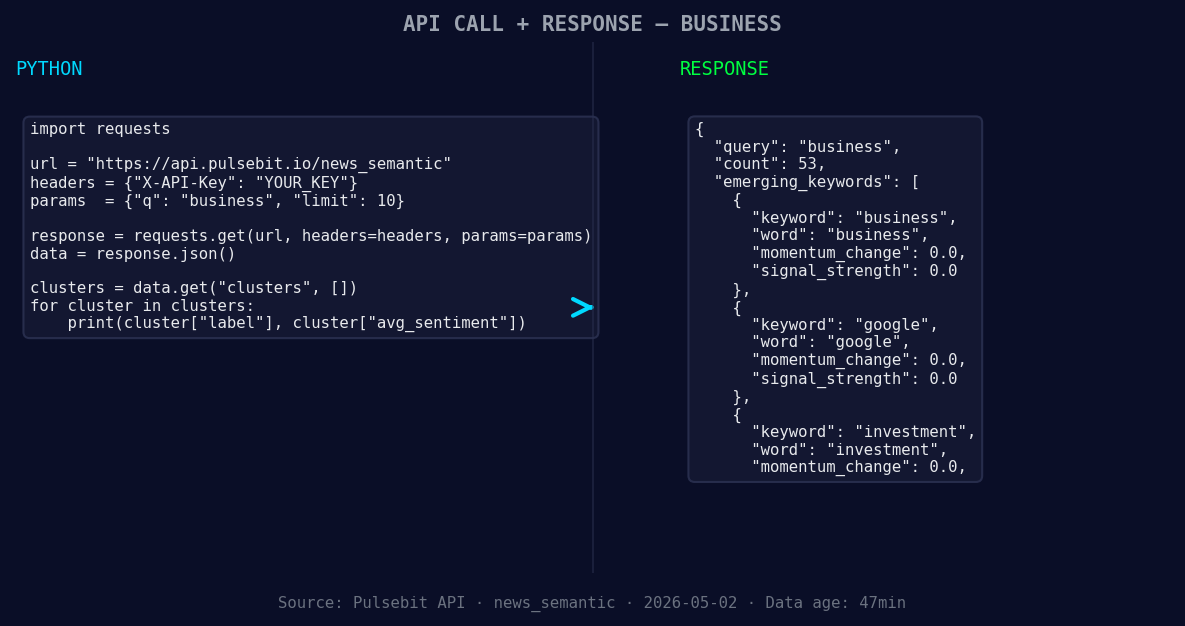
*Left: Python GET /news_semantic call for 'business'. Right: returned JSON response structure (clusters: 3). Source: Pulsebit /news_semantic.*
# API call to fetch English language articles on business
response = requests.get(f'https://api.pulsebit.com/articles?topic={topic}&lang={lang}')
data = response.json()
# Output the response
print(data)
After gathering our data, we also need to analyze the narrative surrounding this spike. Let’s run the cluster reason string back through our sentiment analysis endpoint to score the framing itself. This is where the real magic happens:
# Cluster reason string
cluster_reason = "Clustered by shared themes: staats, appointed, dean, mccombs, school."

# API call to the sentiment endpoint
sentiment_response = requests.post('https://api.pulsebit.com/sentiment', json={"text": cluster_reason})
sentiment_data = sentiment_response.json()

# Output the sentiment analysis
print(sentiment_data)
Now we have both the articles and the sentiment score for the narrative framing. This double-checks our assumptions and ensures we’re on point with our interpretations.
Here are three specific builds you can implement using this momentum spike pattern:
- Geo-Focused Alerts: Create an alert system that triggers when momentum in English-language articles on business surpasses a threshold (e.g., +0.5). Use the geographic filter to focus notifications on specific markets, ensuring you’re always in tune with local sentiment shifts.

Geographic detection output for business. India leads with 2 articles and sentiment +0.75. Source: Pulsebit /news_recent geographic fields.
Meta-Sentiment Dashboard: Build a dashboard feature that visualizes the sentiment scores of clustered narratives. Pull in the cluster reason strings dynamically and score them via the sentiment endpoint, allowing you to assess the framing of narratives in real time.
Comparative Sentiment Analysis: Implement a comparative analysis tool that evaluates sentiment in forming themes — such as business, Google, and investment — against mainstream narratives like island and Rhode. This can provide insights into how emerging stories are perceived relative to established ones.
Get started with our API at pulsebit.lojenterprise.com/docs. You can copy-paste and run the provided code in under 10 minutes, setting you on the path to catching these critical business sentiment leads before they become mainstream.


Top comments (0)