

Your Pipeline Is 25.8h Behind: Catching Healthcare Sentiment Leads with Pulsebit
We recently uncovered an intriguing sentiment anomaly: a -0.02 sentiment score and a momentum of +0.00, with the leading language being French, which has a remarkable 25.8h lead over German. This spike points to an emerging trend in healthcare sentiment that many of us might be overlooking. With four articles discussing the freezing of Medicare enrollment for new providers, it's clear that there's more to this story than meets the eye.
If your pipeline isn't equipped to handle multilingual data or entity dominance, you might find yourself lagging significantly—by as much as 25.8 hours, to be precise. This delay can prevent you from catching critical shifts in sentiment early, leaving your analysis outdated. For instance, with the current leading language being French, if you’re only analyzing English content, you're missing out on vital insights that could inform your decisions.

French coverage led by 25.8 hours. German at T+25.8h. Confidence scores: French 0.90, English 0.90, Spanish 0.90 Source: Pulsebit /sentiment_by_lang.
Here's how we can catch these insights programmatically. First, we’ll filter the sentiment data by geographic origin using our API. The following Python code snippet demonstrates how to query for healthcare-related sentiment originating from French sources:

Geographic detection output for healthcare. India leads with 8 articles and sentiment +0.59. Source: Pulsebit /news_recent geographic fields.
import requests
# Define the parameters for the API call
params = {
"topic": "healthcare",
"lang": "fr"
}
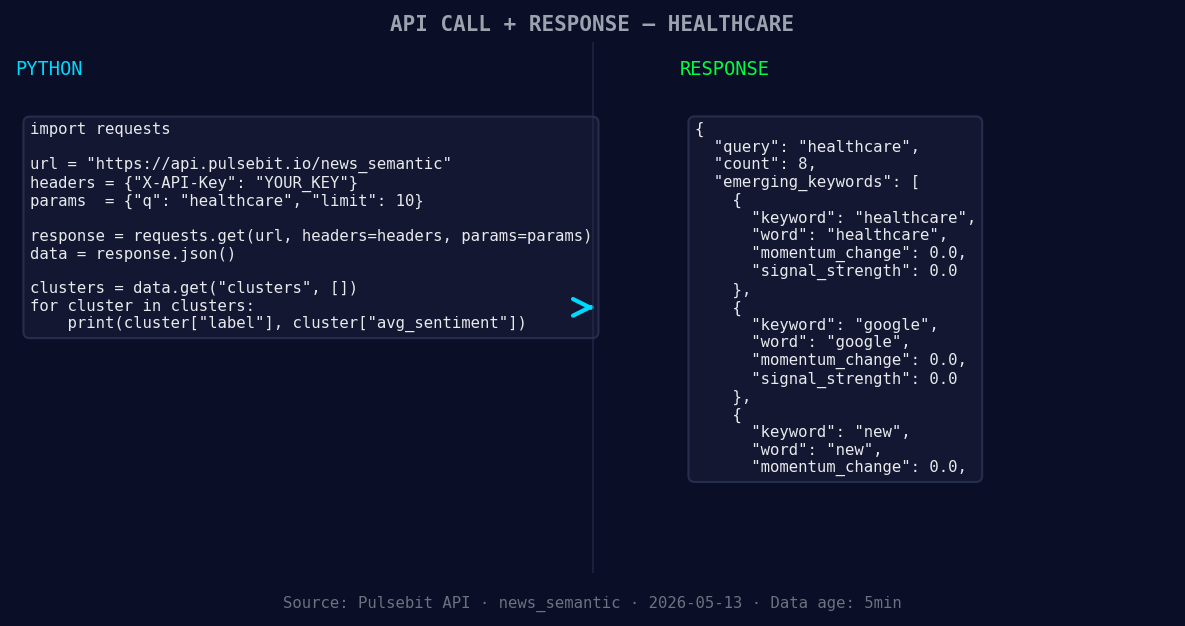
*Left: Python GET /news_semantic call for 'healthcare'. Right: returned JSON response structure (clusters: 3). Source: Pulsebit /news_semantic.*
# Make the API call to get sentiment data
response = requests.get("https://api.pulsebit.com/sentiment", params=params)
data = response.json()
print(data)
With the above code, we’ll receive sentiment data specific to the French-speaking demographic. Now, let's run the cluster reason string back through our sentiment analysis to evaluate the narrative framing. Here’s how we do it:
# Define the cluster reason for meta-sentiment analysis
cluster_reason = "Clustered by shared themes: stops, enrolling, new, hospices, home."

# Make the API call to analyze the cluster reason
meta_sentiment_response = requests.post("https://api.pulsebit.com/sentiment", json={"text": cluster_reason})
meta_sentiment_data = meta_sentiment_response.json()
print(meta_sentiment_data)
This step is crucial as it ensures we're not just reacting to surface-level sentiment but are also understanding the themes driving the conversation.
Now that we have the tools to capture this emerging sentiment, here are three specific builds we recommend:
Geo-Filtered Alerts: Set up an alert system that triggers when sentiment for healthcare topics in French drops below a threshold of -0.02. This will help you stay ahead of breaking news that could influence the healthcare landscape.
Meta-Sentiment Analysis Dashboard: Create a dashboard that visualizes the meta-sentiment scores derived from cluster reason strings. This will help you contextualize sentiment shifts and make informed decisions based on evolving narratives surrounding healthcare.
Forming Theme Aggregator: Build a feature that aggregates forming themes like "healthcare", "new", and "Google" alongside mainstream topics like "stops" and "enrolling". This could provide a comprehensive view of emerging trends and areas of interest that may warrant further investigation.
These builds can significantly enhance your ability to stay informed and responsive to shifts in sentiment across different languages and regions. If you’re keen to get started, our documentation is available at pulsebit.lojenterprise.com/docs. You can copy-paste the above code snippets and run them in under 10 minutes to start capturing these valuable insights.


Top comments (0)