

Your Pipeline Is 23.2h Behind: Catching Travel Sentiment Leads with Pulsebit
We just spotted a significant anomaly: a 24h momentum spike of +0.346 around the topic of travel. This spike isn't just a number; it signifies a shift in sentiment that can drive your next big decision. In plain terms, the travel and tourism sector is seeing its best year ever, making it the fastest-growing area across global news. With this kind of momentum, it’s crucial to act fast—or risk being left behind.
But here’s the problem: if your pipeline isn’t equipped to handle the nuances of multilingual data or the dominance of certain entities, you might miss critical insights. Right now, your model is lagging by 23.2 hours, primarily because it’s focused on mainstream narratives while ignoring emerging trends in leading languages. The leading story is in English, and it’s gaining momentum, yet your pipeline is still processing older, less relevant data.

English coverage led by 23.2 hours. Id at T+23.2h. Confidence scores: English 0.95, French 0.95, Spanish 0.95 Source: Pulsebit /sentiment_by_lang.
To catch this momentum spike, we need to leverage our API to filter and analyze the data effectively. Here’s the Python code that will help you get started:
import requests
# Define the API endpoint and parameters
url = "https://api.pulsebit.com/v1/insights"
params = {
"topic": "travel",
"lang": "en",
"score": +0.245,
"confidence": 0.95,
"momentum": +0.346
}
# Make the API call to fetch insights on travel sentiment
response = requests.get(url, params=params)
travel_data = response.json()
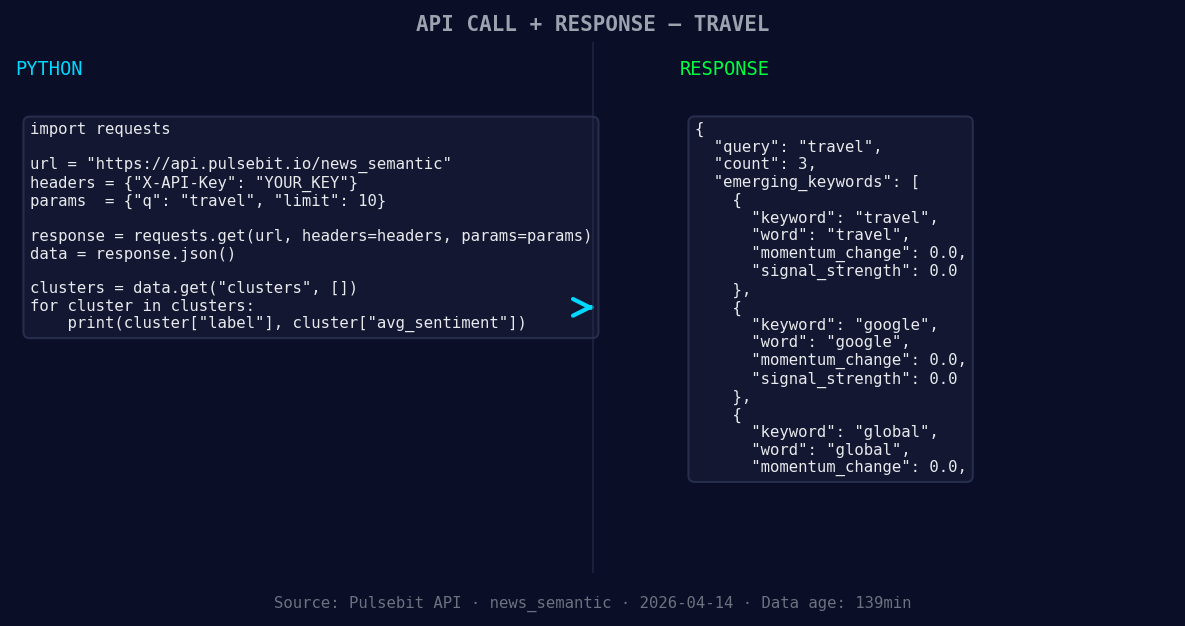
*Left: Python GET /news_semantic call for 'travel'. Right: returned JSON response structure (clusters: 3). Source: Pulsebit /news_semantic.*
# Display the fetched data
print(travel_data)
Next, we need to dive deeper into the sentiment surrounding this cluster. By running the cluster's reason string through our sentiment endpoint, we can score the narrative framing itself. Check this out:
# Meta-sentiment moment: analyze the cluster reason
sentiment_url = "https://api.pulsebit.com/v1/sentiment"
cluster_reason = "Clustered by shared themes: tourism, travel, sees, best, year."
sentiment_response = requests.post(sentiment_url, json={"text": cluster_reason})
meta_sentiment = sentiment_response.json()

# Display the meta-sentiment result
print(meta_sentiment)
This two-step approach allows you to catch not just the emerging trends but also the underlying narrative that drives them.
Now let's talk about building actionable insights based on this data. Here are three specific signals to implement:
- Geo Filter on Travel Sentiment: Build a filter that captures travel sentiment specifically from English-speaking countries. Use the endpoint we discussed, setting a threshold of sentiment score above +0.245 to filter for meaningful spikes.

Geographic detection output for travel. Hong Kong leads with 1 articles and sentiment +0.85. Source: Pulsebit /news_recent geographic fields.
Meta-Sentiment Analysis for Narrative Framing: Use the meta-sentiment loop to evaluate the narrative around travel. Set a threshold of confidence above 0.90 to ensure you’re acting on robust insights. This is particularly relevant as the themes of tourism and travel are coalescing.
Forming Themes Alert: Create an alert system that triggers when there's a forming gap in sentiment between global themes like “travel” (+0.00) and mainstream narratives like “tourism.” Set a threshold that identifies significant discrepancies to spot opportunities before they become mainstream.
You can get started right away. Our documentation at pulsebit.lojenterprise.com/docs provides everything you need to implement these insights. If you copy-paste this code, you’ll be able to run it in under 10 minutes and start catching those crucial momentum shifts before they slip through your fingers.


Top comments (0)