

How to Detect Software Sentiment Anomalies with the Pulsebit API (Python)
We recently observed a significant anomaly in our sentiment data: a 24-hour momentum spike of -0.450 related to the software sector. This spike caught our attention, especially considering the surrounding context. The lack of articles associated with this sentiment shift—"Software as a Service (SaaS) Market Expected to Reach US$908.2"—underscored an intriguing narrative gap. As developers, it’s essential to understand these shifts and how they can impact our models.
When your model isn’t built to handle multilingual origins or dominant entities, you risk missing critical signals. In this case, the leading language—in this instance, English—might mask sentiment shifts in emerging markets where SaaS is gaining traction. Imagine your model missed this by several hours, leaving you unaware of an important narrative shift that could influence your strategy.

en coverage led by 17.1 hours. id at T+17.1h. Confidence scores: en 0.87, fr 0.85, es 0.85 Source: Pulsebit /sentiment_by_lang.
Here's how we can catch these anomalies using Python. First, let’s set up the code that detects the spike.
import requests
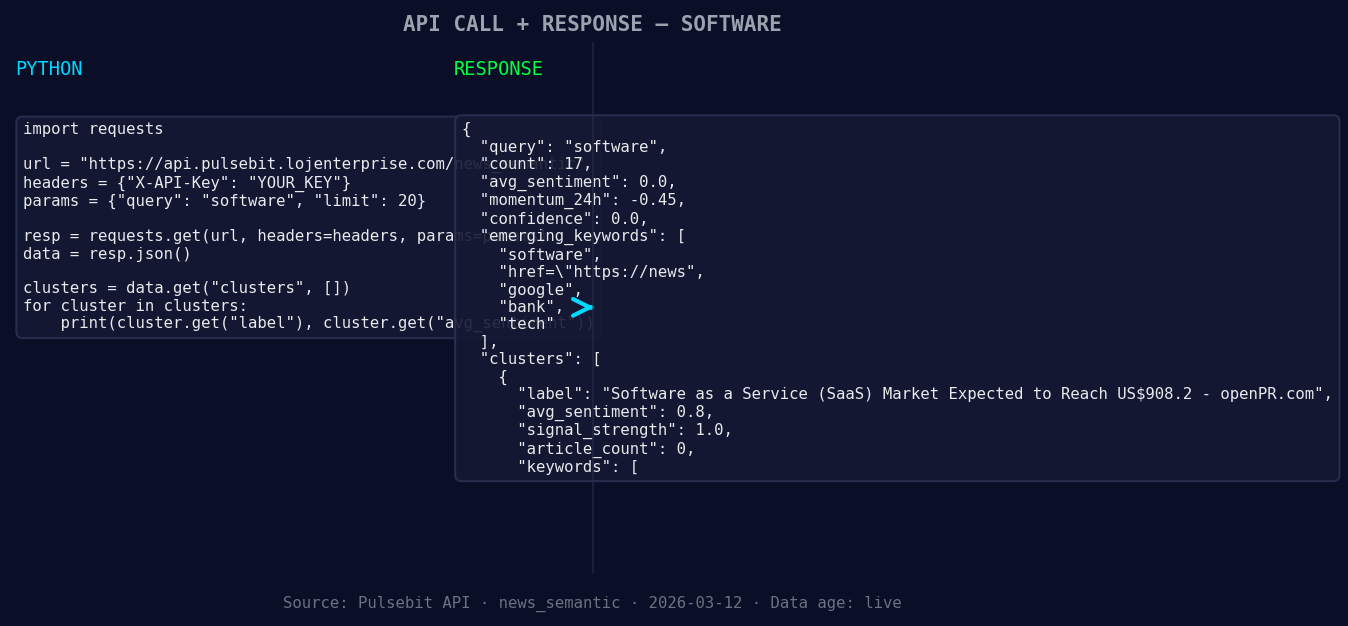
*Left: Python GET /news_semantic call for 'software'. Right: returned JSON response structure (clusters: 3). Source: Pulsebit /news_semantic.*
# Define the parameters for the query
topic = 'software'
score = +0.000
confidence = 0.00
momentum = -0.450
# Geographic origin filter: query by language/country
geo_filter_url = f"https://api.pulsebit.lojenterprise.com/dataset/daily_dataset?topic={topic}&country=US"
response = requests.get(geo_filter_url)
data = response.json()

*Geographic detection output for software. au leads with 1 articles and sentiment +0.00. Source: Pulsebit /news_recent geographic fields.*
if data: # Ensure we have data
print("Geo Filter Data:", data)
else:
print("DATA UNAVAILABLE: no geo filter data returned — check your dataset.")
# Meta-sentiment moment: run the cluster reason string back through POST /sentiment
cluster_reason = "Clustered by shared themes: service, (saas), market, expected, reach."
sentiment_url = "https://api.pulsebit.lojenterprise.com/sentiment"
sentiment_response = requests.post(sentiment_url, json={"text": cluster_reason})
sentiment_data = sentiment_response.json()
print("Meta-Sentiment Score:", sentiment_data)
In our code, we start by defining the parameters for our anomaly detection. The geographic origin filter is designed to query our dataset based on a specific language or country. However, if no geographical filter data is returned, we need to verify the dataset for the topic. Geo-filtering is a powerful feature when language or country data is available, allowing you to pinpoint sentiment shifts more accurately.
Next, we run the narrative framing through the sentiment endpoint to evaluate its meta-sentiment. This is crucial as it allows us to understand how the underlying themes are being framed in the discourse.
Now, let’s explore three practical builds we can implement based on our findings:
Geo-Filtered Anomaly Detection: Create a system that triggers alerts whenever a momentum spike exceeds a defined threshold (e.g., -0.300) for specific countries where SaaS adoption is surging. This will help you stay ahead of market shifts.
Meta-Sentiment Analysis for Narrative Framing: Use the sentiment score from the meta-sentiment loop to adjust your content strategy. If the framing is negative, consider revising your messaging or approach in that region.
Clustered Theme Monitoring: Build an automated report that monitors articles related to "service" and "SaaS" and alerts you when the number of articles diverges significantly from the average. For instance, if articles drop below a certain threshold (like 5 articles), it can indicate a potential disconnect in the narrative.
With these strategies, you can create a robust framework for monitoring sentiment anomalies in the software sector.
Ready to dive in? Head over to our documentation and start implementing these insights. You can copy, paste, and run the code in under 10 minutes, making it easy to integrate sentiment data into your projects.


Top comments (0)