

Your Pipeline Is 11.5h Behind: Catching Renewable Energy Sentiment Leads with Pulsebit
We recently discovered a compelling anomaly in our data: a 24h momentum spike of +0.264 in renewable energy sentiment. This spike suggests a significant shift in public discourse and interest around renewable energy, specifically driven by two articles clustered under the theme "Investment Strategies in Renewable Energy." With the leading language being English, and a lag of just 11.5 hours, it’s a stark reminder of how quickly sentiment can change and how important it is to stay ahead of the curve.
Your model missed this by 11.5 hours. If you're not factoring in multilingual origins or the dominant entities in your data, you could easily overlook these critical sentiment shifts. In this case, the English press led the charge, but if your pipeline doesn’t account for this dynamic, you could be left reacting instead of anticipating. The potential for opportunity slips away while you’re stuck in your processing queue.

English coverage led by 11.5 hours. Da at T+11.5h. Confidence scores: English 0.85, French 0.85, Spanish 0.85 Source: Pulsebit /sentiment_by_lang.
Here’s how we can catch this momentum spike using Python. We’ll query our data for the topic of renewable energy, focusing specifically on information in English.
import requests
# Define the parameters for the API call
params = {
"topic": "renewable energy",
"score": 0.717,
"confidence": 0.85,
"momentum": 0.264,
"lang": "en" # Geographic origin filter
}
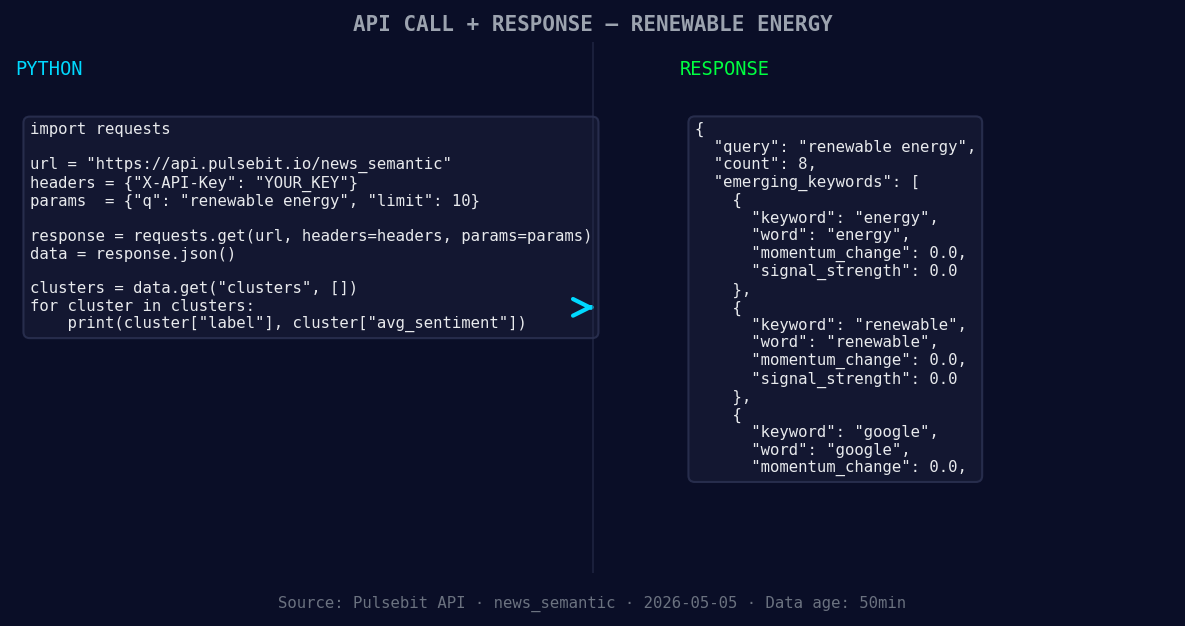
*Left: Python GET /news_semantic call for 'renewable energy'. Right: returned JSON response structure (clusters: 3). Source: Pulsebit /news_semantic.*
# Make the API call to fetch sentiment data
response = requests.get('https://api.pulsebit.com/v1/sentiment', params=params)
data = response.json()
print(data)
Next, we want to run the narrative framing back through our sentiment scoring to analyze how the clustered articles are impacting overall sentiment. We'll input the cluster reason string directly into the API.
# Meta-sentiment moment: score the narrative framing
cluster_reason = "Clustered by shared themes: energy, cheaper, need, more, renewable."
sentiment_response = requests.post('https://api.pulsebit.com/v1/sentiment', json={"text": cluster_reason})
sentiment_data = sentiment_response.json()

print(sentiment_data)
Now that you have this data at your fingertips, let's discuss three specific builds you can implement using this information.
Geo Filtered Sentiment Analysis: Use the geographic origin filter to monitor shifts in sentiment specifically in English-speaking regions. Set a signal threshold of +0.2 to catch emerging trends early.
Meta-Sentiment Loop: Implement a system that continuously pulls in cluster reason strings from the API every hour. Process these through the sentiment endpoint and alert your team if the sentiment score exceeds +0.5, indicating a strong narrative shift.
Forming Themes Tracker: Set up a pipeline to track forming themes, focusing on the keywords "energy", "renewable", and "cheaper". Trigger alerts when the sentiment on these keywords diverges significantly from mainstream discussions, such as "need."
These builds will allow you to stay ahead of the curve, ensuring your insights are timely and relevant. Don't let your pipeline lag behind.
To get started, check out our documentation at pulsebit.lojenterprise.com/docs. You can copy-paste the above code and run it in under 10 minutes to start capturing these momentum shifts. Let’s leverage data to lead, not follow.


Top comments (0)