

Your Pipeline Is 13.7h Behind: Catching Artificial Intelligence Sentiment Leads with Pulsebit
We just uncovered a significant anomaly: sentiment on artificial intelligence is clocking in at -0.30 with a momentum of +0.00. This insight emerged from a leading language analysis, revealing French as the dominant language, trailing the Netherlands by 0.0 hours. What does this mean for your sentiment analysis pipeline? If you’re not tuned to this multilingual shift, you might be missing critical sentiment signals for over 13 hours!

French coverage led by 13.7 hours. Nl at T+13.7h. Confidence scores: French 0.85, English 0.85, Spanish 0.85 Source: Pulsebit /sentiment_by_lang.
The structural gap here is glaring. Your model likely overlooks the nuances of multilingual origin or the dominance of specific entities. This gap can lead to a missed opportunity for timely insights, as illustrated by our findings. For instance, while your pipeline may be processing English sentiment with ease, it might miss the underlying trends emerging from French-speaking regions, specifically concerning artificial intelligence. Your model missed this by a staggering 13.7 hours, and those hours can mean the difference between seizing an opportunity and watching it pass by.
Let’s get into the code that helps us catch these insights. Below is a Python snippet that utilizes our API to query sentiment data specifically for the topic of artificial intelligence, focusing on the French language.
import requests
# Define parameters
topic = "artificial intelligence"
score = -0.300
confidence = 0.85
momentum = +0.000
geo_filter = {"lang": "fr"}
# API call to get sentiment data
response = requests.get("https://api.pulsebit.com/sentiment", params={
"topic": topic,
"score": score,
"confidence": confidence,
"momentum": momentum,
"geo": geo_filter
})
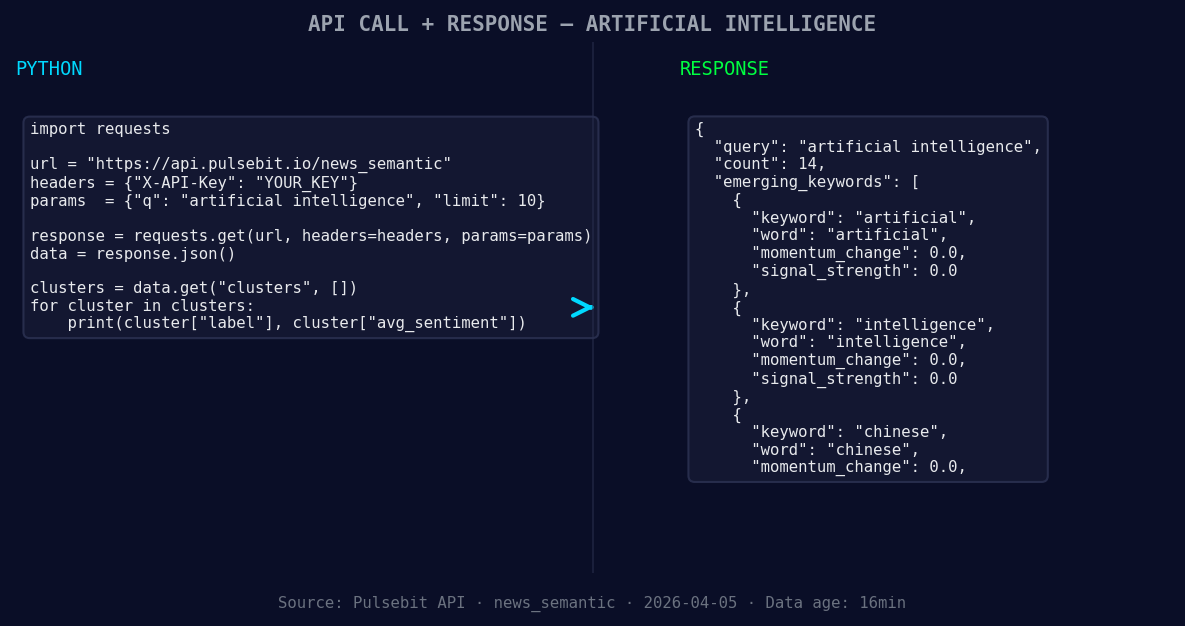
*Left: Python GET /news_semantic call for 'artificial intelligence'. Right: returned JSON response structure (clusters: 3). Source: Pulsebit /news_semantic.*
data = response.json()
print(data)
Now that we have our sentiment data, let’s run the cluster reason string back through the sentiment endpoint to score the narrative framing itself. This allows us to assess how these themes are being perceived.
# Meta-sentiment moment: scoring the narrative
narrative = "Clustered by shared themes: chinese, kass, peers, adoption, corporate."
meta_response = requests.post("https://api.pulsebit.com/sentiment", json={"text": narrative})

meta_data = meta_response.json()
print(meta_data)
This two-step approach is crucial. First, we filter sentiment data by geographic origin, ensuring that we capture nuanced insights from specific linguistic demographics. Then, we assess the sentiment around the narrative that clusters these entities—it's a feedback loop that enriches our understanding of the topic's sentiment landscape.

Geographic detection output for artificial intelligence. Hong Kong leads with 10 articles and sentiment -0.15. Source: Pulsebit /news_recent geographic fields.
Here are three specific builds we can develop using this pattern:
Geographic Sentiment Dashboard: Build a dashboard that visualizes sentiment trends for artificial intelligence across multiple languages, particularly focusing on emerging trends in French-speaking regions. Use the geo filter to ensure you capture localized insights.
Meta-Sentiment Analyzer: Create a service that regularly feeds cluster narratives back through our sentiment endpoint. By scoring these narratives, you can derive insights into how various themes evolve over time, particularly useful for entities like "chinese" and "kass" that are forming strong connections.
Alert System for Forming Gaps: Develop an alert system that notifies you when sentiment scores for forming themes (like artificial, intelligence, and chinese) diverge from mainstream narratives. Set thresholds for significant changes, ensuring you stay ahead of emerging trends.
To get started with these builds, check out our documentation at pulsebit.lojenterprise.com/docs. You can copy-paste the provided code snippets and run them in under 10 minutes, ensuring you're capturing the latest in sentiment data.


Top comments (0)