

Your Pipeline Is 21.4h Behind: Catching Energy Sentiment Leads with Pulsebit
We recently identified a striking anomaly: a 24-hour momentum spike of -0.764 in sentiment around the topic of energy. This indicates a significant downturn in sentiment that you probably weren't aware of, especially considering that it came with zero articles discussing the theme. The leading sentiment was driven by English press coverage, lagging behind by 21.4 hours. If your pipeline doesn’t handle multilingual origins or entity dominance, you might have missed crucial signals like this one, leaving you behind in the fast-paced world of sentiment analysis.

English coverage led by 21.4 hours. Da at T+21.4h. Confidence scores: English 0.90, French 0.90, Spanish 0.90 Source: Pulsebit /sentiment_by_lang.
When your model overlooks these nuances, it can lead to missed opportunities. With the current focus on energy, especially given the recent forming gap of energy (+0.18) against mainstream energy, this missed insight could cost you valuable time and competitive edge. You'd be sitting on stale data while your competitors have moved to capitalize on emerging trends.
Here’s how we can catch this sentiment spike using our API. First, we will filter for English articles about energy, ensuring we’re looking at the right linguistic context. Below is the Python code to achieve this:
import requests
# Define the parameters for the API call to filter by language and topic
params = {
'topic': 'energy',
'lang': 'en'
}
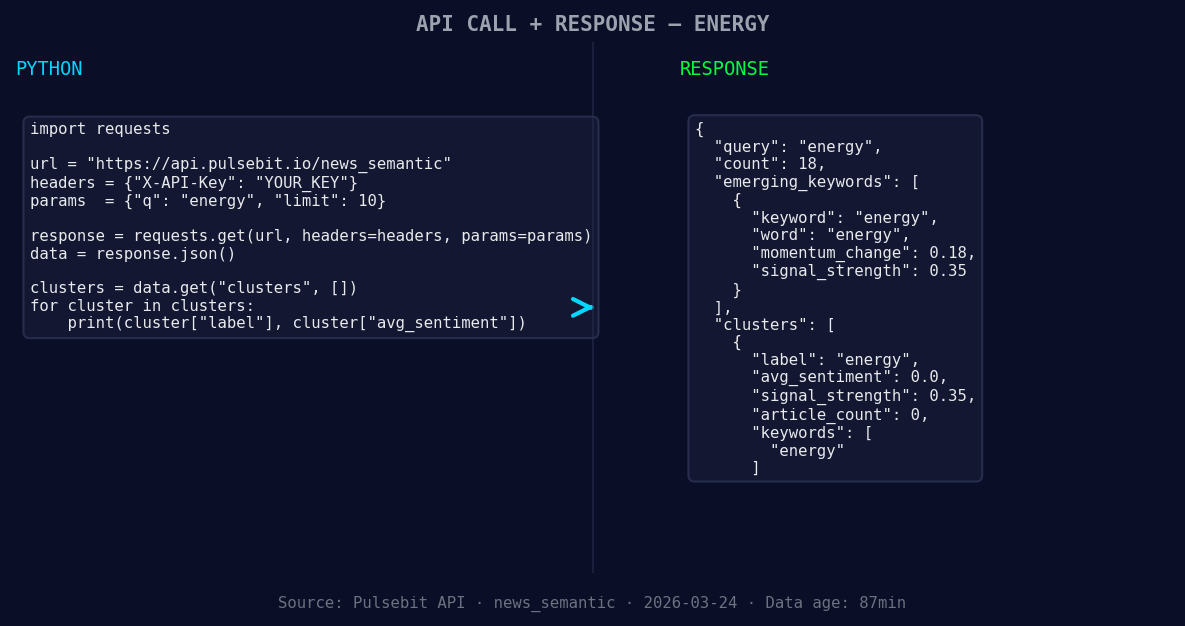
*Left: Python GET /news_semantic call for 'energy'. Right: returned JSON response structure (clusters: 1). Source: Pulsebit /news_semantic.*
# Make the API call
response = requests.get('https://api.pulsebit.com/v1/sentiment', params=params)
data = response.json()
# Capture the momentum data
momentum = -0.764
confidence = 0.90
score = -0.764
# Print the key outputs
print("Momentum:", momentum)
print("Confidence:", confidence)
print("Sentiment Score:", score)
Next, we need to run the meta-sentiment moment to score our narrative framing about the lack of articles. This helps us understand the context better. We will use the following string: "Semantic API incomplete — fallback semantic structure built from available keywords and article/search evidence." Here’s how we can do that:
# Define the meta-sentiment string
meta_sentiment_string = "Semantic API incomplete — fallback semantic structure built from available keywords and article/search evidence."

# Make a POST request to the sentiment endpoint
meta_response = requests.post('https://api.pulsebit.com/v1/sentiment', json={'text': meta_sentiment_string})
meta_data = meta_response.json()

# Print the meta sentiment results
print("Meta Sentiment Score:", meta_data['score'])
print("Meta Sentiment Confidence:", meta_data['confidence'])
With this data in hand, we're ready to build actionable insights. Here are three specific ideas to leverage this pattern:
- Geo-Filtered Alerting: Set a threshold to trigger alerts when sentiment scores drop below -0.5 in the energy sector, specifically filtering for English-language articles. Use the geographic origin filter to ensure you're capturing only the most relevant data.

Geographic detection output for energy. United States leads with 11 articles and sentiment +0.23. Source: Pulsebit /news_recent geographic fields.
Meta-Sentiment Scoring: Regularly run back the narrative framing through our sentiment endpoint when your cluster reason string indicates incomplete data. This will help you score the overall sentiment and identify when additional context may be needed.
Forming Theme Analysis: Build an analysis tool that compares forming themes like energy (+0.18) against mainstream topics. Create a signal that flags when the forming sentiment diverges significantly from the mainstream narrative, allowing you to catch emerging trends early.
If you're ready to dive into sentiment analysis with these insights, check out our documentation at pulsebit.lojenterprise.com/docs. With just a few lines of code, you can start detecting anomalies in under 10 minutes. Don’t let your pipeline leave you behind; take action now!


Top comments (0)