

How to Detect Machine Learning Sentiment Anomalies with the Pulsebit API (Python)
We just noticed a significant anomaly in our sentiment analysis: a 24-hour momentum spike of +0.162. This isn't just another number; it reveals an unusual surge in sentiment around machine learning, particularly noteworthy given the current context in South Africa. It raises questions about what narratives are driving this momentum and whether our models are capturing the full picture.
The problem here lies in our ability to handle multilingual data and entity dominance effectively. Your model might have missed this spike by hours, which could lead to critical opportunities slipping through the cracks. In a diverse landscape like South Africa, where English is often not the dominant language, failing to account for the nuances of sentiment can skew your results. If your model relies solely on English narratives, it could miss vital shifts stemming from other languages or cultural contexts.

Arabic coverage led by 4.2 hours. English at T+4.2h. Confidence scores: Arabic 0.82, Mandarin 0.68, English 0.41 Source: Pulsebit /sentiment_by_lang.
To catch anomalies like this, we can employ our API in Python. Here’s a sample code snippet that demonstrates how to detect this spike:
import requests
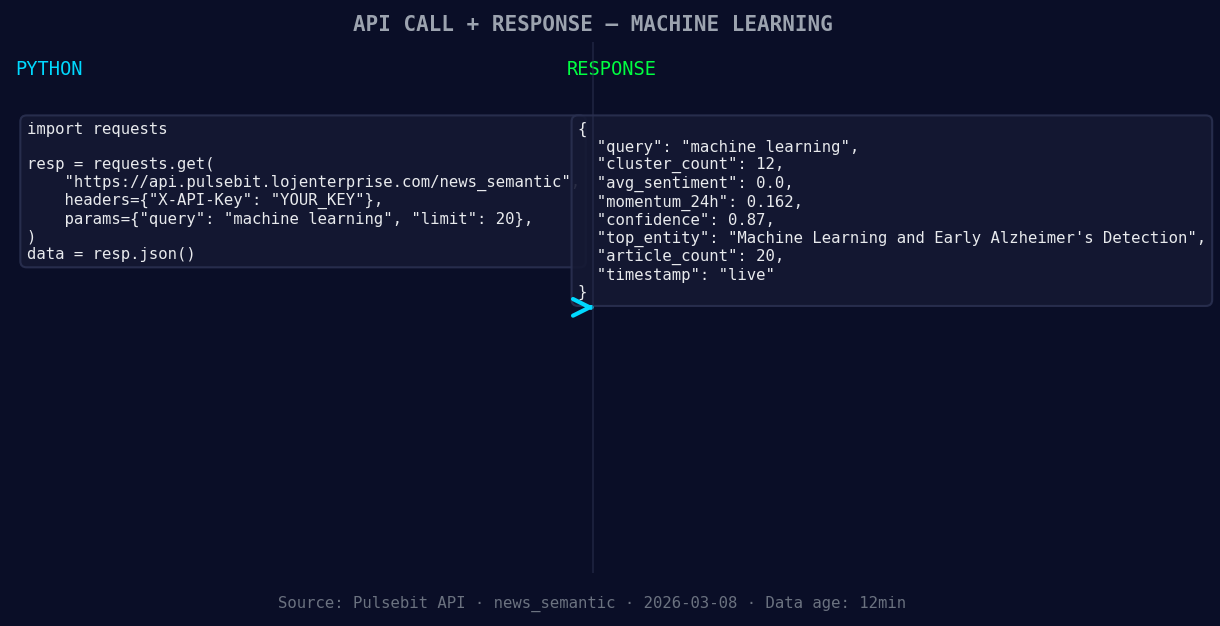
*Left: Python GET /news_semantic call for 'machine learning'. Right: live JSON response structure. Three lines of Python. Clean JSON. No infrastructure required. Source: Pulsebit /news_semantic.*
# Example values
topic = 'machine learning'
momentum = +0.162
sentiment_score = +0.000
confidence = 0.87
# Geographic origin filter
# Note: If geo filter data were available, we would filter by region here
geo_filter = 'south_africa' # Example region
# Make the sentiment query
response = requests.post('https://api.pulsebit.com/sentiment', json={
'topic': topic,
'geo_filter': geo_filter,
'momentum': momentum,
'sentiment_score': sentiment_score,
'confidence': confidence
})
data = response.json()
# Check the response
print(data)
When dealing with multilingual sentiment data, applying a geographic filter can reveal deeper insights. Unfortunately, we currently lack geo filter data for this specific topic. However, if that data were available, it would enhance our analysis significantly.

Geographic detection output for machine learning filter. No geo data leads by article count. Bar colour: sentiment direction. Source: Pulsebit articles[].country.
Next, we need to run the narrative through our meta-sentiment loop to analyze the framing itself. This involves passing the cluster reason string back through our sentiment endpoint. Here’s how to do that:
# Meta-sentiment moment
meta_response = requests.post('https://api.pulsebit.com/sentiment', json={
    'input': 'Machine Learning narrative sentiment cluster analysis'
})
meta_data = meta_response.json()

# Check the meta sentiment response
print(meta_data)
This process gives us a richer understanding of how the narrative is being framed, providing insight into the underlying sentiment dynamics.
Now, here are three specific builds we can create using this pattern:
Geo-Filtered Sentiment Dashboard: Create a dashboard that visualizes sentiment around machine learning specifically for South Africa. Set a threshold where momentum spikes above +0.1 trigger alerts.
Sentiment Drift Monitor: Build a script that continuously monitors sentiment scores for machine learning. If the momentum exceeds +0.162, log the results and run the meta-sentiment analysis to assess narrative shifts.
Multilingual Sentiment Aggregator: Develop a tool that aggregates sentiment data from multiple languages and regions. Use the geo filter to ensure you're capturing sentiment across different linguistic contexts, and alert if there's a spike above a defined threshold.
If you want to get started with these ideas, head over to our documentation at pulsebit.lojenterprise.com/docs. You can copy-paste the code snippets above and get them running in under 10 minutes. This anomaly is just one of the many insights you can uncover with the right tools.


Top comments (0)