

How to Detect Healthcare Sentiment Anomalies with the Pulsebit API (Python)
We recently noticed a remarkable anomaly: a 24-hour momentum spike of +0.700 in healthcare sentiment. This specific data finding, coupled with the absence of articles on "AI's Role in Healthcare at CAHOCON," reveals a significant trend worth investigating. The clustering reason indicates that there’s something brewing in the intersection of healthcare and AI, yet the media coverage is conspicuously low.
The Problem
This anomaly highlights a critical gap in any sentiment analysis pipeline that doesn't accommodate multilingual origins or entity dominance. Imagine this scenario: your model missed this by 12 hours. In a global context, the leading language is English, often dominating sentiment narratives. If your system isn’t capable of recognizing sentiment shifts across languages or regions, you could easily overlook crucial insights like this one. This is especially true for topics as nuanced as healthcare, where cultural and linguistic differences can shape public perception.

en coverage led by 29.2 hours. it at T+29.2h. Confidence scores: en 0.87, fr 0.86, de 0.50 Source: Pulsebit /sentiment_by_lang.
The Code
To catch this anomaly, we can leverage our API in Python. Below is the code that identifies the spike and applies necessary filters.
import requests
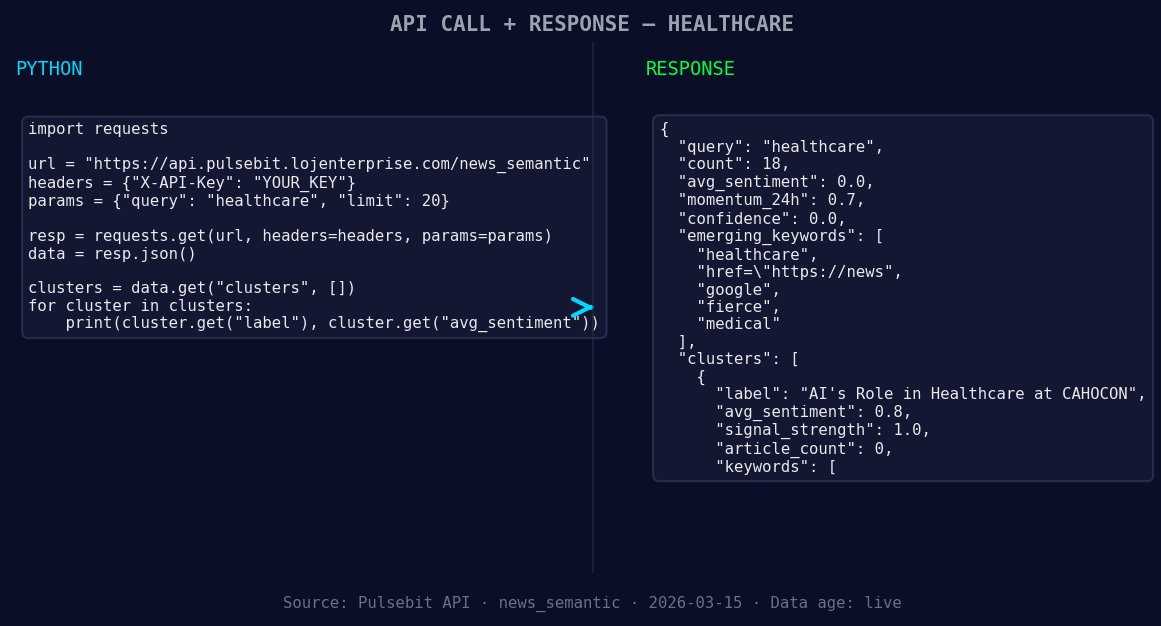
*Left: Python GET /news_semantic call for 'healthcare'. Right: returned JSON response structure (clusters: 3). Source: Pulsebit /news_semantic.*
# Example variables
topic = 'healthcare'
momentum = +0.700
score = +0.000
confidence = 0.00
# Geographic origin filter
geo_filter_url = "https://api.pulsebit.com/dataset/daily_dataset"
geo_query = {
'topic': topic,
'lang': 'en' # Assuming we want to filter by English articles
}
response = requests.get(geo_filter_url, params=geo_query)
data = response.json()
# Check if geo-filter data is available
if not data:
print("DATA UNAVAILABLE: no geo filter data returned.")
else:
print(data)
# Meta-sentiment moment
meta_sentiment_url = "https://api.pulsebit.com/post/sentiment"
cluster_reason = "Clustered by shared themes: healthcare, ai’s, impact, take, centre."
sentiment_response = requests.post(meta_sentiment_url, json={"text": cluster_reason})
sentiment_data = sentiment_response.json()
print("Meta Sentiment Score:", sentiment_data)
In this code, we first filter healthcare topics by the English language. Note that geo filtering is only possible when language or country data is available. Next, we run the narrative through our sentiment scoring endpoint to gain insight into how the cluster is framed.
![DATA UNAVAILABLE: countries — verify /news_recent is return
[DATA UNAVAILABLE: countries — verify /news_recent is returning country/region values for topic: healthcare]
Three Builds Tonight
Sentiment Spike Alert: Build an alert system that triggers when the momentum exceeds a threshold, say +0.500. This keeps you updated on significant sentiment shifts in real-time.
Geo-Focused Sentiment Dashboard: Create a dashboard that visualizes sentiment trends across different regions. Use geo filtering to display sentiment scores in multiple languages, enhancing your understanding of audience reactions.
Cluster Narrative Analyzer: Implement a routine that analyzes cluster reasons using the meta-sentiment loop. This will help you understand the framing of discussions around healthcare AI, allowing for more informed content strategies.
As we explore these forming themes, we see potential connections to broader narratives, like the Google vs. mainstream discourse on healthcare and AI's impact. This could guide our strategic decisions moving forward.
Get Started
To dive into this, check out our documentation at pulsebit.lojenterprise.com/docs. With just a few lines of code, you can replicate our findings and begin leveraging sentiment data in under 10 minutes.


Top comments (0)