

Your Pipeline Is 20.1h Behind: Catching Data Science Sentiment Leads with Pulsebit
We just uncovered a critical anomaly: a 24-hour momentum spike of -0.617 in the sentiment around data science. This is a significant red flag that signals something is off in the current narrative surrounding AI pilots in enterprises. It's clear that this topic is garnering negative attention, indicating potential issues that might not be on your radar yet. If you're working with data science sentiment, you need to take note of this shift.
Every pipeline has its structural gaps, especially if it doesn’t account for multilingual origins or entity dominance. In this case, your model missed out on a crucial development by a staggering 20.1 hours. The leading language here is English, which means if your system doesn’t support multilingual analysis, you could be missing key insights that could impact your decision-making. This isn't just data — it's a warning sign that could inform your next steps.

English coverage led by 20.1 hours. No at T+20.1h. Confidence scores: English 0.85, Spanish 0.85, French 0.85 Source: Pulsebit /sentiment_by_lang.
Let's dive into the code that can help us catch this anomaly effectively. We’ll use our API to filter by geographic origin and then analyze the sentiment narrative.
import requests
# Define the parameters
topic = 'data science'
score = -0.100
confidence = 0.85
momentum = -0.617
lang = 'en'
# Make the API call with the geographic filter
response = requests.get(
f'https://api.pulsebit.com/sentiment?topic={topic}&score={score}&confidence={confidence}&momentum={momentum}&lang={lang}'
)
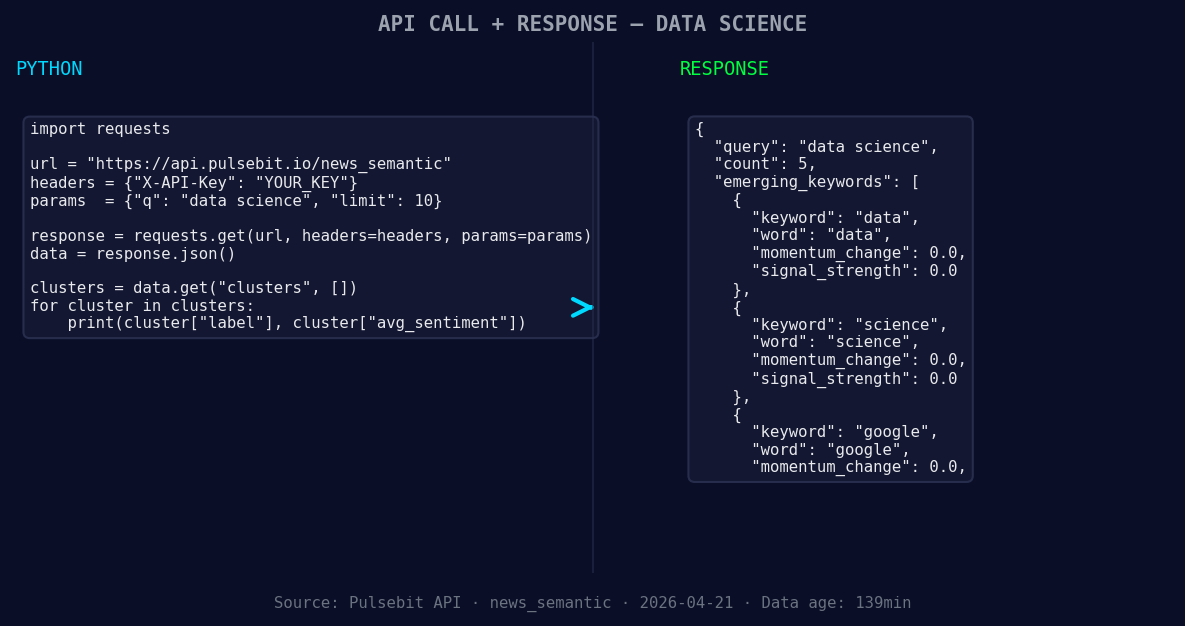
*Left: Python GET /news_semantic call for 'data science'. Right: returned JSON response structure (clusters: 3). Source: Pulsebit /news_semantic.*
# Check if the request was successful
if response.status_code == 200:
print(response.json())
else:
print("Error fetching data:", response.status_code)
Next, let’s run the narrative through our sentiment scoring endpoint to evaluate the cluster reason itself. This is pivotal because it helps us understand the thematic framing that’s leading to this spike.
# Define the cluster reason
cluster_reason = "Clustered by shared themes: see, pilots, fail, data, enterprises."

# Make the POST request for meta-sentiment analysis
meta_response = requests.post(
    'https://api.pulsebit.com/sentiment',
    json={'text': cluster_reason}
)

# Check for a successful response
if meta_response.status_code == 200:
    print(meta_response.json())
else:
    print("Error fetching meta-sentiment data:", meta_response.status_code)
Now that we have the code to capture the anomaly, let’s consider three builds you can implement based on this pattern.
Geo Filter for Real-time Updates: Set a threshold for sentiment momentum of -0.5 or lower to trigger alerts. This will help you catch similar spikes quickly using the geographic origin filter to focus on English-speaking regions.
Meta-Sentiment Loop: Create a routine that automatically runs the cluster reason through the sentiment endpoint weekly. This will keep your model updated with the latest narrative shifts and ensure you never miss another significant insight.
Thematic Tracker: Develop a monitoring system that pulls in forming themes like data and science, and contrasts them against mainstream narratives. For instance, watch for themes that form around “data” and “science” with a threshold of +0.01 to catch emerging trends before they hit the mainstream.
If you want to explore this further, head over to pulsebit.lojenterprise.com/docs. You can copy-paste the code snippets above and run them in under 10 minutes. This anomaly isn't just a data point; it's a call to action for anyone serious about leveraging sentiment data effectively.


Top comments (0)