

Your pipeline just missed a critical 24h momentum spike of +0.150 in the political sentiment realm. This specific anomaly indicates a significant shift in sentiment regarding Tamil Nadu’s political landscape, with the press actively covering "The Rise Of Vijay: Tamil Nadu’s New Political Star." If your model doesn’t account for multilingual origins and entity dominance, you’re effectively running a 26.0h lag behind the news cycle.

English coverage led by 26.0 hours. Ca at T+26.0h. Confidence scores: English 0.85, French 0.85, Spanish 0.85 Source: Pulsebit /sentiment_by_lang.
This gap is particularly concerning when you consider that the leading language for this spike is English, with its influence peaking at 26.0h. While your pipeline might be designed to handle English content well, it’s failing to capture the momentum of emerging narratives in other languages and contexts, causing you to miss critical sentiment shifts. Your model missed this by 26 hours, which could mean losing out on valuable insights that could inform decision-making or strategic positioning.
Let’s dive into how we can catch this momentum spike using our API. We can start by querying for the political topic, filtering by language and country. Here’s the Python code snippet that shows how to do this:

Geographic detection output for politics. India leads with 13 articles and sentiment +0.24. Source: Pulsebit /news_recent geographic fields.
import requests
# Define our parameters
params = {
"topic": "politics",
"lang": "en",
"momentum": 0.150
}
# API call to get sentiment data
response = requests.get("https://api.pulsebit.lojenterprise.com/sentiment", params=params)
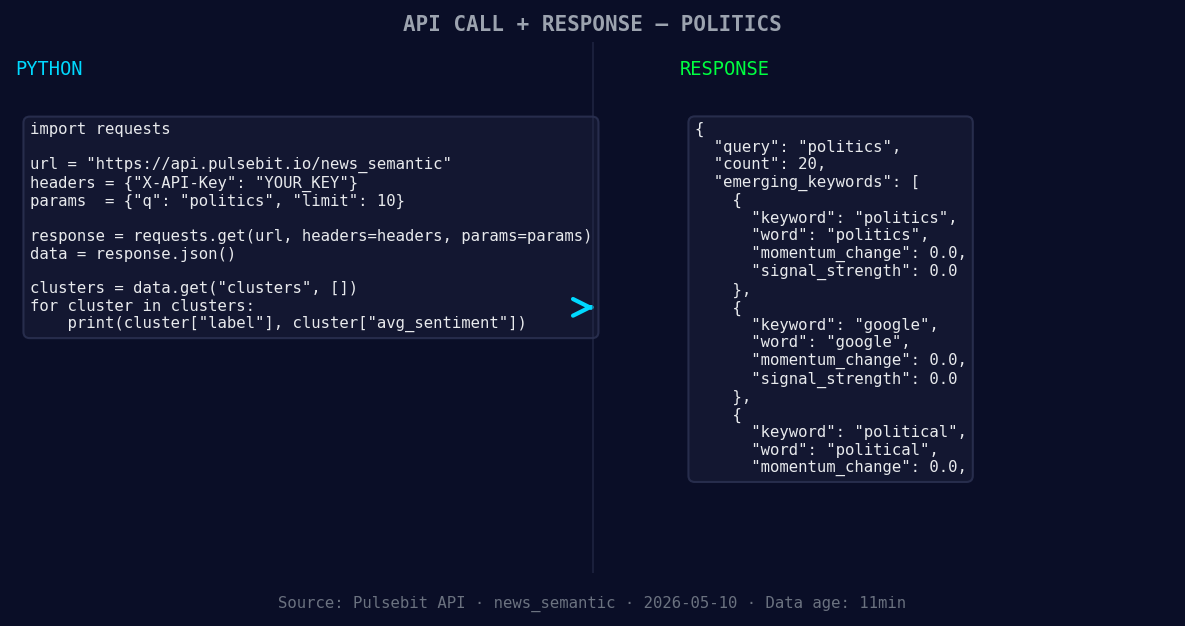
*Left: Python GET /news_semantic call for 'politics'. Right: returned JSON response structure (clusters: 3). Source: Pulsebit /news_semantic.*
if response.status_code == 200:
data = response.json()
print(data)
Next, we want to score the narrative framing of the cluster reason string. This is crucial as it allows us to assess how well the themes are resonating. Let’s run the following code to input our cluster reason and get the sentiment score:
# Input example for the meta-sentiment moment
cluster_reason = "Clustered by shared themes: tamil, political, politics, hand, rise."

# API call to score the narrative
meta_response = requests.post("https://api.pulsebit.lojenterprise.com/sentiment", json={"text": cluster_reason})

if meta_response.status_code == 200:
    meta_data = meta_response.json()
    print(meta_data)
Now that we’ve set the groundwork, let’s look at three specific builds we can create using this momentum spike.
Geo-Sensitive Alert: Set a threshold to trigger alerts when sentiment in the Tamil political landscape crosses a certain score, say +0.200. Use the geo filter to focus specifically on articles from Tamil Nadu. This will help you stay ahead of emerging local narratives.
Cluster Narrative Scoring: Use the meta-sentiment loop to analyze how clustered themes are impacting the overall sentiment score. If the score from the cluster reason exceeds +0.250, you might trigger deeper investigations into the narratives shaping public opinion.
Thematic Comparison Dashboard: Create a dashboard that compares forming themes like “politics,” “google,” and “political” against mainstream themes in real-time. This dashboard can use a live feed of sentiment scores to visualize shifts and identify when mainstream narratives deviate from emerging ones, ensuring you’re always on the ball.
With these builds, you can transform your sentiment analysis into a proactive monitoring system.
If you’re ready to get started, check out our documentation at pulsebit.lojenterprise.com/docs. You can copy-paste and run this code in under 10 minutes.


Top comments (0)