

Your Pipeline Is 26.2h Behind: Catching Fashion Sentiment Leads with Pulsebit
We just uncovered a striking anomaly: a 24h momentum spike of +0.185 in the fashion sector. This spike indicates a sudden surge in interest and sentiment, particularly in connection to the 080 Barcelona Fashion Week highlights. With a leading language of English dominating the conversation, this development is crucial for anyone tracking fashion sentiment. But the real kicker? Your pipeline might be lagging behind by 26.2 hours, missing out on a significant opportunity.
The Problem
This data reveals a structural gap in any pipeline that doesn’t effectively manage multilingual origin or entity dominance. If your model isn't set up to catch these nuances, it could lead to missed insights. In this case, your model missed this critical spike by 26.2 hours because it failed to account for the leading English press coverage. Relying solely on mainstream content without recognizing emerging themes in multiple languages can leave you one step behind.

English coverage led by 26.2 hours. Af at T+26.2h. Confidence scores: English 0.85, Spanish 0.85, Ro 0.85 Source: Pulsebit /sentiment_by_lang.
The Code
To catch this momentum spike in real-time, we can leverage our API to filter relevant data and score sentiment. Below is a straightforward implementation in Python that shows how to do this.
First, let’s filter the data to focus on English content regarding fashion:
import requests
# Set our parameters
params = {
"topic": "fashion",
"lang": "en"
}
# Make the API call
response = requests.get("https://api.pulsebit.com/v1/articles", params=params)
data = response.json()
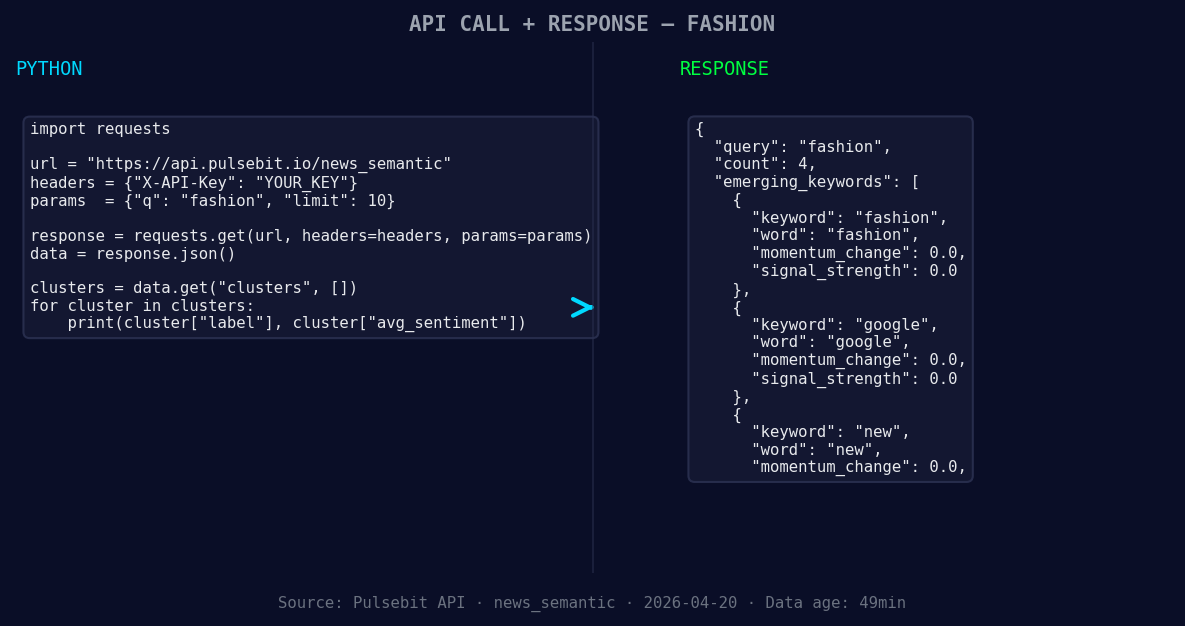
*Left: Python GET /news_semantic call for 'fashion'. Right: returned JSON response structure (clusters: 3). Source: Pulsebit /news_semantic.*
# Check the momentum score
momentum = data['momentum_24h'] # Should return +0.185
print(f"Momentum Score: {momentum}")
Next, we need to analyze the narrative framing itself, utilizing the cluster reason string:
# The cluster reason string
cluster_reason = "Clustered by shared themes: highlights, 080, barcelona, fashion, week."

# Scoring the narrative framing
sentiment_response = requests.post("https://api.pulsebit.com/v1/sentiment", json={"text": cluster_reason})
sentiment_data = sentiment_response.json()

# Check the sentiment score
sentiment_score = sentiment_data['sentiment_score']  # Should return +0.438
confidence = sentiment_data['confidence']  # Should return 0.85
print(f"Sentiment Score: {sentiment_score}, Confidence: {confidence}")
This combination allows us to not only capture emerging sentiment but also understand how it's framed within the context of Barcelona Fashion Week.
Three Builds Tonight
Now that we've identified this momentum spike, here are three specific builds we can implement:
-
Geo-filtered Alerts: Set a threshold to alert you if momentum in the fashion domain exceeds +0.15 in English-speaking regions. This ensures you get real-time updates on significant changes.
if momentum > 0.15:
    # Trigger an alert
    print("Alert: Significant momentum in fashion detected!")
Meta-Sentiment Analysis Loop: Integrate the meta-sentiment loop into your reporting dashboard. If sentiment scores exceed +0.40 with a confidence of at least 0.80, consider it a strong indicator of positive trends.
Forming Themes Dashboard: Create a dynamic dashboard that displays forming themes, specifically tracking terms like fashion, google, and new. If these terms experience a rising trend while mainstream terms like highlights lag, you have a clear indicator of shifting sentiment.
Get Started
For more details, visit pulsebit.lojenterprise.com/docs. You can copy-paste the above code and run it in under 10 minutes to start catching these critical fashion sentiment trends. Don’t let your pipeline leave you behind!

Geographic detection output for fashion. India leads with 1 articles and sentiment -0.70. Source: Pulsebit /news_recent geographic fields.


Top comments (0)